
When organisations evaluate enterprise-level pre-hire assessment tools, Mercer Mettl and ThriveMap are often compared. Both help employers screen candidates and make better hiring decisions, but their focus and approach are quite different.
Mettl is a global enterprise assessment provider with a wide range of tests, including coding simulators, cognitive tests, and behavioural/psychometric assessments. ThriveMap, by contrast, specialises in Realistic Job Assessments – simulations that immerse candidates in the actual day-to-day experience of the job.
If you’re considering Mercer Mettl and ThriveMap side by side, this guide gives you an honest, detailed comparison so you can decide which is right for your hiring needs.
| Feature | ThriveMap | Mercer Mettl |
|---|---|---|
| Assessment type | Job simulations and day-in-the-life tasks | Coding tests, psychometrics, cognitive & behavioural tests |
| Candidate experience | Immersive, mobile-first, tailored to role; objective scoring | Often quiz-like, recall-based questions; less job-contextual |
| Customisation | Fully bespoke or Smart Assessment Builder (fast, tailored) | Domain-specific skills available “on request”; strong coding library |
| Scoring | Objective 0–100% fit score, benchmarked against applicant pool | Psychometric trait comparisons, coding scorecards, percentile-based results |
| Validation | Ecological validity (direct link to job tasks) | Psychometric & standardised test validity |
| UX & onboarding | Intuitive, quick time-to-value; concurrent integration & design | More complex enterprise setup, may require longer onboarding |
| Pricing model | Transparent annual subscription, unlimited candidates | Consultation-based, no public pricing; bespoke enterprise contracts |
| Best suited for | High-volume, entry-level, frontline hiring | Large enterprises, academic institutions, technical hiring teams |
Mercer Mettl, a subsidiary of Mercer, is a global leader in talent assessments. Their cloud-based platform supports corporate organisations and academic institutions with a wide range of assessment types:
💻 Coding assessments (with live IDEs for developers)
🧠 Cognitive and technical tests
🧑🤝🧑 Personality and behavioural trait assessments
🗣️ Communication skills tests
🛡️ Proctored exam solutions (AI-driven anti-cheating tools)
Mettl’s strength lies in its breadth of assessments, its security and proctoring capabilities, and its global enterprise positioning. For organisations building technical teams or running large-scale academic assessments, Mettl is a recognised name.
Mettl offers a robust suite of tools, but it may not be the right fit for every organisation, especially those focused on high-volume, frontline, or entry-level hiring.
Common challenges with Mettl include:
📝 Recall-style testing: Many tests focus on recall of knowledge rather than contextual, on-the-job application.
🖥️ Less intuitive UX: Designed for enterprise and academic use; may require training and longer onboarding before seeing value.
🧑🤝🧑 Generic behavioural and psychometric tests: Trait-based rather than job-specific, which can reduce predictive power for frontline roles.
💰 Opaque pricing: Requires a consultation call to receive a quote, adding friction for busy HR teams looking for fast rollout.
😕 Candidate experience: Assessments can feel quiz-like and disconnected from the actual work environment, which may lead to poor engagement in high-volume roles.
ThriveMap is a next-generation provider of realistic job assessments. Rather than relying on recall tests or psychometrics, ThriveMap immerses candidates in a “day in the life” simulation of the job.
How it works:
🗓️ Real tasks & decisions: Candidates experience real tasks, challenges, and decisions they would face on the job.
Employers can choose between:
🛠️ Fully bespoke assessments: Designed in partnership with ThriveMap’s team.
⚡ Smart Assessment Builder: Allows teams to create tailored assessments quickly.
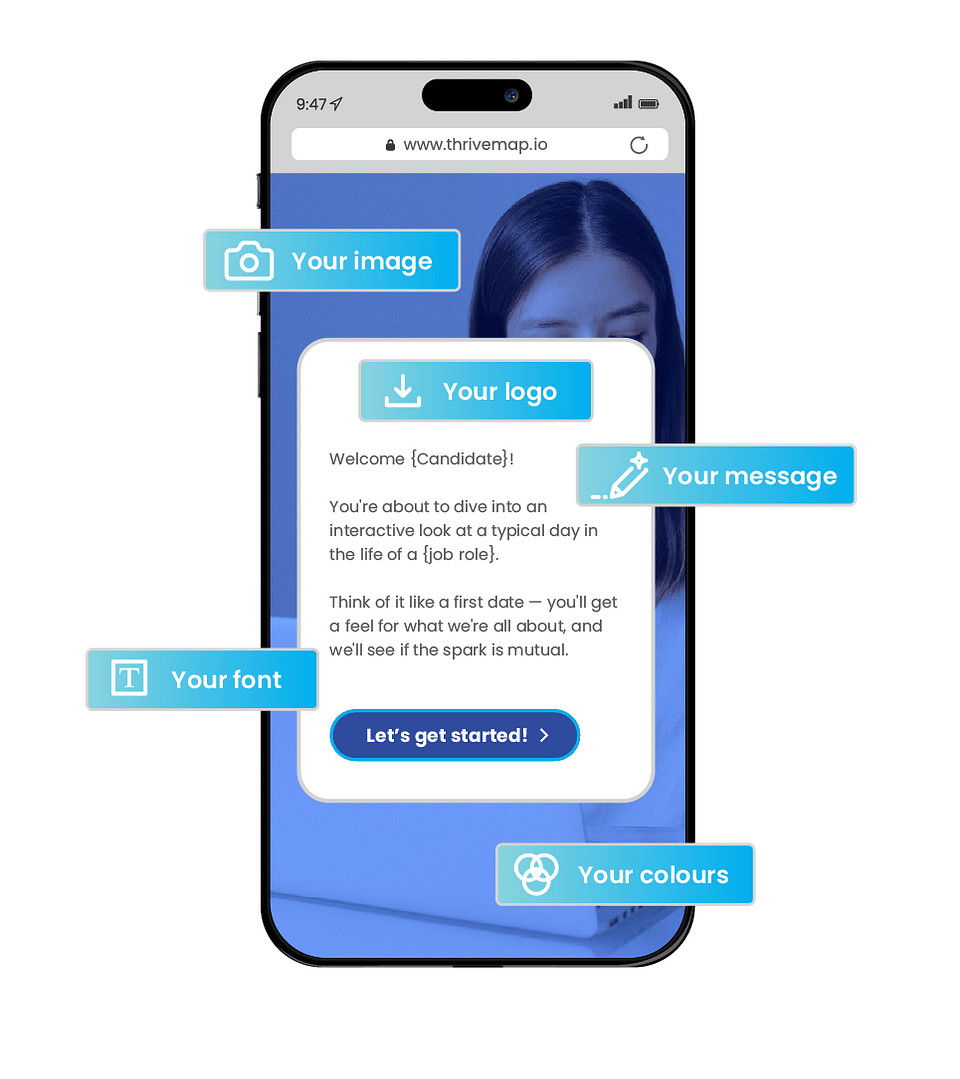
🎥 Branded & mobile-first: Assessments are fully branded, mobile-first, and often include AI-generated short-form video to showcase the role.
📊 Objective fit scores: Each candidate receives an objective fit score (0–100%), benchmarked against the real applicant pool.
📈 Rich analytics: Reports provide insights including dropout points, withdrawal reasons, and attribute-level scores.
✅ Realism + objectivity: This approach offers both job realism and objectivity, reducing bias and early attrition by giving candidates a clear understanding of the job before they accept an offer.
Large library of cognitive, behavioural, and coding assessments; recall and quiz-style questions common.
Realistic simulations based on the actual role, built bespoke or via Smart Assessment Builder.
👉 ThriveMap prioritises predicting success in your unique job context, rather than just testing abstract traits or knowledge.
Strong security and proctoring but can feel academic or test-like, which may deter some candidates.
Immersive, engaging, and role-appropriate in length (can be as short as 7 minutes for entry-level roles).
Domain-specific tests available but often “on request”; behavioural and psychometric assessments are standardised.
Fully bespoke design, branded environments, AI-generated video, flexible question types.
Psychometric reports and percentile scoring; detailed coding scorecards for technical hiring.
Objective 0–100% fit score, benchmarked against actual applicant pool; rich analytics available.
Strong psychometric and technical test validation, with robust proctoring to ensure test integrity.
Ecological validity: directly tied to the role tasks, reducing legal risk and increasing predictive power for real job performance.
Pricing only available after consultation; may be suited for complex enterprise deals but adds friction.
Transparent annual subscription pricing based on role and hiring volume; unlimited candidate usage.


A major logistics company previously used generic psychometric tests from a large assessment vendor to screen frontline workers. Results did not accurately predict job performance and candidate engagement was low.
After switching to ThriveMap’s bespoke job simulation assessment, candidates got a realistic preview of the working environment and could self-select out. Hiring managers reported better quality shortlists and fewer early leavers.
Both platforms are respected solutions in the assessment market, but they serve different purposes:

