How to handle high application volumes with an ATS
7 minute read
Posted by Emily Hill on 23 December 2025
High volume hiring has shifted shape over the last few years.
Application volumes for entry level and frontline roles have increased steadily, driven by mobile job search, one-click apply, aggregated job boards and, more recently, the growing use of AI tools by candidates. It is now common for a single vacancy to attract hundreds of applications, and in some sectors thousands.
For most talent teams, the challenge is no longer how to attract candidates. It is how to handle volume without overwhelming recruiters, introducing bias, or sacrificing hiring quality.
This is where Applicant Tracking Systems play a central role. It is also where their limitations become visible.
Application volumes are rising, and AI is accelerating the trend
Across entry level, frontline and early careers hiring, applications per role have increased year on year.
Industry benchmarks suggest that many large employers now receive two to three times more applications per role than they did five to seven years ago. In customer service, warehouse and retail hiring, it is not unusual to see application volumes increase further during periods of economic uncertainty.
AI has amplified this trend. Candidates are increasingly using tools to generate CVs, tailor applications and apply at speed across multiple roles. This has lowered the effort required to apply and increased the number of speculative or poorly informed applications entering hiring funnels.
The result is a widening gap between the number of applications received and the number that can realistically be reviewed with care.
What ATS platforms do well in high volume hiring
Modern ATS platforms are essential infrastructure for high volume recruitment.
They provide structure and control across large candidate pipelines and enable teams to manage scale without losing visibility. In particular, ATS platforms are strong at:
Centralising applicant data in one system
Managing candidate stages and workflows
Automating communications at scale
Posting jobs across multiple job boards
Supporting compliance, audit trails and reporting
Coordinating offers and onboarding handovers
For high volume teams, an ATS acts as the operating system of recruitment. Without it, even moderate levels of volume quickly become unmanageable.
Where ATS based screening reaches its limits
Where ATS platforms struggle is in creating meaningful signal early in the hiring process.
Most early stage decisions rely on a combination of CVs, basic eligibility questions and recruiter prioritisation. These tools help manage volume, but they were not designed to evaluate job readiness in entry level roles.
As volumes increase, teams often see the same patterns repeat:
Large numbers of technically eligible candidates with limited understanding of the role
Recruiter time spent reviewing applications that later disengage
Interviews and assessment days filled with candidates who decline or drop out
Early attrition driven by expectation gaps rather than capability
These outcomes are not caused by poor technology. They are the result of limited job relevant signal early in the funnel.
Why not just rely on ATS CV screening for high volume hiring?
ATS CV screening is useful for organising applications, but it is a weak filter for high volume decision making. Keyword matching largely reflects how a CV is written, not how someone will perform in the role. As AI makes it easier for candidates to tailor CVs at scale, keyword based screening increasingly ranks application quality rather than job readiness. For entry level and frontline roles, this leads to large numbers of well worded CVs progressing, followed by drop out, no shows and early leavers. CV screening helps manage volume, but on its own it does not reduce wasted effort or improve hiring outcomes.
Why assessments help when they are designed for volume
Assessments are one of the few scalable ways to make early stage decisions based on something other than a CV.
When they are built around the real job, pre hire assessments let candidates show how they handle the situations they will actually face, such as prioritising tasks, dealing with ambiguity, following instructions, or communicating under pressure. They also set expectations properly, so candidates understand the work before they invest time in interviews or assessment days.
This matters more now because application volumes are rising and AI is accelerating the pace. Candidates can apply faster and to more roles than ever. Without an early stage assessment that reflects the job, recruiters end up spending time on candidates who were never going to convert, never going to show up, or were always going to leave early.
If you want it even sharper, here’s a shorter version:
Pre hire assessments are one of the most practical ways to reduce wasted effort in high volume hiring. They replace early stage guesswork with job relevant evidence and clearer candidate expectations, which is exactly what you need when application volumes are inflated by AI.
“Get your online assessment right and it does loads of the recruitment heavy lifting.” – Chris Platts, ThriveMap CEO
The role of Realistic Job Assessments in high volume hiring
They simulate the tasks, decisions and pressures candidates will encounter on the job. This allows hiring teams to assess job relevant behaviours at scale while giving candidates a clear picture of what they are opting into.
In practice, this means fewer poorly-matched candidates progressing — not because they were rejected, but because they chose not to continue.
As volumes rise, this form of informed self selection becomes one of the most effective ways to reduce downstream workload without compromising fairness.
ThriveMap’s Realistic Job Assessments are built specifically for entry-level roles where expectation gaps are costly.
Each assessment is bespoke to the role, grounded in job analysis and validated against real performance data, reducing the candidate expectation gap by 55%.
A practical guide: The High Volume Recruiting Playbook
High application volumes are now a permanent feature of entry level hiring. ATS platforms remain essential for managing scale, but they are not designed to assess job readiness on their own. As AI continues to increase application volume, early stage assessment design becomes more important, not less.
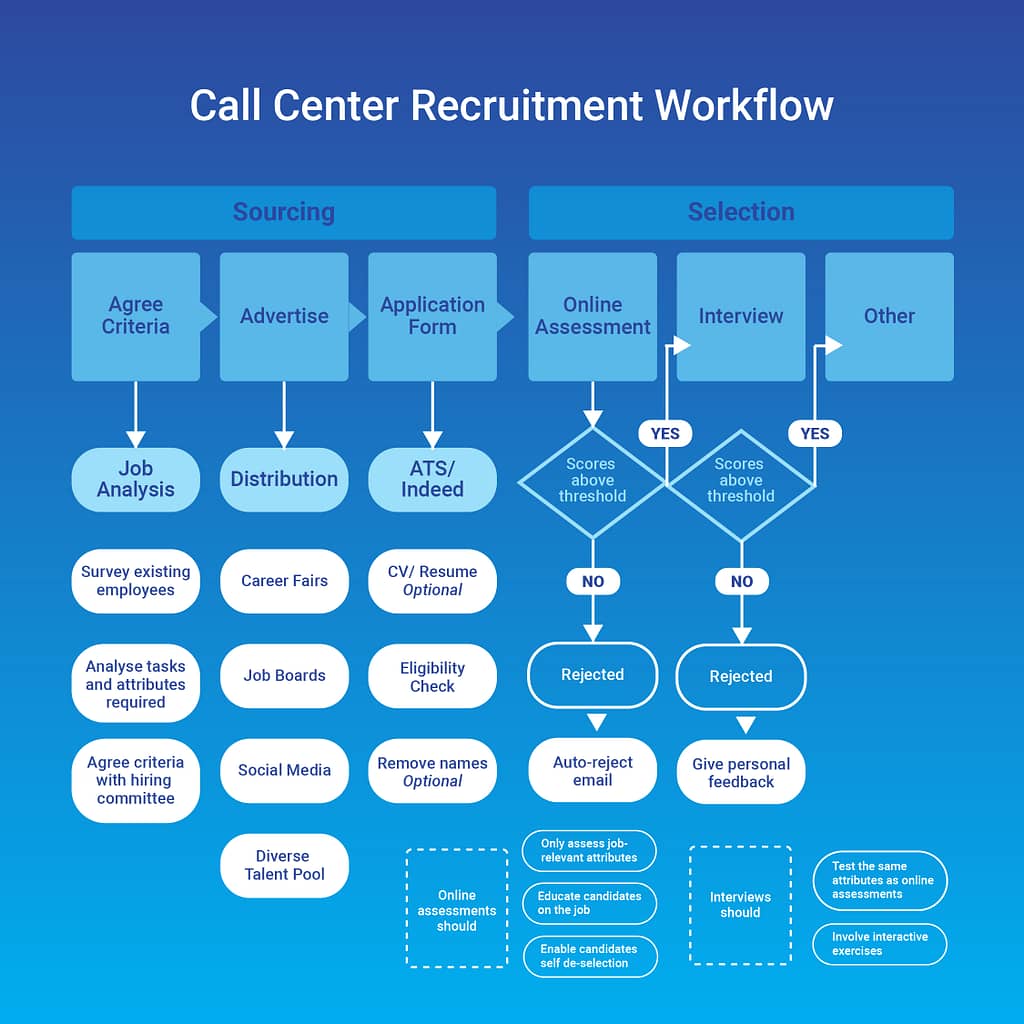
To help teams navigate this, ThriveMap has created the High Volume Recruiting Playbook. It provides step by step guidance for building scalable, fair hiring workflows across warehouse, call centre, retail, hospitality and early careers roles, with a clear focus on execution rather than theory.
The most resilient hiring teams combine structured ATS workflows with realistic, job relevant assessments early in the process. That is how volume is handled without sacrificing fairness, quality or recruiter capacity.
Subscribe for insights, debunks and what amounts to a free, up-to-date recruitment toolkit.
About ThriveMap
ThriveMap creates customised assessments for high volume roles, which take candidates through an online “day in the life” experience of work in your company. Our assessments have been proven to reduce staff turnover, reduce time to hire, and improve quality of hire.
Not sure what type of assessment is right for your business? Read our guide.
Other articles you might be interested in
The Employment Rights Act 2025: What resourcing needs to fix now
The Employment Rights Act, to be phased in from 2026, represents a structural reset of UK employment law by shifting risk, accountability and decision making much earlier in the employee lifecycle. For resourcing leaders, this goes beyond procedural tweaks. It forces a rethink of how work is resourced in the first place. How demand is […]
New Eploy integration brings Realistic Pre-Hire Assessments to the heart of your workflow
Hiring teams using Eploy can now improve the accuracy of their candidate selection by adding ThriveMap’s Realistic Job Assessments into their workflow. In entry level roles, first week attrition can exceed 50 percent, usually because the reality of the job doesn’t match what the candidate expected. This integration gives Eploy users something they cannot get […]
The hidden “tests” candidates face — and why entry-level hiring needs proper processes
A guide to fair, consistent, and predictive selection methods for entry-level hiring. Every week another Reddit post goes viral, exposing the strange, improvised “tests” candidates face. And this week, one Reddit post summed up the whole problem in a single screenshot. A hiring manager proudly described their “punctuality test”: They join a Zoom call 15 […]