Most hiring teams are under pressure to improve time-to-fill. That makes sense, open roles create real operational pain.
But speed doesn’t tell you whether the person who accepted the role will still be there in three weeks.
And when candidates aren’t a good fit, it shows through early attrition, retraining costs, frustrated managers, and leadership asking:
“Why can’t we just hire the right people?”
That’s where the difference between traditional and realistic recruitment becomes visible.
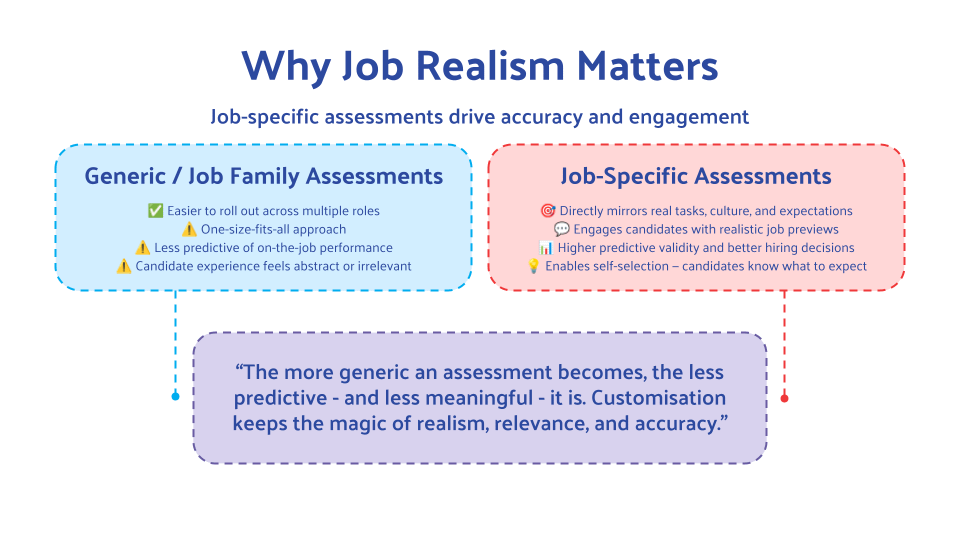
Traditional recruitment is designed to keep the process moving. Realistic recruitment is designed to turn job-fit into a repeatable, evidence-based system.
And that difference impacts who stays, who leaves, and who thrives.
What traditional recruitment looks like:
In most organisations, hiring falls into a familiar rhythm.
First, CVs get scanned for the right experience and keywords. Then come competency-based interviews. Sometimes there’s a standard assessment in the mix. At the end, a decision gets made based on scores, references, and gut feel.
There’s nothing inherently wrong with this. It’s efficient. It’s repeatable.
At its core, this kind of process is very good at answering one question: “Can we move enough people through the system quickly and reliably?”
That’s valuable.
But it also shapes what decisions get based on. Instead of the realities of the role, they often lean on:
Generic competency frameworks
How well someone performs in an interview setting
Standardised tools that get reused across very different jobs
All of that drives process efficiency, not necessarily commercial confidence.
And the side effect is subtle but important: a lot of the job itself stays imagined rather than experienced.
Candidates hear about the role. They rarely get to see it. So they fill in the gaps themselves, usually in the most optimistic way possible.
What realistic recruitment does differently
Realistic recruitment starts with a simple, practical idea.
If someone is going to spend most of their week doing a job, they deserve a clear, honest sense of what that work actually feels like before they say yes.
So instead of keeping the role at arm’s length, parts of the real job get pulled into the hiring process. Things like:
The kinds of decisions people actually make on a normal day
The trade-offs they have to navigate
The pace, pressure, or ambiguity that comes with the work when things aren’t going smoothly
Rather than asking, “Would this person fit our culture?” It asks something more grounded: “Would this person still want this job if they saw it up close?”
And the impact of realistic recruitment has tangible benefits.
When candidates see the reality of a role early, two patterns tend to follow:
Fewer people leave because “this isn’t what I thought I was signing up for”
Hiring managers spend less time reopening the same role a few months later
Both of those improve 90-day retention and reduce repeat hiring for the same positions.
The difference between traditional and realistic hiring:
Help candidates and hiring teams make a well-informed decision
Design focus
Standardisation and consistency
Role-specific clarity and relevance
What candidates experience
Job descriptions and competency-based interviews
Real tasks, scenarios, and everyday challenges
What hiring teams rely on
Scores, CV signals, and interview impressions
Evidence from job-like situations and observed behaviour
Predictive value
Moderate for performance in the role
Higher for performance and retention
Impact on early attrition
Indirect, often reactive
Direct, via expectation-setting and self-selection
Decision explainability
Score- and framework-based
Evidence- and job-based
Bias and fairness control
Depends heavily on interviewer consistency
Anchored to role-relevant criteria and scenarios
Scalability
High, with generic frameworks
High, with structured role frameworks
Typical risk
“Great on paper” hires that struggle in practice
Requires more upfront investment, fewer surprises later
Where mismatches usually start
Most early leavers don’t quit because they can’t do the job.
They leave because:
The pace is different than they expected
The role is not the same as they imagined
The environment isn’t what they pictured from the interview
None of that shows up clearly in a CV. And it rarely shows up in a competency question either.
It shows up in the work itself.
Why realistic recruitment is better for candidates
From the candidate side, traditional hiring can feel like a guessing game.
They try to work out:
What a “typical day” actually looks like
What success really means in this role
What people struggle with once they’re in
Realistic recruitment makes that visible. And when candidates can see the job more clearly, two useful things happen:
Some people lean in, because it’s exactly what they want
Others step back, because it isn’t
Both outcomes save everyone time, energy, and awkward conversations later.
Why realistic recuitment is essential for high volume and entry-level hiring
High-volume hiring is often treated as a numbers game. More applicants. Faster screening. Shorter time-to-fill.
But entry-level, frontline, graduate, and seasonal roles are exactly where CVs and generic criteria are least predictive.
Most candidates in these roles look similar on paper. What actually determines success is how they handle:
Pace and pressure on a normal shift
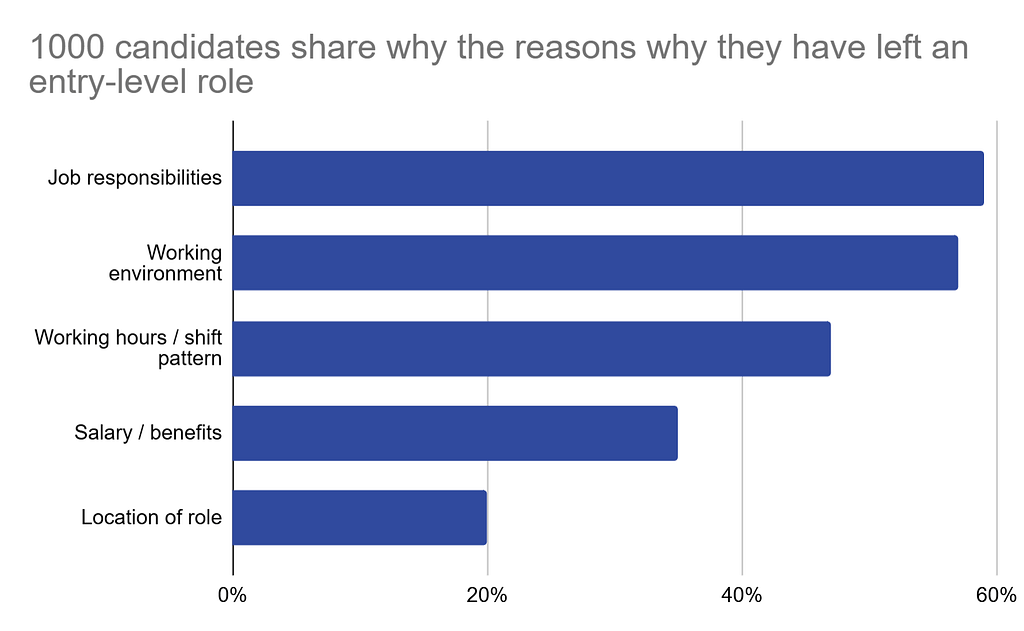
Shift patterns (Yes – 20% of entry-level new recruits have left a job because the shift pattern was different to what they assumed)
Repetition and routine
Customer or operational friction
Working patterns, environments, and physical or cognitive demands
When those realities aren’t visible in the hiring process, people accept roles based on assumptions, and those assumptions are usually optimistic.
High-volume environments often experience high early attrition when using traditional recruitment approaches because the job isn’t what they thought they were signing up for.
Realistic recruitment changes that dynamic. It brings the work itself into the decision for both sides before an offer ever goes out.
Building role criteria from how current employees actually succeed
Using scenarios that reflect real shifts, real customers, and real operational trade-offs
Capturing clear, job-based evidence for every hiring decision
This is where specialist providers come in.
Teams using job-realistic assessment platforms have been able to roll this approach out across thousands of hires without losing consistency or speed — particularly in high-volume, early-career, and frontline roles.
Organisations like Mitie, Wincanton, Berkeley Group, and Higgs LLPhave used this model to improve hiring accuracy, reduce early attrition, and give candidates a clearer picture of what the job really involves before day one.
Share
The ThriveMap Newsroom
Subscribe for insights, debunks and what amounts to a free, up-to-date recruitment toolkit.
About ThriveMap
ThriveMap creates customised assessments for high volume roles, which take candidates through an online “day in the life” experience of work in your company. Our assessments have been proven to reduce staff turnover, reduce time to hire, and improve quality of hire.
Not sure what type of assessment is right for your business? Read our guide.
Other articles you might be interested in
Steps in the candidate selection process: 4 examples you can use.
The modern candidate selection process is having an identity crisis. On one side, speed. Automation. One-click apply. AI screening. Funnels that look more like e-commerce checkout flows than human decisions. On the other, reality: real jobs, real people, and real consequences when a hire goes wrong. Hiring teams are under pressure to move faster than […]
How to build remote work culture More than half of employers now offer remote work. Yet over a third are actively pulling people back to the office, citing drops in productivity and culture. The problem isn’t location. It’s design. Most companies are still running office-era systems in a work model that no longer has an […]
The Candidate Expectation Gap: Why Filtering Faster Is Not the Same as Hiring Better
Why Most Hiring Systems Measure the Wrong Things Modern hiring processes are built to move people through a funnel. Applications in. Screens out. Interviews. Offer. Start date. Most of the metrics that define success sit at the top of that funnel. Speed to hire. Time to shortlist. Cost per hire. Interview to offer ratio. Those […]