Work sample assessments: why they outperform traditional hiring methods

4 minute read

Posted by Emily Hill on 15 April 2026

Most hiring assessments try to predict performance.

Work sample assessments don’t predict it.
They observe it directly.

And the data is increasingly clear: candidates trust them more, see them as fairer, and perform better when they’re used properly.

What is a work sample assessment?

A work sample assessment is a hiring method where candidates complete tasks that closely reflect the actual job.

Instead of answering abstract questions or personality tests, candidates are asked to:

  • handle realistic scenarios
  • complete job-relevant tasks
  • demonstrate how they would perform in role

Examples include:

  • responding to a frustrated customer (contact centre)
  • prioritising tasks under time pressure
  • reviewing and fixing real-world problems

The goal is simple:

👉 simulate the job before someone is hired into it

Why work sample assessments outperform other methods

Most hiring processes optimise for signals:

  • CVs
  • past job titles
  • interview performance

But these are indirect indicators of performance.

Work samples measure actual behaviour.

And candidates recognise that.

1. Candidates believe work samples are the most accurate

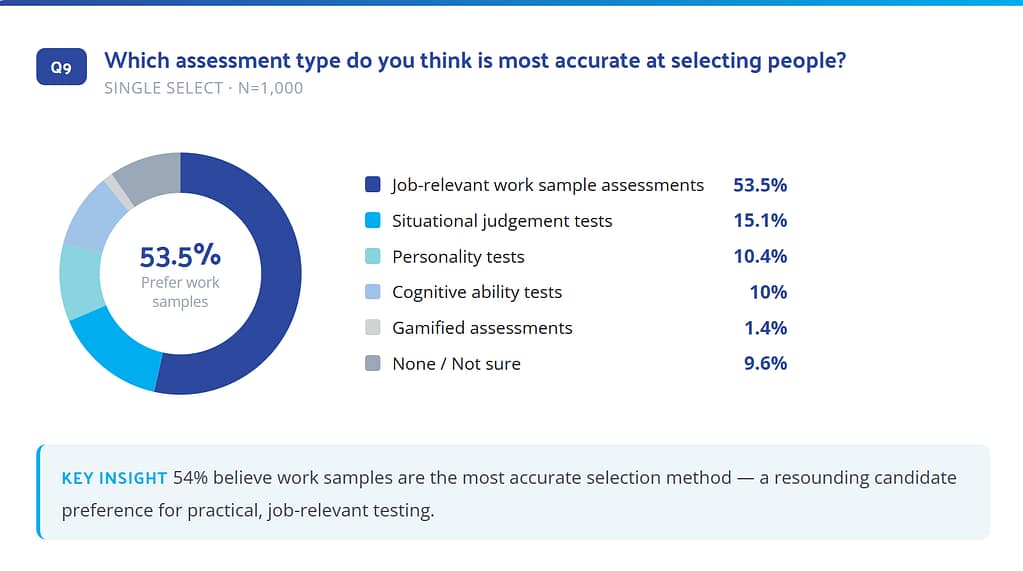
According to the State of the Assessment Market Report 2026:

  • 53.5% of candidates say work samples are the most accurate way to assess someone
  • compared to:
    • 15.1% for situational judgement tests
    • 10.4% for personality tests
    • 10% for cognitive ability tests

That’s not a marginal preference. It’s a dominant one.

2. They’re also seen as the fairest method

Fairness is a major issue in hiring, especially with increasing scrutiny on bias and AI.

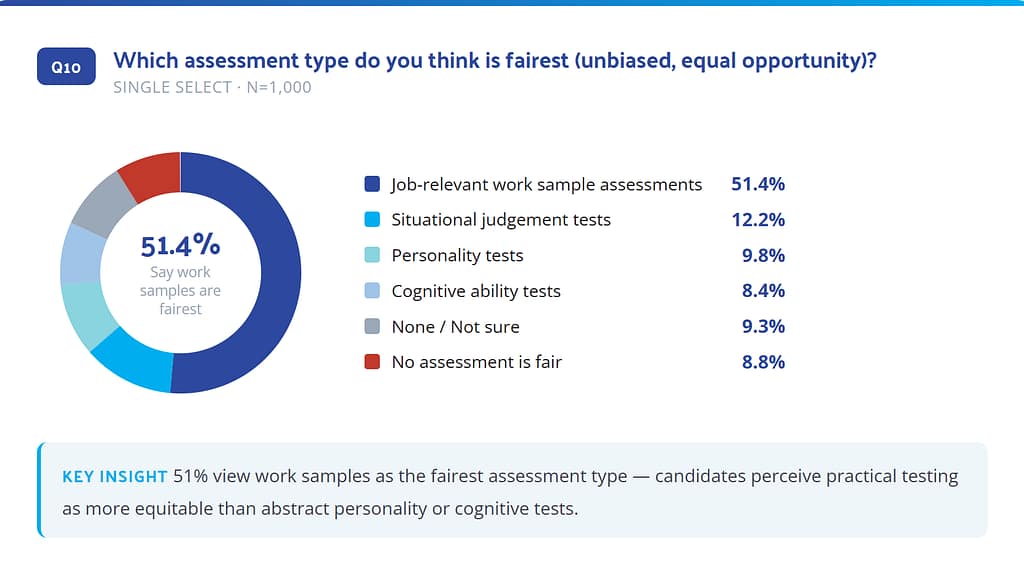
The same report found:

  • 51.4% of candidates say work samples are the fairest assessment type
  • far ahead of any alternative

This matters because perceived fairness impacts:

  • candidate trust
  • acceptance rates
  • employer brand

3. They increase candidate confidence before accepting a role

One of the biggest problems in hiring is misalignment between expectation and reality.

The data is stark:

  • 82% of candidates say they would feel more confident accepting a role after completing a realistic work sample
    • 33.7% much more confident
    • 47.8% somewhat more confident

This is critical.

Because low confidence leads to:

  • dropouts before start
  • early attrition
  • disengagement
work sample assessments

The real problem: hiring without job realism

Most hiring processes fail to show candidates what the job is actually like.

Instead, they rely on:

  • job descriptions
  • interviews
  • generic assessments

But candidates themselves say this isn’t enough.

When asked what would have helped them understand a role before accepting:

  • 48.3% wanted more honest information about workload and pressure
  • 30.7% wanted clearer expectations
  • 29% wanted a “day in the life” preview
  • 16.5% wanted a realistic task or work sample

That gap is where hiring breaks down.

Why this matters: the cost of getting it wrong

When hiring lacks realism:

  • candidates accept roles they don’t fully understand
  • expectations don’t match reality
  • people leave early

This isn’t rare.

From the same report:

  • 72% say they accepted a job that turned out to be misrepresented
  • 66% have left a role because it wasn’t what they expected

Work sample assessments directly address this.

How work sample assessments improve hiring outcomes

1. Better job fit

You see how candidates actually perform, not how they present themselves.

2. Lower early attrition

Candidates self-select out when they experience the reality of the role.

That’s a feature, not a flaw.

3. Higher quality of hire

You prioritise people who can do the job and want the job.

4. More efficient screening

Instead of reviewing hundreds of CVs, you focus on a smaller, higher-quality group.

When to use work sample assessments

They are especially effective for:

  • high volume hiring
  • entry-level roles
  • contact centres and frontline roles
  • roles with high early attrition
  • roles where day-to-day reality is hard to communicate

Best practices for work sample assessments

To be effective, work samples need to be:

1. Job-relevant

They should reflect real tasks, not abstract exercises.

2. Realistic

Include real constraints:

  • time pressure
  • ambiguity
  • competing priorities

3. Transparent

Use them to educate candidates about the role, not just assess them.

4. Used early in the process

The biggest impact comes when they’re used before CV screening, not after.

Work sample assessments vs traditional hiring

MethodWhat it measuresLimitation
CV screeningExperienceMisses capability and fit
InterviewsCommunicationSubjective, inconsistent
Personality testsTraitsWeak predictor of performance
Cognitive testsAbilityNot job-specific
Work samplesActual performanceRequires thoughtful design

The shift toward assessment-led hiring

Hiring is moving from:

  • signal-based decisions
    → to
  • evidence-based decisions

Work sample assessments are central to this shift.

They reduce guesswork and increase confidence on both sides.

Final thought

Most hiring processes try to infer who will succeed.

Work sample assessments show you.

And when candidates themselves say they are:

  • more accurate
  • fairer
  • and increase confidence

…it’s not just a better candidate experience.

It’s a better hiring decision.

If you’re hiring for roles where early attrition is a problem, the question isn’t whether you assess candidates.

It’s how realistic that assessment is.

Request a demo here

Share

The ThriveMap Newsroom

Subscribe for insights, debunks and what amounts to a free, up-to-date recruitment toolkit.

About ThriveMap

ThriveMap creates customised assessments for high volume roles, which take candidates through an online “day in the life” experience of work in your company. Our assessments have been proven to reduce staff turnover, reduce time to hire, and improve quality of hire.

Not sure what type of assessment is right for your business? Read our guide.

Other articles you might be interested in

Banner image for this post

50 AI hiring Stats for 2026: How Candidates are Really Using It

Candidates are embracing AI on their side of the hiring process. But when employers use it to screen and select talent? Confidence drops fast. Here’s 50 AI Hiring stats from our State of Assessment Market Report 2026. The survey data is from 1,000 UK workers. 1. AI in applications is real, but still not mainstream […]

Continue reading
Banner image for this post

The State of the Assessment Market Report 2026: Now Live

As the new UK National Hiring Strategy highlights, poor hiring decisions come at a significant cost. The strategy estimates that poor hiring decisions cost the UK economy £14.4 billion each year. Unemployment drains a further £61 billion, while inefficient recruitment processes and unfilled vacancies add nearly £150 million more. But the challenge facing employers isn’t […]

Continue reading
Banner image for this post

How Berkeley achieved 100% graduate retention by optimising their pre-hire assessment

Most hiring teams optimise for speed. Time to hire.Application conversion.Assessment completion rates.Offer acceptance. These metrics are easy to measure and easy to improve. They also tell us very little about whether hiring actually worked. The real test of hiring success happens months later, when new employees decide whether to stay. Across early careers hiring, this […]

Continue reading

View all articles