50 AI hiring Stats for 2026: How Candidates are Really Using It
6 minute read
Posted by Emily Hill on 8 April 2026
Candidates are embracing AI on their side of the hiring process. But when employers use it to screen and select talent? Confidence drops fast.
Here’s 50 AI Hiring stats from our State of Assessment Market Report 2026.
The survey data is from 1,000 UK workers.
1. AI in applications is real, but still not mainstream
AI is not niche anymore, but it is not dominant either. Most candidates are still not using it, which creates a split experience recruiters need to understand.
1. Just 2% of AI users were not sure or could not remember how they used it.
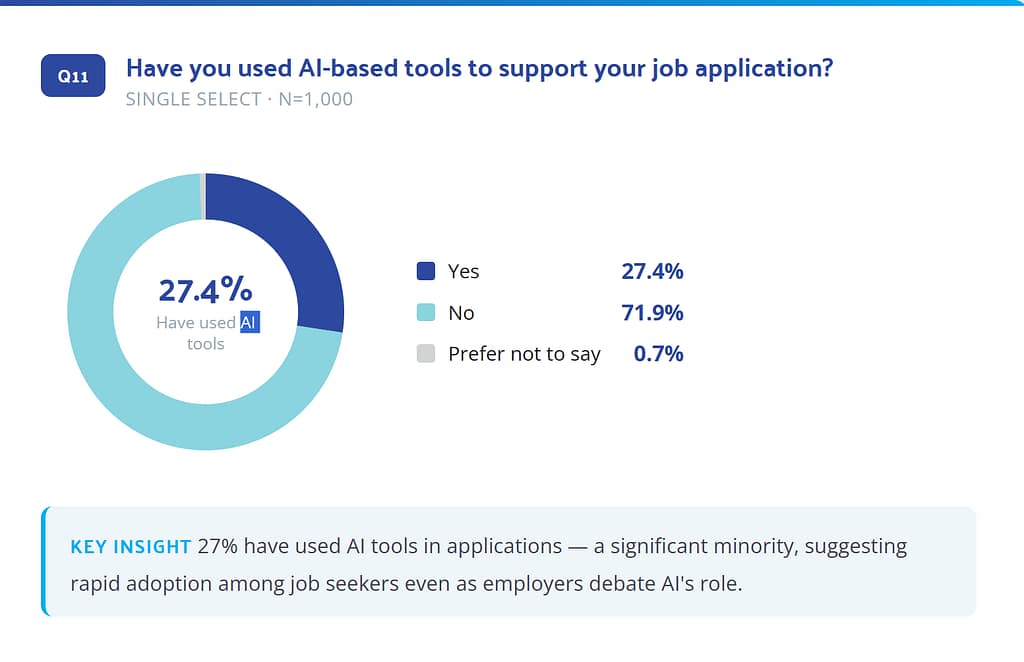
2. 27% of candidates used AI based tools at some stage of applying for their current role.
3. 72% did not use AI based tools during the application process.
4. Just 1% preferred not to say whether they had used AI.
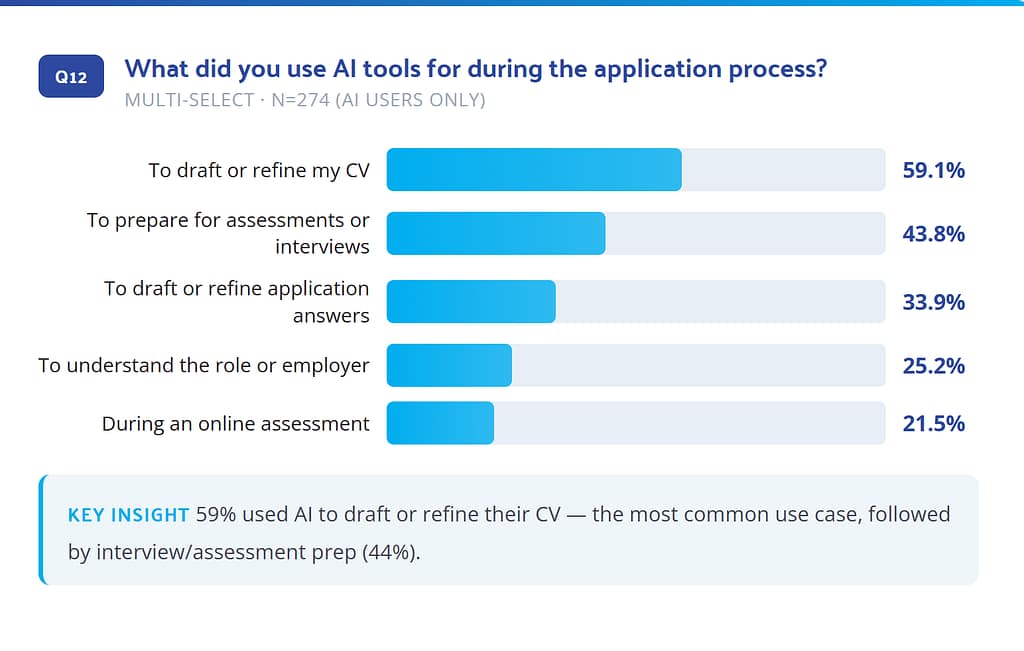
5. Among candidates who used AI, 59% used it to draft or refine their CV.
6. Among AI users, 44% used it to prepare for assessments or interviews.
7. Among AI users, 34% used it to draft or refine application answers.
8. Among AI users, 25% used it to understand the role or employer.
9. Among AI users, 22% used it during an online assessment.
10. Only 1% of AI users said they used it for another purpose.
2. AI usage is heavily skewed towards younger candidates
AI adoption is not evenly distributed. If your hiring skews younger, AI is already shaping candidate quality and behaviour.
11. 32% of 18 to 24 year olds used AI during the application process.
12. 31% of 25 to 34 year olds used AI during the application process.
13. 27% of 35 to 44 year olds used AI during the application process.
14. AI usage drops to 17% among 45 to 54 year olds.
15. It drops further to 8% among 55 to 64 year olds.
16. 67% of 18 to 24s did not use AI.
17. 68% of 25 to 34s did not use AI.
18. 73% of 35 to 44s did not use AI.
19. 82% of 45 to 54s did not use AI.
20. 92% of 55 to 64s did not use AI.
3. Candidates are using AI tactically, not blindly
This is not “AI doing the whole application”. Candidates are using it in specific, high leverage moments, especially around written content and preparation.
21. 60% of AI users aged 18 to 24 used AI to draft or refine their CV.
22. 63% of AI users aged 25 to 34 used AI to draft or refine their CV.
23. 56% of AI users aged 35 to 44 used AI to draft or refine their CV.
24. 46% of AI users aged 45 to 54 used AI to draft or refine their CV.
25. 37% of AI users aged 18 to 24 used AI to prepare for assessments or interviews.
26. 48% of AI users aged 25 to 34 used AI to prepare for assessments or interviews.
27. 50% of AI users aged 45 to 54 used AI to prepare for assessments or interviews.
28. 46% of AI users aged 35 to 44 used AI to draft or refine application answers.
29. 31% of AI users aged 45 to 54 used AI to understand the role or employer.
30. 30% of AI users aged 35 to 44 used AI during an online assessment.
4. Gender differences are subtle, but behaviour differs
Adoption rates are similar, but how candidates use AI differs. Men lean more towards exploratory and analytical use, women slightly more towards structured outputs like CVs.
31. 28% of women used AI based tools during the application process.
32. 27% of men used AI based tools during the application process.
33. 71% of women did not use AI.
34. 73% of men did not use AI.
35. Among women who used AI, 61% used it to draft or refine their CV.
36. Among men who used AI, 55% used it to draft or refine their CV.
37. Among women who used AI, 44% used it to prepare for assessments or interviews.
38. Among men who used AI, 43% used it to prepare for assessments or interviews.
39. Among women who used AI, 30% used it to draft or refine application answers.
40. Among men who used AI, 33% used it to understand the role or employer.
5. Trust is the real issue, not adoption
Candidates are comfortable using AI themselves, but sceptical when employers use it. This trust gap is the real strategic problem.
41. 49% of candidates say it is unfair when employers use AI to screen and select candidates.
42. Only 22% say this is fair.
43. 29% say it is neither fair nor unfair.
44. Just 5% say employer use of AI in screening is very fair.
45. 16% say it is very unfair.
46. Candidates give AI hiring tools an average optimism score of 4.26 out of 10.
47. 15% are not at all optimistic about AI identifying the right candidate.
48. Only 3% are extremely optimistic.
49. 41% say recruitment decisions should be made primarily by humans, without AI involvement.
50. Only 14% say AI can make most recruitment decisions, even if it improves accuracy and fairness.
So what does this actually mean for assessments?
It means the bar has changed.
Candidates are now using AI to improve how they present themselves. CVs are more polished. Answers are more structured. Interview prep is more rehearsed. On the surface, everything looks stronger.
But that does not mean candidates are a better fit. It means you have less visibility into who they really are.
At the same time, candidates are telling you something equally important. They do not trust AI led screening. Nearly half see it as unfair. Optimism is low. And most still want humans firmly involved in decisions.
So you end up with a clear tension:
candidates are using AI to shape how they appear
employers are using AI to filter what they see
and neither side fully trusts the system
That is not a hiring process. That is a distortion layer.
This is where assessments matter more than ever.
If traditional signals like CVs and written answers are now AI assisted, then assessments need to do what those signals no longer can. They need to show how someone actually thinks, works, and behaves in the context of the role.
Not abstract questions. Not polished responses. Real work. Real scenarios. Real expectations.
82% of candidates say a Realistic Job Assessment would make them more confident accepting a role
66% have left a job because it was not what they expected
and 72% say the role they accepted was different from how it was presented
That is the real problem.
AI is not breaking hiring. It is exposing the gap between how roles are presented and what they are actually like.
Assessments are your opportunity to close that gap.
Not by filtering candidates more aggressively. But by showing them the reality of the role before they join.
Because in an AI shaped hiring market, the organisations that win will not be the ones that screen hardest.
They will be the ones that are most honest.
Share
The ThriveMap Newsroom
Subscribe for insights, debunks and what amounts to a free, up-to-date recruitment toolkit.
About ThriveMap
ThriveMap creates customised assessments for high volume roles, which take candidates through an online “day in the life” experience of work in your company. Our assessments have been proven to reduce staff turnover, reduce time to hire, and improve quality of hire.
Not sure what type of assessment is right for your business? Read our guide.
Other articles you might be interested in
The State of the Assessment Market Report 2026: Now Live
As the new UK National Hiring Strategy highlights, poor hiring decisions come at a significant cost. The strategy estimates that poor hiring decisions cost the UK economy £14.4 billion each year. Unemployment drains a further £61 billion, while inefficient recruitment processes and unfilled vacancies add nearly £150 million more. But the challenge facing employers isn’t […]
How Berkeley achieved 100% graduate retention by optimising their pre-hire assessment
Most hiring teams optimise for speed. Time to hire.Application conversion.Assessment completion rates.Offer acceptance. These metrics are easy to measure and easy to improve. They also tell us very little about whether hiring actually worked. The real test of hiring success happens months later, when new employees decide whether to stay. Across early careers hiring, this […]
Pre-hire assessment completion rates & candidate drop-off by industry
What 200,000+ candidate journeys reveal about how hiring performance changes across sectors Why do candidates complete nearly every assessment in some industries — but never even start them in others? At first glance, the explanation seems obvious. Different sectors have different candidates, different expectations, or different hiring challenges. But analysis of more than 200,000 pre-hire […]