6 mistakes to avoid when implementing work sampling assessments
5 minute read
Posted by Emily Hill on 8 May 2025
Work sampling assessments can be a powerful way to predict how candidates will perform in a role—but only if they’re well designed. When implemented poorly, they can backfire, creating a frustrating experience for candidates and hiring teams alike.
Let’s look at the common pitfalls when implementing work samples, what a well-executed work sample looks like, and how ThriveMap’s Realistic Job Assessments make it easy to get it right.
The cost of getting work samples wrong
Hiring mistakes are expensive. From lost productivity and re-hiring costs to poor team morale and customer experience, the ripple effects of a bad hire can be significant. But many of these issues stem from one simple problem: candidates don’t truly understand what the job involves until it’s too late.
This disconnect leads to:
High early attrition
Low engagement
Poor job performance
Wasted time and resources
What work sampling assessments are
Work sampling assessments are tasks or exercises that replicate key parts of a job. They let candidates experience what the role actually involves, and allow hiring teams to evaluate relevant skills in context.
There are a few different types:
Situational judgement tests – candidates choose how they’d respond to realistic scenarios.
Task-based exercises – simulations or tasks that mirror everyday responsibilities.
Role previews – a step-by-step walkthrough of what a typical day looks like, often with questions or decisions built in.
When done well, work sampling assessments offer huge advantages over CVs and traditional interviews. They are:
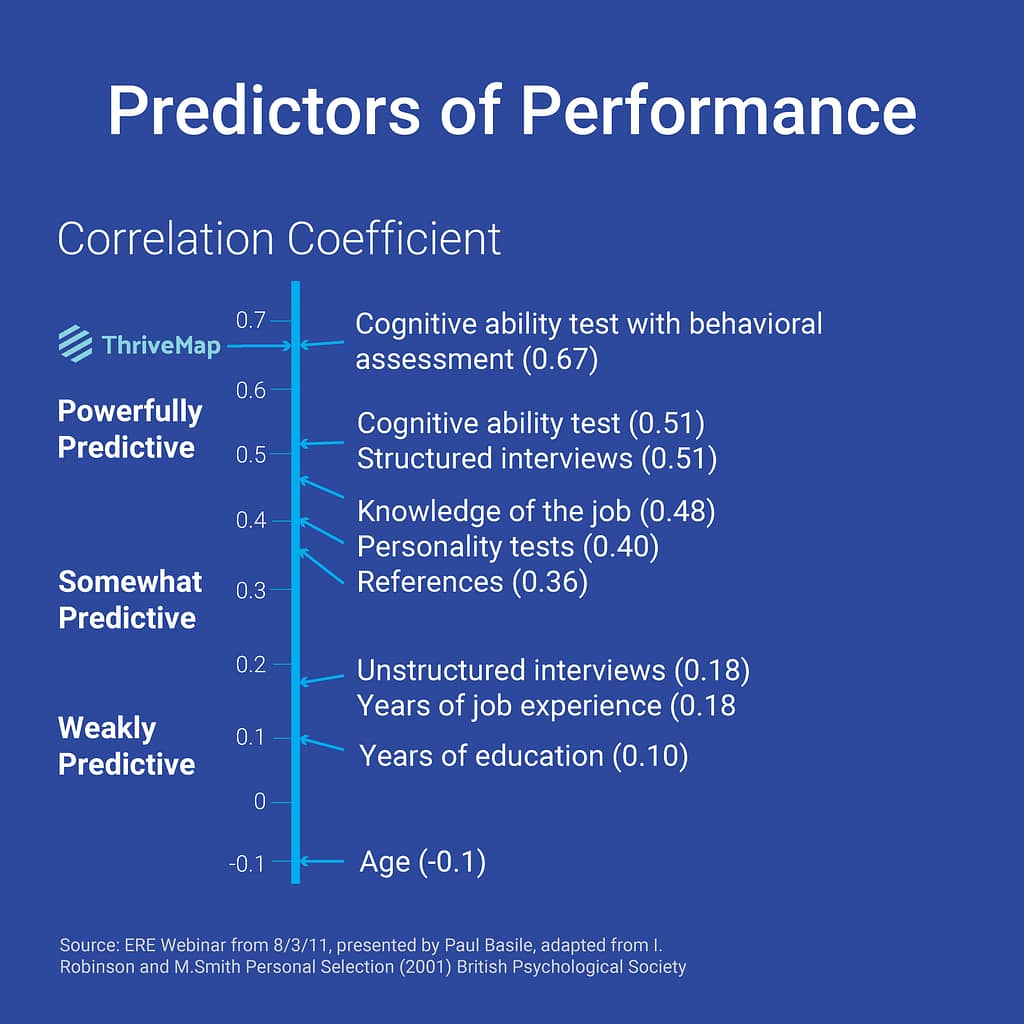
More predictive of success: Contextually-relevant assessments are the best indicators of future job performance – more accurate than personality tests or generic aptitude assessments.
Fairer: Candidates from all backgrounds can demonstrate their potential and job-fit, not just those with polished CVs.
More engaging: Candidates get a clear, honest preview
of the job, helping them decide if it’s right for them.
6 common mistakes businesses make when implementing work sampling assessments
Even with the best intentions, it’s easy to go wrong. Here are the most common mistakes—and how ThriveMap helps you avoid them:
1. Creating tasks that don’t reflect the actual job
If the assessment doesn’t align with real job tasks, the results aren’t going to be accurate. Candidates may pass the test but struggle in the role.
How ThriveMap helps: Build a detailed job analysis using our free Signal tool, ensuring every assessment is rooted in what the job actually requires. This guarantees full alignment between the role and the assessment.
2. Making assessments too long or complex
Asking candidates to spend hours on unpaid tasks is off-putting and risks losing the best people—especially for entry-level roles.
How ThriveMap helps: Our assessments are designed to be the right length—long enough to be predictive, short enough to respect candidates’ time. They’re remote, mobile-friendly, and perfect for high-volume roles.
3. Giving poor instructions or vague expectations
When candidates don’t understand what’s being asked, they underperform—and you lose out on talent.
How ThriveMap helps: Our Smart Assessment Builder guides you through crafting clear, structured assessments in minutes. Or, let our team run workshops with your hiring managers to set clear hiring criteria from the start.
4. Lacking standardised evaluation
Inconsistent scoring opens the door to bias and makes it hard to compare candidates objectively.
How ThriveMap helps: Our assessments are scored consistently using pre-defined criteria. You get structured, comparable results without needing manual reviews.
5. Not building a scalable assessment process
When you’re hiring at volume—especially for entry-level roles—you need a repeatable, efficient way to assess candidates without overwhelming your team.
How ThriveMap helps: Our platform is built for scale. Whether you’re hiring for 10 or 10,000 roles, you can automatically send, score, and review candidates at speed. Plus, every candidate gets the same fair, engaging experience.
6. Ignoring accessibility and inclusion
Using niche tools or culturally biased scenarios can disadvantage some groups and reduce your talent pool.
How ThriveMap helps: Our assessments are built to be inclusive, accessible, and role-relevant—giving everyone a fair chance to shine, regardless of background.
Real-world success: ThriveMap in action
Many companies have seen significant improvements in hiring outcomes after switching to ThriveMap’s Realistic Job Assessments.
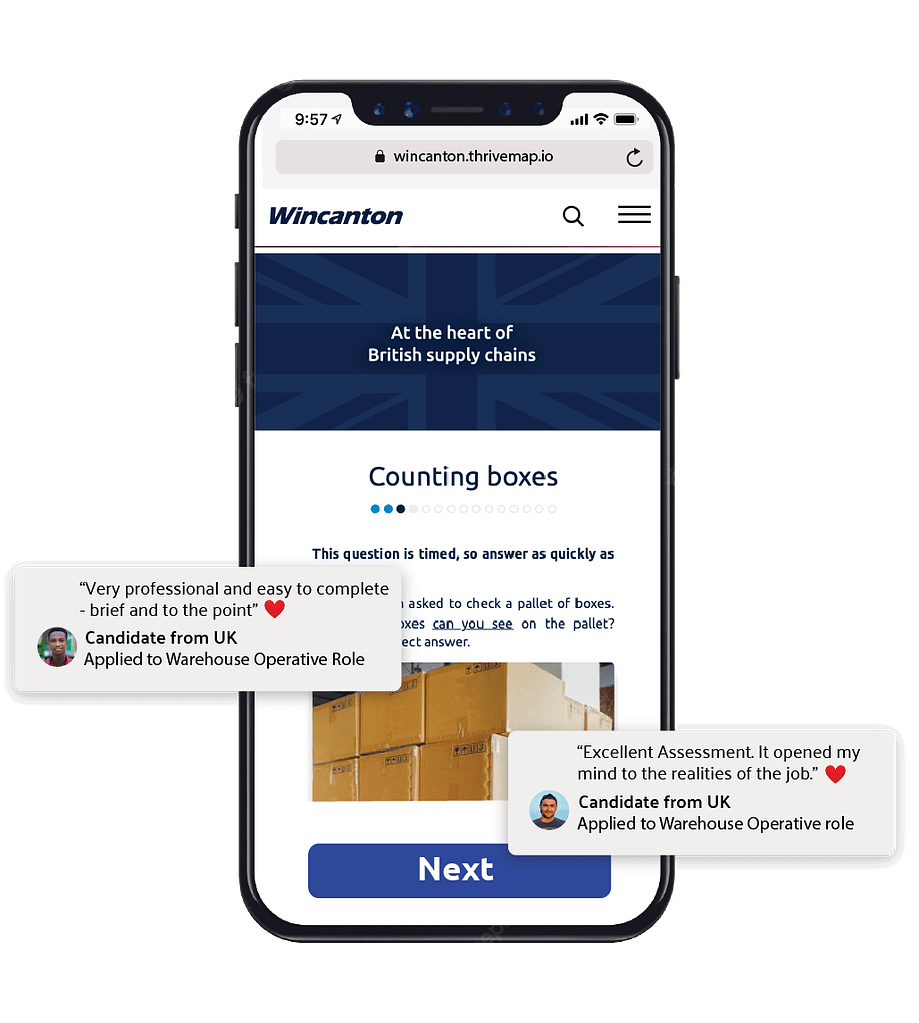
Take Wincanton, one of the UK’s largest logistics companies. Before ThriveMap, they faced high early attrition and misaligned candidate expectations.
After implementing our assessments, they saw:
A 9% increase in the quality of new hires
A 27% reduction in early attrition
Higher engagement and job satisfaction among new starters
Safelite, a leading vehicle glass repair company, replaced traditional hiring tests with ThriveMap’s assessments and saw:
A 55% drop in early turnover
More engaged employees
Faster, more accurate hiring decisions
Reducing early employee turnover
One of the biggest hiring challenges today is early attrition—when new hires leave within weeks of starting. It usually comes down to one thing: the job wasn’t what they expected.
ThriveMap solves this by showing candidates exactly what the role involves before they say yes. In fact, companies using our approach see up to 55% lower early attrition, saving time, money, and hassle.
Get started today
Hiring doesn’t have to be a guessing game. With ThriveMap, you can build realistic, role-specific assessments in minutes—or let us take care of the heavy lifting for you.
Subscribe for insights, debunks and what amounts to a free, up-to-date recruitment toolkit.
About ThriveMap
ThriveMap creates customised assessments for high volume roles, which take candidates through an online “day in the life” experience of work in your company. Our assessments have been proven to reduce staff turnover, reduce time to hire, and improve quality of hire.
Not sure what type of assessment is right for your business? Read our guide.
Other articles you might be interested in
94% of the cost of early attrition sits outside the recruitment budget
New customer analysis has found that almost all of the financial cost of early employee turnover falls outside recruitment, with training and lost productivity accounting for more than 94% of the total cost. A UK retail and distribution business mapped every cost associated with a warehouse operative leaving within their first month as part of […]
What skills talent acquisition professionals need in 2026 and beyond
Every conversation about AI in recruitment seems to end in the same place. “AI is saving recruiters hours.” That’s great. But the more interesting question is what recruiters should actually be doing with those hours. That was one of the biggest themes coming out of RecFest UK 2026. The technology is improving at an incredible […]
The 8 priorities separating high-performing talent acquisition teams in 2026
Based on research with 200 talent acquisition leaders and analysis of more than 200,000 candidate assessment journeys. The hiring conversation in 2026 has been dominated by AI. But when ThriveMap surveyed 200 talent acquisition leaders, a more grounded picture emerged. The highest-performing teams aren’t chasing speed. They’re investing in hiring accuracy: improving quality of hire, […]