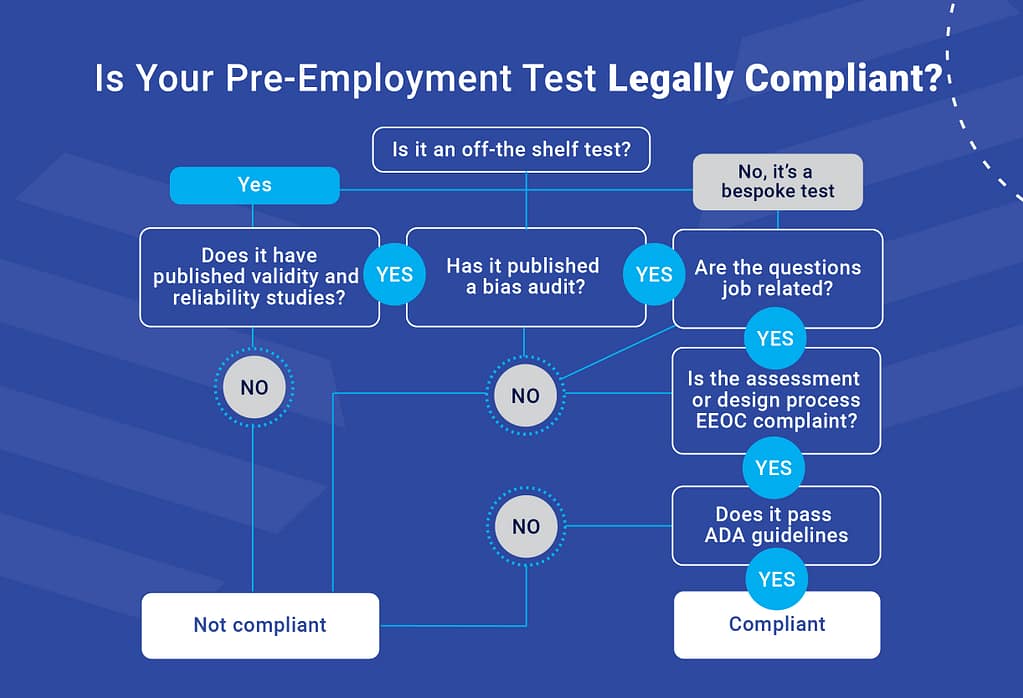
A bad hire hurts. But using assessments that can’t be legally justified? That can cost far more — in tribunal payouts, reputation, and compliance penalties.
From the UK to North America, employment law is converging around one principle: selection tools must be fair, evidence-based, and clearly job-related. Regulators, candidates, and courts are now asking what many HR leaders quietly fear: Can we actually defend how we hire?
For most organisations, the honest answer is no. Off-the-shelf psychometrics and generic aptitude tests rarely stand up to scrutiny. Without evidence that your assessment predicts success in that specific job, it’s not just poor practice — it’s a legal liability.
There’s a defensible alternative. Realistic Job Assessments (RJAs) simulate the role itself — letting candidates prove how they’d actually perform. The result: fairer decisions, stronger validity, and a compliance trail you can stand behind.
Let’s unpack why.
The problem with traditional assessments
Across major jurisdictions, the legal trend is clear: hiring tools must be job-related, evidence-based, and equitable. If they’re not, they could be unlawful.
In the UK:
The Equality Act 2010 requires hiring decisions to be based on objective, proportionate criteria. Assessments that disadvantage protected groups – even unintentionally – may be considered indirect discrimination unless they’re clearly justifiable.
In the US:
The EEOC enforces federal anti-discrimination laws, including Title VII of the Civil Rights Act. The Uniform Guidelines on Employee Selection Procedures (UGESP) demand that all selection tools be validated – ideally through content validity, where test items map directly to job tasks.
In Canada:
Human rights legislation across provinces prohibits hiring practices that adversely affect candidates based on protected characteristics. The law requires demonstrable linkage between the assessment and actual job performance.
Put simply: if your assessment isn’t obviously job-relevant and fair to all candidates, you’re exposed.
“Traditional tests are risky because they rarely connect to real work,” says Chris Platts, CEO of ThriveMap. “We’ve seen organisations rely on abstract puzzles or personality profiling that have no bearing on actual performance. That’s a legal red flag.”
Why Realistic Job Assessments are built for compliant hiring practices
Realistic Job Assessments (RJAs) flip the script from theory to practice. Instead of assuming what makes a good hire, they ask use real criteria that are important for the job, and then simulate real scenarios from the role – letting candidates show how they’d perform.
Examples include:
Prioritising tasks under time pressure for an operations role
Responding to a customer query for a support position
Making decisions based on competing deadlines for a team lead role
Because they’re based on what the job actually involves, they’re much easier to defend legally – and more predictive of performance.
Here’s why they hold up to legal and organisational scrutiny:
1. Built from job analysis
RJAs are constructed using input from real jobholders and line managers. That means every part of the assessment maps directly to the competencies and challenges of the role.
2. Valid by design
RJAs support content validity – the gold standard in EEOC and UK legal frameworks – because tasks are directly related to job duties, not abstract traits.
3. Fairer to diverse candidates
By focusing on observable behaviour, RJAs reduce reliance on cultural norms, verbal reasoning styles, or personality fit – all of which have been shown to disadvantage certain groups.
4. Standardised and transparent
All candidates see the same scenarios, and scoring is based on clearly defined criteria. This creates a more objective process and lowers the risk of unconscious bias.
How to make your assessments compliant
Legal defensibility doesn’t just come from good intent – it comes from good documentation and process. Here’s what that looks like:
Interview current team members. Review day-to-day tasks. Identify what success actually looks like. This is your blueprint.
📌 Map assessment tasks to job behaviours
Keep a clear record of how each question or task links back to the job description or competency framework.
📌 Test for fairness
Where local law permits, track demographic trends in your results. Are certain groups scoring significantly lower? If so, re-evaluate those questions.
📌 Train your hiring managers
Make sure everyone understands how the assessment works, how to score consistently, and what bias looks like in practice.
📌 Review regularly
Jobs evolve – and your assessments should, too. Review them annually to ensure they still reflect the real world of work.
“Compliance isn’t just about having the right tool. It’s about showing your work – that every task, every score, every decision has a job-relevant reason behind it,” says Chris.
Compliance without compromise
Hiring shouldn’t feel like a legal minefield. But with the wrong assessments, it often is.
Realistic Job Assessments offer a defensible, data-backed approach that not only protects your organisation – but leads to better hires, stronger retention, and fairer candidate experiences.
“Too many assessments are designed to select the best test-taker,” says Chris. “We help you select the best person for the job. And that stands up to scrutiny – from regulators, tribunals, and candidates alike.”
Share
The ThriveMap Newsroom
Subscribe for insights, debunks and what amounts to a free, up-to-date recruitment toolkit.
About ThriveMap
ThriveMap creates customised assessments for high volume roles, which take candidates through an online “day in the life” experience of work in your company. Our assessments have been proven to reduce staff turnover, reduce time to hire, and improve quality of hire.
Not sure what type of assessment is right for your business? Read our guide.
Other articles you might be interested in
Principles and best practices for pre hire assessment design
A pre hire assessment can look sophisticated, feel engaging and process thousands of candidates without measuring anything especially useful. The quality of an assessment is not determined by how impressive the technology appears or how many question formats it contains. It depends on whether the assessment measures capabilities that genuinely matter in the job, produces […]
The AI Doom Loop: Why automated hiring is screening out the people you actually want
Job applications grew four times faster than job openings in the first half of 2024 alone, and that gap has only widened since. Gartner projects that by 2028, one in four job candidates globally will be fake: AI-generated profiles with fabricated resumes, cloned voices, and deepfaked video sitting through interviews that were never a real […]
Want to assess attention to detail in your hiring process? Here’s how to ensure you hire the right person
Attention to detail is one of the most commonly assessed skills in recruitment, and for good reason. In many roles, the ability to spot errors, follow processes and work accurately has a direct impact on quality, compliance and customer outcomes. So it makes sense that employers invest in attention to detail tests. The problem is […]