How to reduce candidate drop off rates: Wincanton hiring case study
4 minute read
Posted by Emily Hill on 2 January 2026
Here’s how Wincanton reduced candidate drop-off by 50% using Realistic Job Assessments
Candidate drop-off is one of the hardest challenges in volume hiring.
When applicants start a process but never reach interview or offer, it drains recruiter time, slows hiring and increases cost. But Wincanton, one of the UK’s largest logistics firms, implemented Realistic Job Assessments which reduced candidate drop-off by improving conversion by 50%, increasing job offers by 150% and cutting time to offer by 96%.
The problem: candidate drop-off at every stage of hiring
Wincanton hires into a tight labour market where candidate availability is low and competition is high, making traditional recruitment approaches harder to sustain at scale.
Before implementing ThriveMap’s Realistic Job Assessments, recruiters were spending days sifting CVs, making screening calls and arranging interviews. This resulted in candidates dropping out at multiple stages of the funnel, sometimes before interview and even after receiving an offer.
This drop-off problem isn’t unique to Wincanton. Data shows that candidates disengage when they don’t understand the role or find early stages of hiring unclear or slow. When expectations don’t match reality, many never complete the process, dragging out time to hire and increasing cost per hire.
The solution: immersive Realistic Job Assessments
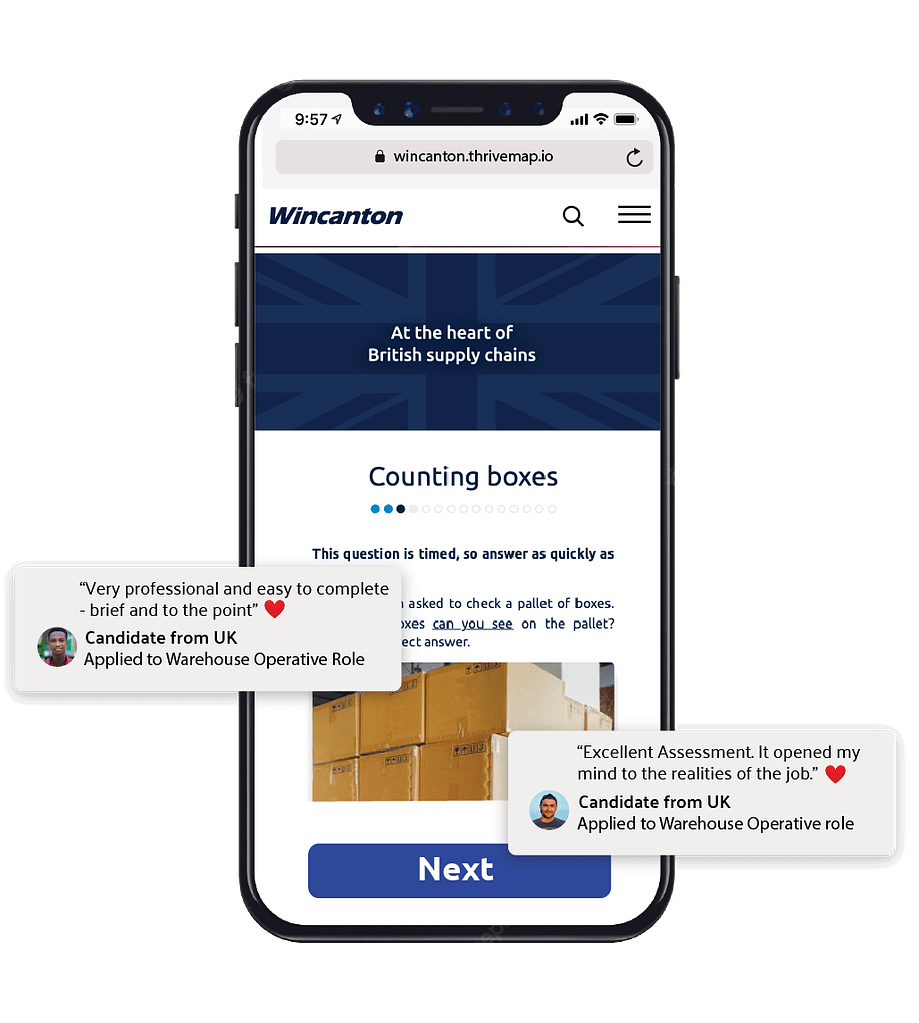
To tackle this, Wincanton partnered with ThriveMap through its innovation programme W² Labs to design a new digital hiring tool called Recruiter. At the core of this solution are Realistic Job Assessments which are pre-hire experiences that provide candidates with meaningful, job-relevant assessment scenarios reflecting a typical day in the role.
Rather than a generic questionnaire or traditional personality test, these assessments give applicants a true preview of the role. Candidates see realistic tasks and challenges, so they can self-select based on whether the job feels like a fit. This clarity upfront has two benefits:
Candidates are better informed and more engaged, because they know what to expect.
Recruiters spend time only on genuinely interested and suitable candidates, instead of chasing disengaged ones.
This alignment directly reduces early funnel drop-off — which is the key to improving hiring metrics at scale.
Real results: better engagement, faster decisions
Wincanton’s experience shows that this approach works, and works fast. After launching the ThriveMap-powered solution:
Conversion rates improved by 50%: more candidates moved through the funnel. ThriveMap
Job offers increased by 150%: from the same applicant pool, as more suitable candidates were identified early. ThriveMap
91% of candidates reported a positive experience, underlining how role-realistic assessments improve candidate perception and engagement. ThriveMap
Time to offer dropped by 96%, shrinking hiring delays from weeks to around a day. ThriveMap
These outcomes translate into a more efficient process overall, not just happier recruiters and candidates, but a measurable reduction in drop-off rates right where it matters most.
Why this approach reduces candidate drop off rates
Realistic Job Assessments tackle the core reasons candidates disengage early:
Candidates often drop out when:
They don’t understand what the job really involves.
The screening feels unrelated to actual work.
The process is slow or unclear.
By contrast, immersive assessments:
Set clear expectations about the role before interview.
Engage candidates with real-life tasks, removing guesswork.
Shorten the decision cycle, so candidates don’t lose interest while waiting.
The result is a smoother, faster funnel where candidates either commit or opt out before costly screening steps. This intentional alignment is the key to cutting drop-off and elevating the quality of hire.
Key insights for recruiters focusing on reducing candidate drop-off
Wincanton’s approach offers three transferable insights for any talent team looking to reduce candidate drop off rates:
1. Give candidates context early. Clarity about the job reduces uncertainty and uncertainty drives abandonment.
2. Use assessments that reflect real work. Abstract or generic tests don’t build confidence; realistic ones do.
3. Speed up decisions with immediate, objective data. Long waits increase drop-off more than almost any other factor.
Subscribe for insights, debunks and what amounts to a free, up-to-date recruitment toolkit.
About ThriveMap
ThriveMap creates customised assessments for high volume roles, which take candidates through an online “day in the life” experience of work in your company. Our assessments have been proven to reduce staff turnover, reduce time to hire, and improve quality of hire.
Not sure what type of assessment is right for your business? Read our guide.
Other articles you might be interested in
Principles and best practices for pre hire assessment design
A pre hire assessment can look sophisticated, feel engaging and process thousands of candidates without measuring anything especially useful. The quality of an assessment is not determined by how impressive the technology appears or how many question formats it contains. It depends on whether the assessment measures capabilities that genuinely matter in the job, produces […]
The AI Doom Loop: Why automated hiring is screening out the people you actually want
Job applications grew four times faster than job openings in the first half of 2024 alone, and that gap has only widened since. Gartner projects that by 2028, one in four job candidates globally will be fake: AI-generated profiles with fabricated resumes, cloned voices, and deepfaked video sitting through interviews that were never a real […]
Want to assess attention to detail in your hiring process? Here’s how to ensure you hire the right person
Attention to detail is one of the most commonly assessed skills in recruitment, and for good reason. In many roles, the ability to spot errors, follow processes and work accurately has a direct impact on quality, compliance and customer outcomes. So it makes sense that employers invest in attention to detail tests. The problem is […]