The Candidate Expectation Gap: Why Filtering Faster Is Not the Same as Hiring Better
6 minute read
Posted by Emily Hill on 22 January 2026
Why Most Hiring Systems Measure the Wrong Things
Modern hiring processes are built to move people through a funnel.
Applications in. Screens out. Interviews. Offer. Start date.
Most of the metrics that define success sit at the top of that funnel. Speed to hire. Time to shortlist. Cost per hire. Interview to offer ratio.
Those numbers tell you how efficiently candidates were filtered. They do not tell you whether the person who accepted the role is actually a good fit for the job they are about to do.
This is where the candidate expectation gap begins.
Traditional assessments and interviews are designed to eliminate risk by removing candidates who do not sound right. They rarely test whether the candidates who remain truly understand the work, the environment, and the trade offs that define success in the role.
So the system gets faster at filtering people out, while getting no better at aligning people in.
What Is the Candidate Expectation Gap?
The candidate expectation gap is the difference between what a candidate believes a job will be like and what the role is actually like once they are doing it.
It forms when hiring focuses on performance in the process instead of performance in the job.
Candidates learn how to pass interviews. They mirror job descriptions. They describe their ideal way of working.
Employers describe roles in abstract terms like fast paced, collaborative, or high growth.
Both sides leave the process feeling confident. Neither side has tested reality.
What the Data Shows
Research from OnePoll in 2023, based on a nationally representative sample of 1,000 employed adults, puts scale behind this problem.
More than half of employees, 55 percent, said they have left a job because it was not what they expected when they accepted it.
That means expectation failure is not a rare event. It is a normal part of working life for a majority of people.
The same study shows that the gap is not about surface level perks or office culture. When asked what specifically did not match their expectations, respondents pointed to the core mechanics of the job.
The most common mismatches were:
Job responsibilities and what they were actually expected to do day to day.
Working environment, including how teams really operate under pressure.
Working hours and shift patterns.
Pay and benefits compared to what was implied during hiring.
The severity of the gap also matters. A large proportion of respondents described the difference between expectation and reality as either a lot or somewhat different, not just a small adjustment period.
This is not about onboarding taking a few weeks. It is about people realising they signed up for a fundamentally different role.
The data also highlights how early these decisions are made. Many respondents who left due to unmet expectations did so within the first few months of starting. That places the cost of the gap squarely inside the most expensive phase of employment, when training, ramp up, and manager time are at their highest.
Why Filtering Faster Just Makes the Problem Worse
When hiring systems prioritise speed and volume, they naturally reward candidates who are good at navigating hiring processes.
That means people who can:
Present themselves confidently in interviews.
Give polished examples.
Align their language with the job description.
None of these behaviours reliably predict how someone will perform in the real job.
So organisations end up optimising for interview success, not job success.
At the same time, candidates are optimising for getting an offer, not for choosing a role they will actually enjoy and succeed in.
That is how both sides walk into a mismatch that only becomes visible once real work begins.
The Cost of the Expectation Gap
The OnePoll findings show that expectation failure is one of the most common reasons people leave jobs. That makes it one of the most preventable causes of attrition.
The cost is not just financial.
There is the direct cost of re hiring, re onboarding, and lost productivity.
There is also the quieter cost to employer brand. People who feel misled talk about it. They leave reviews. They warn their networks.
A reputation for roles not matching reality spreads faster than any recruitment campaign can repair.
How ThriveMap Changes What Gets Measured
ThriveMap is built on a different assumption.
Behaviour is shaped by context, not by how someone describes themselves.
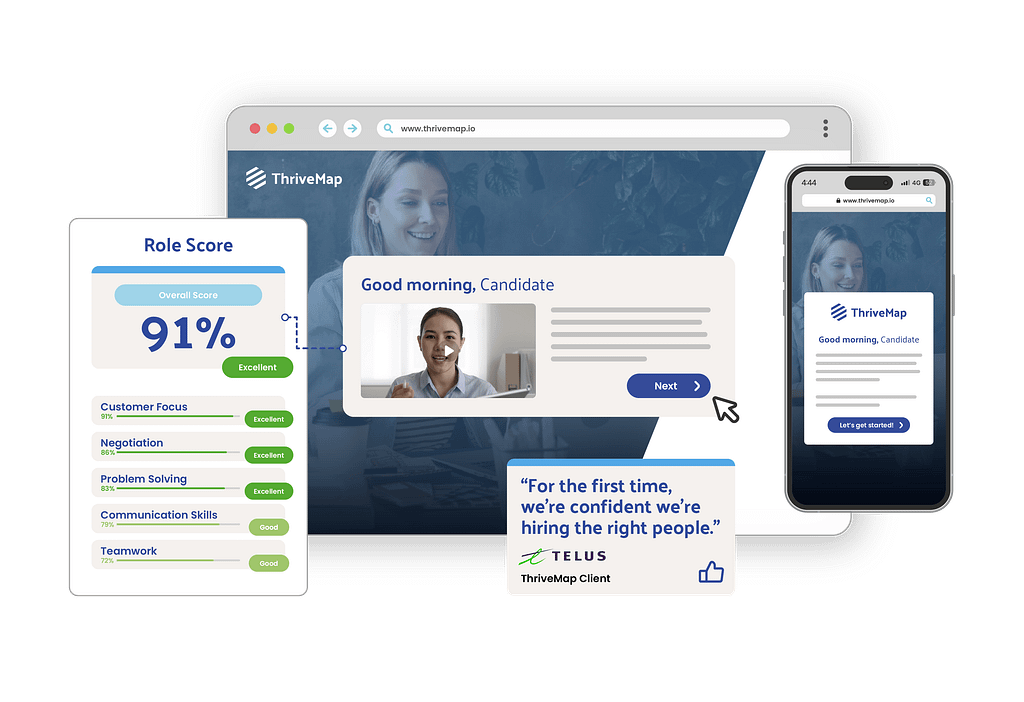
Instead of asking candidates to talk about the job, ThriveMap puts them inside it.
From Role Marketing to Real Job Experience
ThriveMap creates Realistic Job Assessments drawn from the real pressures, trade offs, and decisions that define success in the role.
Candidates are not asked what they would do in theory. They are asked to respond to situations that mirror what they will actually face.
This turns the hiring process into a two way test.
The organisation learns how the candidate behaves in its real environment.
The candidate learns what the job truly feels like and is encouraged to opt-out if it’s not going to be a good fit.
Measuring Job Fit Instead of Interview Skill
Rather than scoring people on how well they perform in an interview, ThriveMap focuses on job readiness.
That means assessing:
Commitment, whether the candidate genuinely wants this role as it exists, not as they imagined it.
Competence, whether they can handle the real demands and complexity of the work.
Culture fit, whether their natural behaviours align with how decisions are made and how work gets done in the organisation.
This shifts hiring away from filtering out the wrong sounding candidates and towards selecting the right fitting ones.
Closing the Expectation Gap Before Day One
Because candidates experience the reality of the role during the assessment, expectations are aligned before an offer is accepted.
People who realise the job is not for them opt out early.
People who continue do so with a clear understanding of what they are signing up for.
That is how the expectation gap shrinks.
The Bigger Shift
The OnePoll data tells a simple story. More than half of people have left a job because reality did not match expectation.
This is not a problem of hiring efficiency. It is a problem of hiring accuracy.
Filtering faster does not create better matches.
Understanding the job and the human who will do it does.
ThriveMap makes job fit and expectations measurable before someone starts, not after you have already paid the full cost of a bad hire.
Share
The ThriveMap Newsroom
Subscribe for insights, debunks and what amounts to a free, up-to-date recruitment toolkit.
About ThriveMap
ThriveMap creates customised assessments for high volume roles, which take candidates through an online “day in the life” experience of work in your company. Our assessments have been proven to reduce staff turnover, reduce time to hire, and improve quality of hire.
Not sure what type of assessment is right for your business? Read our guide.
Other articles you might be interested in
Principles and best practices for pre hire assessment design
A pre hire assessment can look sophisticated, feel engaging and process thousands of candidates without measuring anything especially useful. The quality of an assessment is not determined by how impressive the technology appears or how many question formats it contains. It depends on whether the assessment measures capabilities that genuinely matter in the job, produces […]
The AI Doom Loop: Why automated hiring is screening out the people you actually want
Job applications grew four times faster than job openings in the first half of 2024 alone, and that gap has only widened since. Gartner projects that by 2028, one in four job candidates globally will be fake: AI-generated profiles with fabricated resumes, cloned voices, and deepfaked video sitting through interviews that were never a real […]
Want to assess attention to detail in your hiring process? Here’s how to ensure you hire the right person
Attention to detail is one of the most commonly assessed skills in recruitment, and for good reason. In many roles, the ability to spot errors, follow processes and work accurately has a direct impact on quality, compliance and customer outcomes. So it makes sense that employers invest in attention to detail tests. The problem is […]