How much do companies spend on pre-hire assessments in 2026?
6 minute read
Posted by Emily Hill on 23 April 2026
Companies are investing heavily in evaluating candidates before they even make an offer. But exactly how much are they spending, and where are those budgets going? If you want to understand the modern hiring landscape, you need to look at the numbers.
At ThriveMap, we recently surveyed 200 talent acquisition leaders to uncover exactly how their organizations allocate their hiring budgets.
The findings from our State of Assessment Market Report 2026 reveal a significant financial commitment across all sectors. However, the data also exposes a critical flaw in how we measure the return on investment (ROI) for these tools.
This post breaks down the raw data on pre-employment assessment spending in 2026. We will look at the average budgets, explore how spending varies by industry and hiring volume, and discuss why the recruitment sector must shift its focus from speed to job readiness.
The Baseline: Average Annual Spend on Assessments
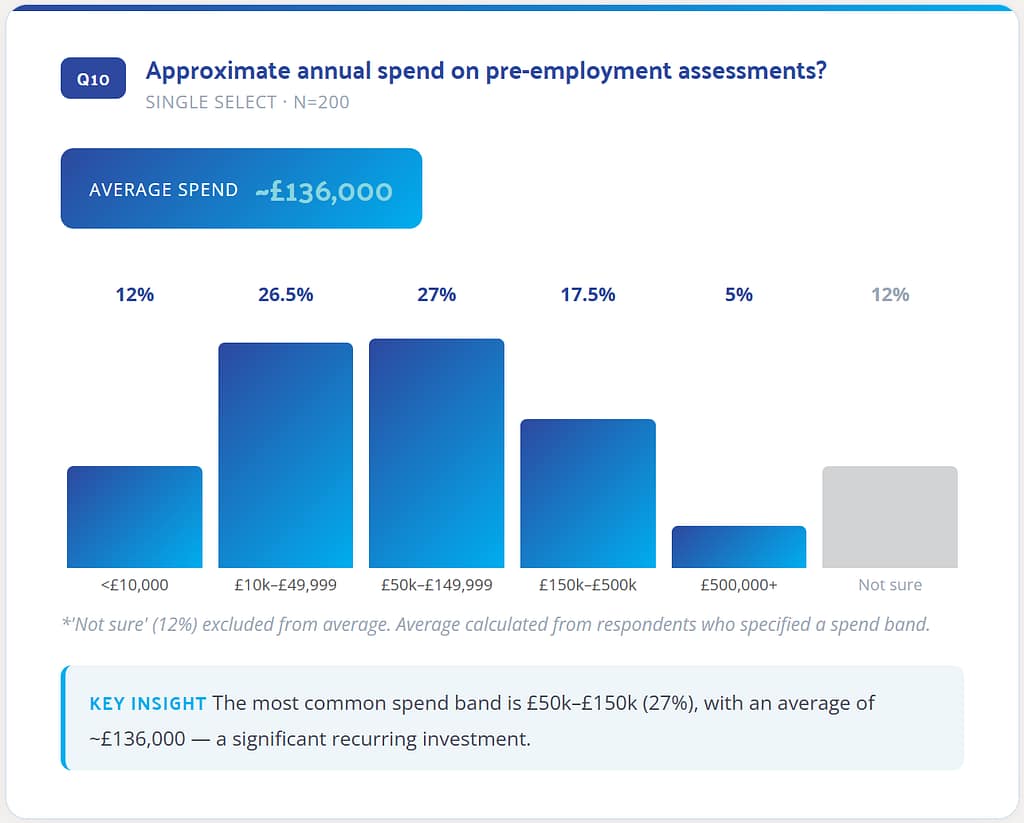
Pre-hire assessments are no longer a minor administrative expense. They are a core operational line item. According to our latest data, the average organisation spends approximately £136,000 annually on pre-employment assessments.
When we break down the spending into specific brackets, a clear pattern emerges. The majority of companies commit significant capital to these platforms every year:
Under £10,000: 12% of companies
£10,000 to £49,999: 26.5% of companies
£50,000 to £149,999: 27% of companies (The most common spend band)
£150,000 to £500,000: 17.5% of companies
Over £500,000: 5% of companies
(Note: 12% of respondents were unsure of their exact spend and were excluded from this average calculation).
The concentration of companies in the £50k–£150k bracket proves that mid-market and enterprise organizations view candidate evaluation as a critical business infrastructure. This is not casual spending. It is a deliberate strategy to filter high volumes of applicants.
Breaking Down Spend by Industry
Not all sectors approach hiring with the same urgency or budget. Industries with high turnover rates and execution-heavy roles naturally spend more to find the right talent. When we analyze the State of Assessment Market Report 2026 by sector, we see distinct differences in average annual spending.
High-Spend Sectors
Industries that rely on large, frontline workforces report the highest average annual investments in assessment tools:
Hospitality: £201,666
Manufacturing: £158,823
Retail: £142,799
Contact Centre / Customer Service: £128,408
For a hospitality or manufacturing business, a bad hire causes immediate operational friction. If a worker cannot handle the pace of a commercial kitchen or the safety protocols of a factory floor, the company loses productivity instantly. These sectors spend top dollar because the cost of hiring the wrong person is staggeringly high.
Moderate to Lower-Spend Sectors
Other industries show slightly more conservative averages, though the investments remain substantial:
Healthcare / Social Care: £101,499
Logistics / Warehousing: £79,374
Even at the lower end of the spectrum, companies are spending nearly £80,000 a year just to evaluate whether someone is fit for the job.
The Impact of Hiring Volume on Cost Per Hire
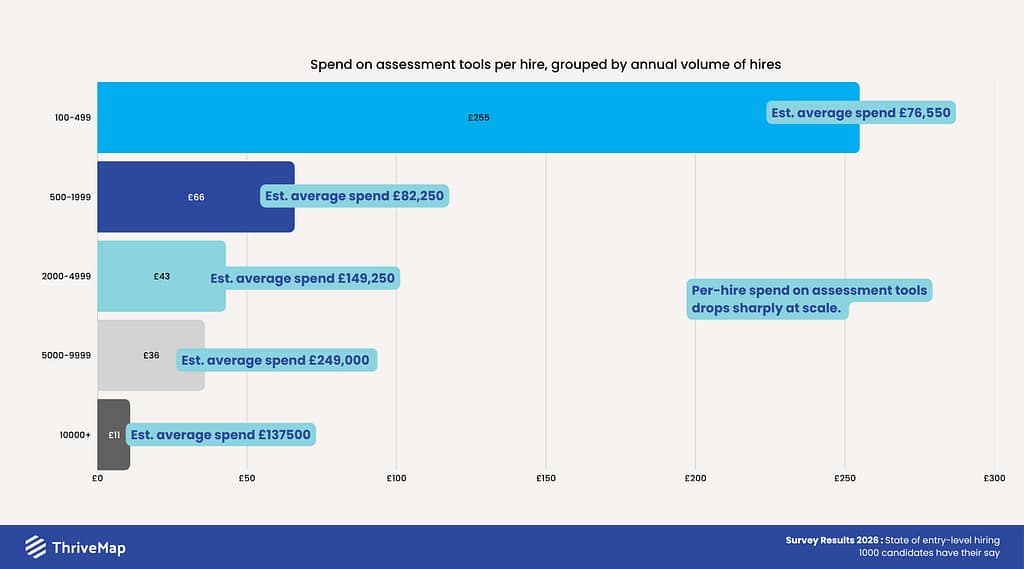
Annual budget numbers only tell half the story. To understand the real economics of candidate evaluation, we must look at the cost per hire. Our data reveals a dramatic inverse relationship between the volume of hires and the cost of assessing them.
As your hiring volume increases, the cost per hire drops significantly.
Companies that hire between 100 and 499 employees annually face the highest per-hire assessment costs. They often rely on fragmented toolsets or pay premium per-candidate pricing models.
Conversely, enterprise organizations making 10,000 or more hires per year see their cost per decision plummet. At this scale, organizations integrate their assessment platforms directly into their Applicant Tracking Systems (ATS). They leverage flat-fee enterprise licensing and fully automated workflows. This system maturity allows them to test thousands of candidates for a fraction of the unit cost.
However, paying less per hire does not necessarily mean you are getting better results. Efficiency is important, but it is not the ultimate measure of success.
Rethinking the ROI of Assessment Tools
The recruitment industry suffers from a severe misalignment of metrics. For the past decade, vendors have sold assessment tools entirely on the promise of “speed and efficiency.” They promise to cut your time-to-hire by five days. They promise to automatically screen out 80% of your applicant pool before a recruiter even opens a resume.
While efficiency matters, it is a superficial metric. Optimizing for speed alone creates a blind spot regarding the actual quality and retention of the hire.
The Expectation Gap
When you optimize solely for speed, you process candidates quickly but fail to prepare them for the reality of the work. This leads to an alarming statistic: 66% of candidates report leaving a role because the job simply was not what they expected.
That is not a failure of candidate quality. It is a failure of expectation alignment.
If a company spends £136,000 a year to hire people 10% faster, but 66% of those new hires quit within six months due to unmet expectations, the ROI of that assessment tool is completely negative. You are paying six figures to fill a leaky bucket faster.
Shifting to Job Readiness and Job Fit
To secure a genuine return on investment, talent acquisition teams must redefine what an assessment is supposed to achieve. We must stop prioritizing speed and start prioritizing job readiness and job fit.
High-performing hiring systems use assessments to simulate the actual working environment. Instead of asking candidates abstract personality questions or testing their general cognitive ability, modern assessments should provide a realistic job preview.
Candidates need to experience the specific tasks they will do every day. They need to understand the pace, the pressures, and the unique challenges of the role. When you use work sample-based evaluations, two things happen simultaneously:
The employer sees if the candidate can actually do the work.
The candidate sees if they actually want to do the work.
This mutual evaluation process is the secret to long-term retention. When a candidate fully understands what they are signing up for, they are far less likely to become part of that 66% who quit early.
Building a Data-Driven Hiring Strategy
The data from 2026 is unambiguous. Companies are heavily invested in pre-hire assessments, with the average organisation spending £136,000 annually.
Execution-heavy industries like hospitality and manufacturing lead the charge, driven by the immediate need for capable frontline staff.
While enterprise organizations benefit from economies of scale that reduce their cost per hire, all companies face the same fundamental challenge: proving the ROI of these tools.
You cannot prove ROI by simply showing a faster time-to-hire. You prove it by showing higher retention rates, faster time-to-productivity, and better operational performance from your new hires. To achieve this, you must move away from traditional screening and embrace realistic, job-specific evaluations that align expectations from day one.
Want to dive deeper into the numbers? Explore all the insights, industry breakdowns, and emerging trends in our complete State of Assessment Market Report 2026.
Our main takeaway? Ensure your six-figure investment is actually buying you better hires, not just faster rejections.
Share
The ThriveMap Newsroom
Subscribe for insights, debunks and what amounts to a free, up-to-date recruitment toolkit.
About ThriveMap
ThriveMap creates customised assessments for high volume roles, which take candidates through an online “day in the life” experience of work in your company. Our assessments have been proven to reduce staff turnover, reduce time to hire, and improve quality of hire.
Not sure what type of assessment is right for your business? Read our guide.
Other articles you might be interested in
Principles and best practices for pre hire assessment design
A pre hire assessment can look sophisticated, feel engaging and process thousands of candidates without measuring anything especially useful. The quality of an assessment is not determined by how impressive the technology appears or how many question formats it contains. It depends on whether the assessment measures capabilities that genuinely matter in the job, produces […]
The AI Doom Loop: Why automated hiring is screening out the people you actually want
Job applications grew four times faster than job openings in the first half of 2024 alone, and that gap has only widened since. Gartner projects that by 2028, one in four job candidates globally will be fake: AI-generated profiles with fabricated resumes, cloned voices, and deepfaked video sitting through interviews that were never a real […]
Want to assess attention to detail in your hiring process? Here’s how to ensure you hire the right person
Attention to detail is one of the most commonly assessed skills in recruitment, and for good reason. In many roles, the ability to spot errors, follow processes and work accurately has a direct impact on quality, compliance and customer outcomes. So it makes sense that employers invest in attention to detail tests. The problem is […]