You set up a realistic job assessment for your latest open role. Candidates log in, answer a few scenario-based questions, and receive a score. You get a neat dashboard showing who performed best. The process feels efficient. But are you actually evaluating if the candidate fits the reality of the job, or are you just testing their common sense?
Many talent acquisition teams believe they offer realistic job assessments. In fact, 82% say they are using job-relevant skills / work sample assessments.
However, a closer look reveals a massive gap in quality across the market. Most of these tools do not go nearly far enough. They present a scenario or two that creates the illusion of progress, but they completely miss the opportunity to educate the candidate on whether they actually want the job.
If your assessment process fails to cover the unglamorous truths of the role, you are setting your new hires up for disappointment. Here is why all realistic job assessments are not equal, the hidden costs of getting it wrong, today’s best practices, and exactly what you need to look for when building a process that works.
The Illusion of Progress in Hiring
When we talk about assessments, we often focus entirely on the employer’s needs. We want to know if the candidate possesses the right skills, the correct temperament, and the appropriate problem-solving abilities. We build basic multiple-choice quizzes or situational judgment tests to check these boxes.
This approach creates an illusion of progress. You move candidates from stage one to stage two. You filter out the bottom quartile. You feel confident because you have data. Yet, this data is deeply flawed if the candidate completes the assessment without gaining a real understanding of what the job entails.
A genuine assessment goes two ways. It evaluates the candidate for you, and it evaluates the role for the candidate. If your process only features sanitized, idealized scenarios, it fails its most critical function: allowing candidates to opt out before you spend money onboarding them.
The Devastating Cost of Misrepresentation
When candidates accept jobs they do not fully understand, the results are expensive. According to the ThriveMap State of Assessment Market Report 2026, 72% of candidates say a role they accepted was not accurately represented in the hiring process. This is a staggering failure of expectation management.
What happens when we fail to manage these expectations? People leave. The same report reveals that as a result of this misrepresentation, 60% of these individuals left the job sooner than planned.
Turnover is costly. You lose the money spent on recruitment, the time invested by your hiring managers, and the productivity lost while the seat sits empty again. You also damage your employer brand. Candidates who feel misled will talk about their experiences, making it harder for you to attract top talent in the future.
What Are TA teams Getting Wrong?
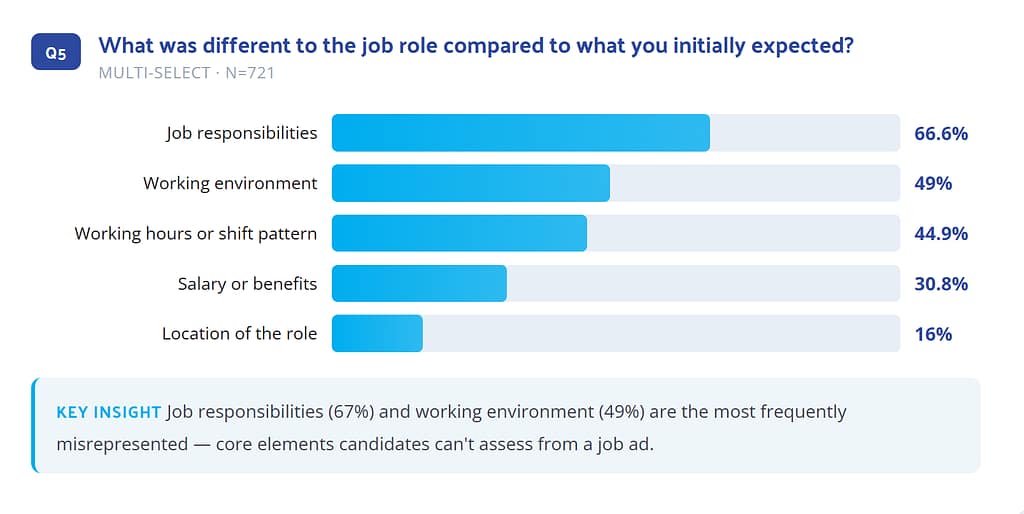
When we dig into exactly what elements candidates feel are misrepresented, the data tells a clear story. The core components of the job—the things candidates cannot easily assess from a standard job advertisement—are the most frequently misunderstood.
When asked what was different about the job role compared to their initial expectations, candidates pointed to several major discrepancies:
Job responsibilities (66.6%): Two-thirds of candidates found their day-to-day tasks did not match what they expected.
Working environment (49%): Nearly half arrived to find the team culture, pace, or physical workspace vastly different from the picture painted during interviews.
Working hours or shift pattern (44.9%): A huge portion of new hires felt surprised by the actual time commitments required.
Salary or benefits (30.8%): Compensation structures often contained unexpected caveats.
Location of the role (16%): Even basic logistics like remote work policies or office locations were sometimes unclear.
These numbers prove that standard hiring practices leave candidates in the dark. A few basic interview questions and a generic skills test cannot bridge this expectation gap.
What to Look for in a High-Quality Realistic Job Assessment
Not all realistic job assessments are equal because most ignore the structural realities of the job. To build an assessment that actually predicts retention and performance, you must embed the raw, unfiltered truth of the role into the experience.
Here is what a truly effective realistic job assessment must cover at the assessment stage.
Unfiltered Job Responsibilities
Do not just ask candidates how they would handle a strategic triumph. Ask them how they handle the mundane, repetitive tasks that make up 40% of their actual week. If the role requires heavy data entry, cold calling angry customers, or managing conflicting priorities from difficult stakeholders, put those exact tasks into the assessment. Let them feel the weight of the actual responsibilities. If they hate the work, you want them to figure that out during the assessment, not during week three of onboarding.
The Real Working Environment
Your assessment should reflect the true pace and pressure of your environment. If your team operates in a chaotic, high-stakes setting where priorities shift hourly, design your assessment to interrupt the candidate with a simulated “urgent” task. If your environment is highly collaborative and requires endless consensus-building, simulate that friction. Show them the reality of your culture, warts and all.
Working Hours and Shift Patterns
Candidates often feel misled about the hours they need to work. If you hire for shift work, retail, or healthcare, the realities of weekend work, night shifts, or unpredictable scheduling must be front and center.
Transparent Salary and Benefits
While you might not test a candidate on their salary, a good assessment process weaves compensation realities into the narrative. Help them understand the stress and the reality of the pay structure so they can make an informed financial decision.
Location and Logistics
If a role requires heavy travel, being on your feet for eight hours, or commuting to a remote site, build this into the context of the assessment scenarios. Ensure candidates understand the physical and geographic demands of the role before they sign an offer letter.
Educating Candidates to Drive Retention
The best realistic job assessments function as a powerful education tool. They strip away the fluff and give candidates a clear, interactive preview of their future.
When you cover the actual responsibilities, the true environment, the real hours, the pay structure, and the location logistics, you empower candidates to make a choice. Some will realize the job is not for them and drop out of the process. You should celebrate this. Early dropouts save you from expensive early turnover.
The candidates who complete a comprehensive, honest assessment and still want the job are your most valuable assets. They know exactly what they are signing up for. They arrive on day one with accurate expectations, ready to engage with the actual work rather than fighting against unexpected realities.
Stop settling for assessments that merely look like work. Demand tools that educate your candidates, represent your roles accurately, and ultimately protect your bottom line.
Ready to build an informative Realistic Job Assessment that actually works? thrivemap.io/demo
Share
The ThriveMap Newsroom
Subscribe for insights, debunks and what amounts to a free, up-to-date recruitment toolkit.
About ThriveMap
ThriveMap creates customised assessments for high volume roles, which take candidates through an online “day in the life” experience of work in your company. Our assessments have been proven to reduce staff turnover, reduce time to hire, and improve quality of hire.
Not sure what type of assessment is right for your business? Read our guide.
Other articles you might be interested in
Principles and best practices for pre hire assessment design
A pre hire assessment can look sophisticated, feel engaging and process thousands of candidates without measuring anything especially useful. The quality of an assessment is not determined by how impressive the technology appears or how many question formats it contains. It depends on whether the assessment measures capabilities that genuinely matter in the job, produces […]
The AI Doom Loop: Why automated hiring is screening out the people you actually want
Job applications grew four times faster than job openings in the first half of 2024 alone, and that gap has only widened since. Gartner projects that by 2028, one in four job candidates globally will be fake: AI-generated profiles with fabricated resumes, cloned voices, and deepfaked video sitting through interviews that were never a real […]
Want to assess attention to detail in your hiring process? Here’s how to ensure you hire the right person
Attention to detail is one of the most commonly assessed skills in recruitment, and for good reason. In many roles, the ability to spot errors, follow processes and work accurately has a direct impact on quality, compliance and customer outcomes. So it makes sense that employers invest in attention to detail tests. The problem is […]