Nobody invests in pre-hire assessments because they enjoy adding steps to the hiring process. They invest because they want better hires. Better retention. More confidence in decisions. Less of that sinking feeling six months in.
And yet many organisations never stop to ask the most important question: is our assessment actually improving quality of hire?
Not completion rates. Not time-to-hire. Not dashboard metrics. Whether the people they hire go on to succeed, stay and thrive in the role.
The intention is almost universal. The outcomes rarely match it. So before asking why your assessment isn’t working, it’s worth making sure you’ve actually checked whether it is.
Three signs your assessment isn’t working
These are the signals that almost always appear when an assessment has stopped predicting what it should.
1. Early attrition hasn’t improved
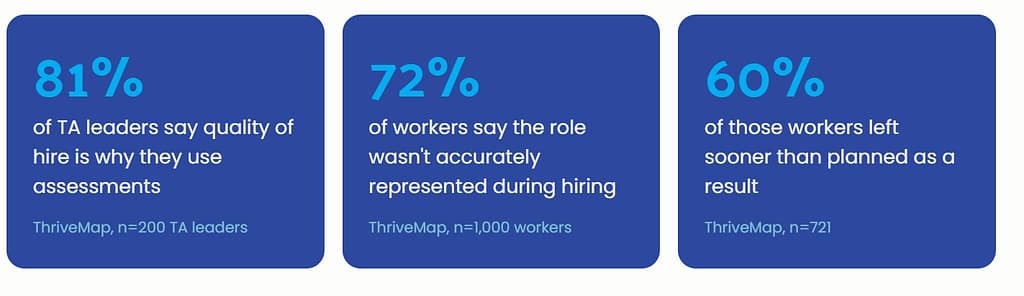
If your 90-day or 6-month turnover hasn’t moved since introducing assessments, the assessment probably isn’t measuring what predicts longevity in the role. In our research, 60% of workers who felt misled about a role left sooner than planned. An assessment that doesn’t surface the reality of the job can still generate a score. It just won’t reduce regretted hires.
2. High scorers aren’t outperforming low scorers
This is the cleanest test. Pull your last 12 months of performance data and check whether assessment scores correlate with manager ratings, retention or time to productivity. If high and low scorers are performing similarly, the assessment isn’t measuring the right things. Most organisations have never run this check.
3. Hiring managers still rely on gut feel
A good assessment gives hiring managers information they didn’t previously have. If they still feel the decision comes down to interview performance or instinct, the assessment is adding process without adding insight. When results don’t change the conversation, they rarely change the outcome.
If any of those feel familiar, the problem usually comes down to one of the same few causes.
Why so many pre-hire assessments don’t deliver results
If any of those warning signs feel familiar, the problem usually comes down to one of a handful of common issues.
1. They’re measuring the wrong things
An assessment can be highly reliable and still fail to improve quality of hire. Why? Because measuring something accurately isn’t the same as measuring the right thing. Many organisations assess candidates against generic competencies, personality traits or cognitive abilities. But success in the role often comes down to much more specific behaviours. The traits that help someone thrive as a retail assistant are different from those required in a call centre, warehouse or care setting. If your assessment isn’t measuring the behaviours that actually drive success in the role, don’t be surprised when high scoring candidates fail to become high performing employees.
2. The role has changed but the assessment hasn’t
Most assessments are designed during a procurement cycle, shaped largely by the vendor, then embedded in the ATS and left to run. Many organisations are still assessing candidates against a profile built around a version of the role that no longer exists.
Annual review, at minimum, is the baseline. Most processes don’t come close to that.
3. Candidates don’t understand what they’re signing up for
Most assessments are entirely focused on helping employers evaluate candidates. Far fewer help candidates evaluate the role.
When we asked workers what would have helped them better understand a job before accepting it, the most common answer wasn’t a harder test. It was more honest information about workload, working conditions and day-to-day expectations, cited by 48%. An assessment that only scores and doesn’t inform is leaving a lot on the table.
4, Nobody is checking whether the scores mean anything
Many organisations track assessment completion. Some track scores. Very few track whether those scores actually predicted anything. Only 29% of TA leaders in our research track early attrition as an assessment KPI. Only 34% track drop-off rates. Without linking assessment performance to retention, productivity or quality of hire over time, there’s no way to know if the assessment is working, or has quietly stopped.
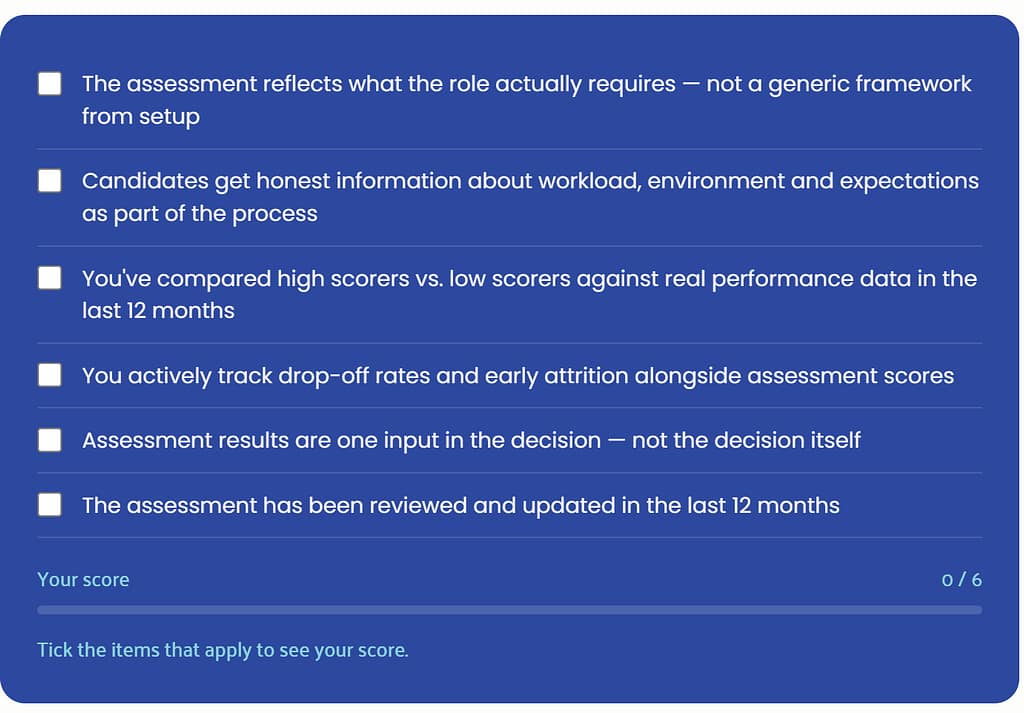
Assessment healthcheck:
What good looks like
The organisations seeing the most from their assessments aren’t doing anything exotic. But a few things consistently show up.
1. The assessment reflects the realities of the actual job
Not a generic competency framework. The specific behaviours and pressures that determine success in this role, in this organisation, right now. Updated when the role changes.
2. It’s honest, not just rigorous
The best assessments give candidates a realistic picture of what they’re signing up for, not just a set of questions to be scored on. When candidates can self-select out of roles that aren’t right for them, attrition falls before the offer is even made.
3. Scores are validated against outcomes.
High scorers are periodically checked against performance data and retention. If the correlation has weakened, something changes. This is the basic test most organisations have never run.
4. It’s reviewed regularly, not set and forgotten
Annual at minimum. More often when roles or labour markets are shifting. Treating assessment as a live part of hiring strategy — not a background process — is what separates the organisations that see it compound from the ones that stay stuck. This is the approach ThriveMap takes with every client, building assessments around realistic job previews and work samples, and working with teams on an ongoing basis to make sure scores are still predicting what they should. Because ultimately, the standard every assessment should be judged against isn’t completion rates or dashboard metrics. It’s whether the people you hire go on to succeed, stay and thrive in the role.
“
One thing we consistently hear from customers switching to ThriveMap is that their previous assessments never changed. The same questions, the same scoring, year after year — regardless of how the role had evolved. With ThriveMap, the assessment evolves with your data. Every hiring cycle feeds back in, reducing assumptions and strengthening predictive accuracy over time. The result is an assessment that doesn’t just screen candidates — it genuinely prepares them for the reality of the role.
ThriveMap Customer Success
A recurring theme from customer interviews, 2026
See whether your assessment is doing what you think it is
Most assessments are evaluated on completion rates and candidate satisfaction. ThriveMap evaluates them on something harder: whether high scorers genuinely outperform low scorers in your organisation, over time.
In a free consultation, we’ll look at what you’re currently measuring, whether it maps to the behaviours that actually predict success in your roles, and where the gaps are most likely to show up in your retention and performance data.
No audit document. No generic recommendations. A conversation with people who’ve built assessments for some of the world’s highest-volume hirers, and know what good looks like.
Subscribe for insights, debunks and what amounts to a free, up-to-date recruitment toolkit.
About ThriveMap
ThriveMap creates customised assessments for high volume roles, which take candidates through an online “day in the life” experience of work in your company. Our assessments have been proven to reduce staff turnover, reduce time to hire, and improve quality of hire.
Not sure what type of assessment is right for your business? Read our guide.
Other articles you might be interested in
Employers have adopted the job-relevant assessments, but personality tests are undermining them
New research finds most talent acquisition teams have already moved to skills-based hiring, but legacy tools may be cancelling out the benefit. New UK research* from pre-hire assessment specialist ThriveMap suggests that mostemployers have already made the right call on assessment format, testing job-relevant skillsand real work samples rather than relying on personality profiling alone. […]
94% of the cost of early attrition sits outside the recruitment budget
New customer analysis has found that almost all of the financial cost of early employee turnover falls outside recruitment, with training and lost productivity accounting for more than 94% of the total cost. A UK retail and distribution business mapped every cost associated with a warehouse operative leaving within their first month as part of […]
What skills talent acquisition professionals need in 2026 and beyond
Every conversation about AI in recruitment seems to end in the same place. “AI is saving recruiters hours.” That’s great. But the more interesting question is what recruiters should actually be doing with those hours. That was one of the biggest themes coming out of RecFest UK 2026. The technology is improving at an incredible […]