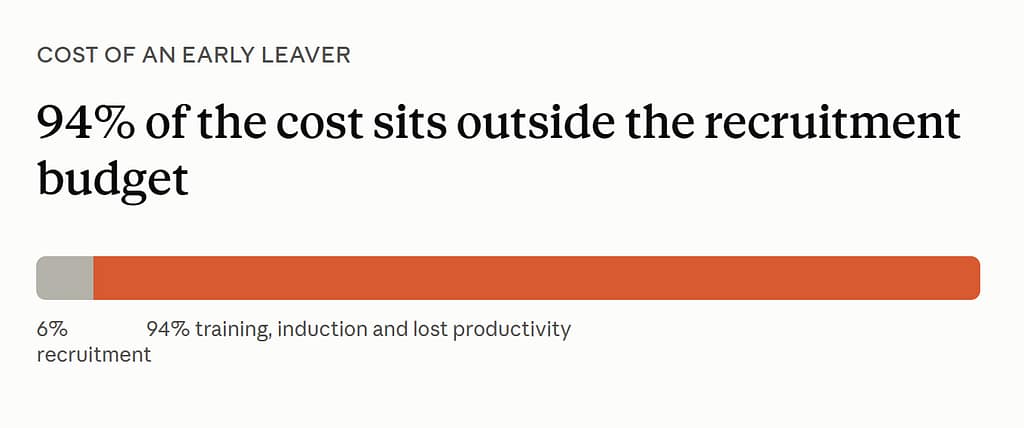
94% of the cost of early attrition sits outside the recruitment budget
3 minute read
Posted by Emily Hill on 15 July 2026
New customer analysis has found that almost all of the financial cost of early employee turnover falls outside recruitment, with training and lost productivity accounting for more than 94% of the total cost.
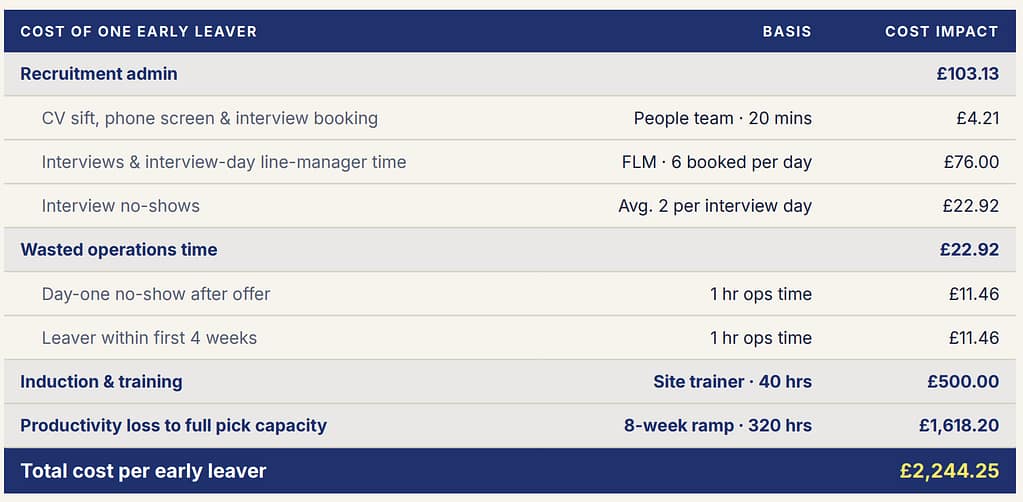
A UK retail and distribution business mapped every cost associated with a warehouse operative leaving within their first month as part of an ROI analysis of its hiring process.
The customer found that an early leaver cost the business £2,244, but only £126 of that came from recruitment administration and interview activity. The remaining 94% came after the employee had started, through induction, training and reduced productivity while new starters ramped up.
The findings highlight a disconnect between how organisations measure hiring success and where the real commercial costs occur.
Recruitment teams have traditionally focused on metrics such as time to hire, cost per hire and quality of hire. Yet those measures rarely capture whether candidates truly understand what the job will be like before accepting an offer.
That gap is reflected in ThriveMap’s State of the Assessment Market research, which found 66% of employees who left a job earlier than expected said it was because the reality of the role did not match what they expected.
The customer introduced ThriveMap’s Realistic Job Assessments to give candidates an accurate picture of the role before interview. Candidates completed realistic job scenarios based on day to day work, allowing people who were not suited to the role to opt out earlier and helping hiring teams assess genuine job fit rather than relying solely on CVs.
The results extended beyond retention. The customer reduced time from application to offer from more than two weeks to less than 48 hours, increased offers made from the same applicant pool by 150%, improved candidate conversion by around 50% and achieved a 91% positive candidate experience score.
Using a warehouse workforce of 1,200 people, the customer also calculated that a 2% improvement in retention would recover the cost of implementing ThriveMap in under 12 months.
The findings suggest the biggest opportunity in hiring is no longer making recruitment faster. It is making it more accurate.
While employers have spent years investing in faster hiring, automated screening and lower recruitment costs, many are still failing to answer one of the most important questions in hiring: does the candidate actually understand what the job is really like?
The customer analysis suggests the financial consequences of getting that wrong are far greater than many organisations realise. Almost all of the cost of a bad hire appears after someone joins, not during the recruitment process itself.
For employers under pressure to reduce turnover, the findings point to a simple conclusion. Early attrition is not just a retention problem. It is a hiring design problem. Giving candidates a realistic understanding of the role before they accept an offer can prevent costly expectation mismatches before day one, reducing hidden operational costs while improving hiring outcomes for both employers and candidates.
Access the Business Case PDF here
Share
The ThriveMap Newsroom
Subscribe for insights, debunks and what amounts to a free, up-to-date recruitment toolkit.
About ThriveMap
ThriveMap creates customised assessments for high volume roles, which take candidates through an online “day in the life” experience of work in your company. Our assessments have been proven to reduce staff turnover, reduce time to hire, and improve quality of hire.
Not sure what type of assessment is right for your business? Read our guide.
Other articles you might be interested in
Principles and best practices for pre hire assessment design
A pre hire assessment can look sophisticated, feel engaging and process thousands of candidates without measuring anything especially useful. The quality of an assessment is not determined by how impressive the technology appears or how many question formats it contains. It depends on whether the assessment measures capabilities that genuinely matter in the job, produces […]
The AI Doom Loop: Why automated hiring is screening out the people you actually want
Job applications grew four times faster than job openings in the first half of 2024 alone, and that gap has only widened since. Gartner projects that by 2028, one in four job candidates globally will be fake: AI-generated profiles with fabricated resumes, cloned voices, and deepfaked video sitting through interviews that were never a real […]
Want to assess attention to detail in your hiring process? Here’s how to ensure you hire the right person
Attention to detail is one of the most commonly assessed skills in recruitment, and for good reason. In many roles, the ability to spot errors, follow processes and work accurately has a direct impact on quality, compliance and customer outcomes. So it makes sense that employers invest in attention to detail tests. The problem is […]