The AI Doom Loop: Why automated hiring is screening out the people you actually want
11 minute read
Posted by Emily Hill on 30 July 2026
Job applications grew four times faster than job openings in the first half of 2024 alone, and that gap has only widened since. Gartner projects that by 2028, one in four job candidates globally will be fake: AI-generated profiles with fabricated resumes, cloned voices, and deepfaked video sitting through interviews that were never a real person to begin with.
The outright fakes are the extreme end of a much more ordinary problem. Most of that application volume isn’t fraud, it’s honest candidates doing what the market has taught them works: apply fast, apply wide, and let AI handle the writing. LinkedIn reports around 11,000 job applications submitted every minute. When a candidate doesn’t hear back, the rational response isn’t to slow down and tailor the next one, it’s to apply faster and to more roles, because volume is the only lever they can see. That behaviour scales the same problem from the other direction: recruiters drowning in applications that all sound the same, genuine interest getting harder to spot, and candidates who land a role they never really understood leaving within months, feeding the attrition numbers straight back into the cycle.
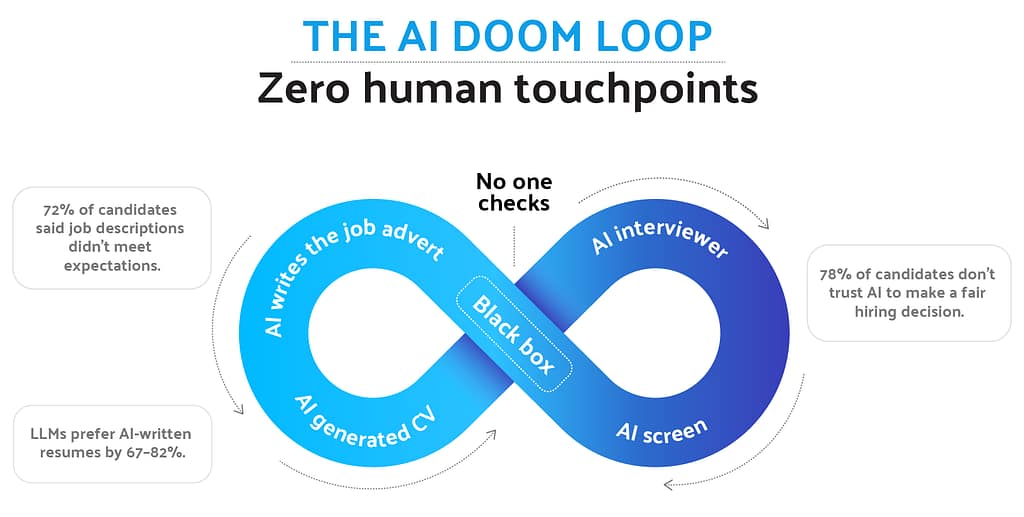
No recruiter, faced with that volume from both real and fake candidates at once, can manually read it, let alone verify who’s who or who’s actually right for the job. So the job of reading it gets handed to AI. That handoff, repeated at every stage of the process, is what’s now being called the AI doom loop.
Here’s what it looks like in practice, playing out thousands of times a day rather than once. A candidate opens a job board, and an AI-optimised advert (written to rank, not to describe the job accurately) tells them what they want to hear. They run that advert through ChatGPT and get back a CV tuned to match it. An applicant tracking system scans that CV for keywords, scores it, and ranks it against a pool of other AI-optimised CVs, most of them arriving faster than any human could ever read them. An AI interview tool asks the candidate a fixed set of questions and scores their answers against a model. A recruiter, looking at a shortlist an algorithm already built from a pile they never saw, approves the top names.
None of this was designed as a coherent process. Each piece got bolted on to survive the volume the last piece created, and the humans it was all meant to serve, both recruiter and candidate, ended up locked out of a system running faster than their processes and governance systems caught up to.
Nobody in that chain is evaluating a person. What’s being evaluated is how well one AI system talks to another, and a growing body of lawsuits suggests that gap is now a legal liability, not just a hiring quality problem.
What’s actually happening inside the loop
The doom loop isn’t one bad tool. It’s AI-driven systems, each optimising for a different, narrower goal, stacked on top of each other with nobody checking the join.
The advert is written to be found, not to be accurate. AI copywriting tools optimise job ads for search visibility and click-through, the same way they’d optimise any other landing page. The result: 72% of candidates say the job description didn’t match what the role actually involved once they started.
The CV is written to pass a filter, not to represent the person. Research on large language models shows they prefer AI-generated resumes over human-written ones by a margin of 67–82% when asked to rank candidates. If the screening step is itself AI-driven, that preference compounds: the CV most likely to reach a human is the one an AI wrote for an AI to read.
The ATS was never built to judge quality, only to filter volume. Most applicant tracking systems work by matching keywords, job titles, and phrasing against the job description, not by assessing whether someone can actually do the job. Harvard Business School research on this found 88% of employers believe qualified, high-skilled candidates are being filtered out by their own ATS because they didn’t use the exact wording the system expected, rising to 94% for middle-skill roles. Formatting trips the same wire: tables, columns, and non-standard layouts routinely get scrambled or dropped entirely by ATS parsers, meaning a genuinely strong candidate can be screened out for how their CV was laid out rather than what it said.
The scoring layer isn’t consistent, and most vendors can’t explain why. AI scoring systems have been shown to score the same answer differently on different occasions, with no clear audit trail for why. If two identical candidates can receive two different scores, the question worth asking a vendor isn’t “how accurate is this,” it’s “what is this actually measuring.”
And candidates know it. 78% say they don’t trust AI to make a fair hiring decision. Trust isn’t a soft metric here. It’s the thing that determines whether your best candidates finish the application at all.
The legal reckoning has already started
This stopped being a theoretical risk in 2026. A cluster of cases now shows exactly where automated screening breaks the law, and what it costs when it does.
Mobley v. Workday is the one to watch. In June 2026, a federal judge allowed key discrimination claims against Workday’s AI hiring tools to proceed, following an earlier ruling that certified a nationwide collective action on behalf of applicants aged 40 and over dating back to September 2020. The court’s reasoning is significant because it held that Workday could potentially be treated as an agent of the employers using its software when performing traditional hiring functions. If that argument ultimately succeeds, employers may not be able to avoid liability simply by pointing to the vendor when an AI tool discriminates. The plaintiffs also allege the screening tools relied on proxy indicators, including employment gaps, that could disproportionately disadvantage disabled applicants. Workday denies the allegations and maintains that employers, not Workday, make the final hiring decisions.
Baker v. CVS Health tested a different angle. An applicant argued CVS’s AI video interview platform functioned as a de facto lie detector test under Massachusetts law. The claim survived a motion to dismiss before ultimately settling.
The ACLU’s complaint against HireVue and Intuit, filed in March 2025, alleged an AI video interview tool discriminated against a deaf Indigenous employee seeking an internal promotion, reportedly generating feedback recommending she “practice active listening” for a disability the tool never accounted for.
EEOC v. iTutorGroup, the first AI hiring discrimination case brought by the Equal Employment Opportunity Commission, alleged a screening tool automatically rejected applicants on the basis of age. It settled.
A class action against Eightfold AI, filed in early 2026, adds a new theory entirely. The lawsuit argues that AI generated applicant scores, built from data including social media activity and inferred “career trajectory”, function as consumer reports under the Fair Credit Reporting Act. If successful, candidates could be entitled to the same disclosure and dispute rights that apply when a lender uses a credit report.
The pattern across all five cases is the same. Courts are increasingly willing to let these claims past the pleading stage, employers can’t outsource accountability to a vendor’s black box, and settlements are landing before verdicts, which tells you plaintiffs’ firms see this as winnable.
Regulation is catching up, but that’s not really the point
In May 2026, the EU pushed back the high-risk obligations covering recruitment and candidate screening under the EU AI Act from August 2026 to December 2027. The date moved. The requirements didn’t: human oversight, risk management, and documentation are all still coming.
It isn’t only an EU problem. NYC’s Local Law 144 has required bias audits on automated employment decision tools since 2023, and Colorado and Illinois are advancing their own AI employment legislation on separate timelines. None of it waits for a single deadline the way the EU Act does, and the US litigation above shows enforcement doesn’t need new legislation to bite. Existing anti-discrimination and consumer-protection law is already being applied to hiring algorithms.
But chasing compliance misses the real issue. Every version of this regulation, and every one of the lawsuits above, is converging on the same test: can a business show it made a fair call, not just that it approved a recommendation an algorithm handed it.
How the loop takes hold inside a TA function
Part of the problem is trust that hasn’t been earned. Talent acquisition teams are often too willing to take a vendor’s word that a tool is “best practice” because the website says so, without asking what’s actually behind the score a candidate gets, what data trained it, or whether anyone has checked it for bias since launch.
ThriveMap’s own research backs this up. Across the State of Assessment Market Report 2026, built from 1,000 candidates, 200 TA leaders, and over 200,000 assessment completions, 82% of employers say they use job-relevant assessments, but only 22% can point to any measurable impact on attrition. That’s a wide gap between using a tool and knowing what it’s actually doing. And 66% of candidates who left a role early said it was because the job didn’t match what they were told to expect going in, the same disconnect the Mobley and Eightfold cases are surfacing on the legal side.
If a vendor can’t explain how a decision was reached, that’s not a detail to skip past. As Mobley v. Workday shows, it’s the whole legal exposure.
The way out isn’t less AI. It’s human decisions first, not last
The alternative to the doom loop isn’t rejecting AI in hiring. It’s changing where the human judgement sits in the process, moving it to the front instead of leaving it as a rubber stamp at the end.
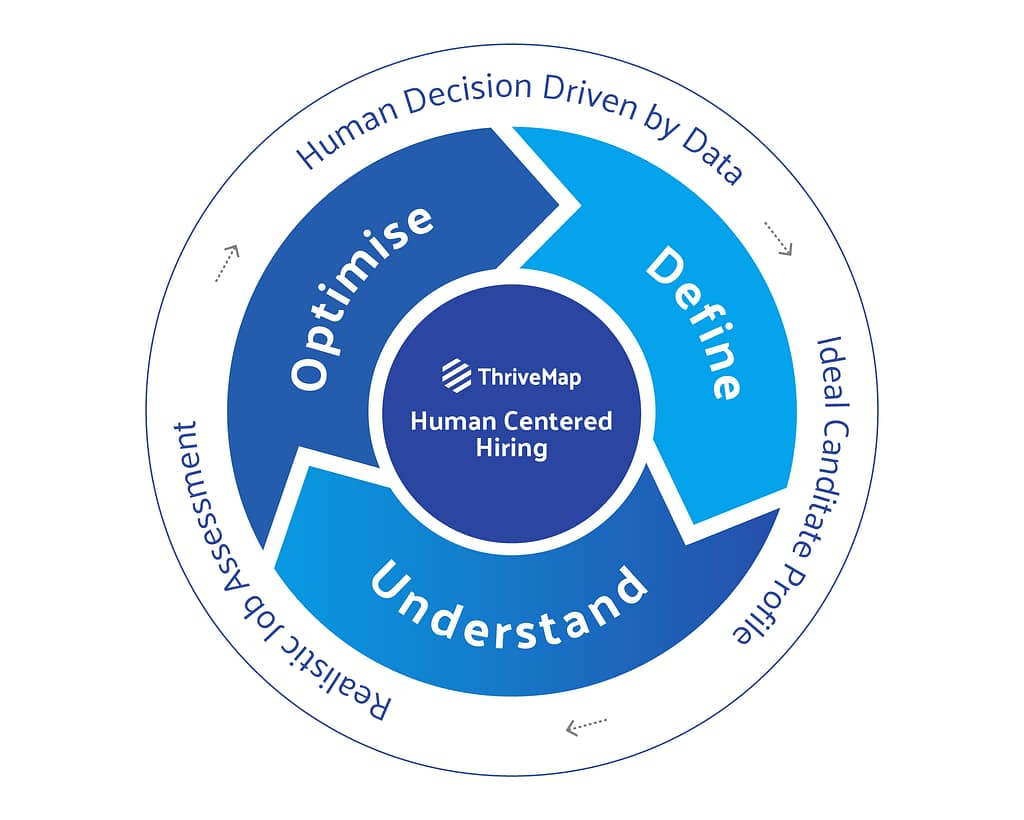
That’s the model behind ThriveMap’s approach to human-centred hiring: understand the real job, define the ideal candidate profile, and only then build the assessment that puts those two things in front of a real applicant.
It starts with the people who actually know the role, in workshops that define what the ideal candidate looks like before any technology gets involved. That judgement is what the assessment gets built around. The technology’s job is to apply it consistently at volume, not to replace it.
Candidates get more than a job title and a bullet-point list, too. They get real insights from the actual job, so they’re the ones deciding whether it’s right for them before a recruiter spends any time on their application.
Why human-centred hiring matters commercially, not just ethically
Fixing that isn’t about screening candidates faster. It’s about people starting the job already knowing what they signed up for.
One warehouse operator client is a useful example of this in practice. Flipping the process so candidates saw the realities of the role upfront dropped ghosting, cut time to offer, and put attrition on track to fall by around 20%. Berkeley Group saw a similar pattern on their apprenticeship programme: 6-month retention improved from 87% to 98%, 12-month retention rose from 62% to 85%, and female intake reached nearly three times the industry average.
The support doesn’t stop at go-live, either. An assessment should keep getting sharper as the role and the data evolve, because the job isn’t finished the day it launches. That’s the difference between a tool that gets handed over and forgotten, and a process that keeps improving alongside the business.
What TA leadership is becoming
The TA leader’s role is shifting. Less about approving whatever a tool recommends, more about continuous improvement: keeping attrition down and actively risk-managing every tool in the stack, rather than assuming the vendor has already done that work.
That shift is exactly what the doom loop makes impossible. A black box can’t be risk-managed. It can only be trusted or not.
If you recognise your hiring process in the loop above, it’s worth seeing what the alternative looks like at scale.Book a demo to see how human-centred hiring works in practice.
Share
The ThriveMap Newsroom
Subscribe for insights, debunks and what amounts to a free, up-to-date recruitment toolkit.
About ThriveMap
ThriveMap creates customised assessments for high volume roles, which take candidates through an online “day in the life” experience of work in your company. Our assessments have been proven to reduce staff turnover, reduce time to hire, and improve quality of hire.
Not sure what type of assessment is right for your business? Read our guide.
Other articles you might be interested in
Want to assess attention to detail in your hiring process? Here’s how to ensure you hire the right person
Attention to detail is one of the most commonly assessed skills in recruitment, and for good reason. In many roles, the ability to spot errors, follow processes and work accurately has a direct impact on quality, compliance and customer outcomes. So it makes sense that employers invest in attention to detail tests. The problem is […]
Employers have adopted the job-relevant assessments, but personality tests are undermining them
New research finds most talent acquisition teams have already moved to skills-based hiring, but legacy tools may be cancelling out the benefit. New UK research* from pre-hire assessment specialist ThriveMap suggests that mostemployers have already made the right call on assessment format, testing job-relevant skillsand real work samples rather than relying on personality profiling alone. […]
94% of the cost of early attrition sits outside the recruitment budget
New customer analysis has found that almost all of the financial cost of early employee turnover falls outside recruitment, with training and lost productivity accounting for more than 94% of the total cost. A UK retail and distribution business mapped every cost associated with a warehouse operative leaving within their first month as part of […]