A pre hire assessment can look sophisticated, feel engaging and process thousands of candidates without measuring anything especially useful.
The quality of an assessment is not determined by how impressive the technology appears or how many question formats it contains. It depends on whether the assessment measures capabilities that genuinely matter in the job, produces consistent evidence and gives candidates a fair opportunity to demonstrate what they can do.
Get those foundations wrong and the assessment simply automates a weak hiring decision. Get them right and it can improve hiring accuracy, candidate understanding, early retention and confidence in the selection process.
That distinction matters because employers are investing heavily in assessment technology. ThriveMap’s State of the Assessment Market 2026 found that talent acquisition leaders at larger employers spend an average of £136,278 a year on assessments. Eighty per cent said improving quality of hire was their main objective, while 81% identified job-relevant content as the most important feature when selecting an assessment provider.
The intent is clearly there. The harder question is whether the assessments being bought have been designed to improve hiring accuracy.
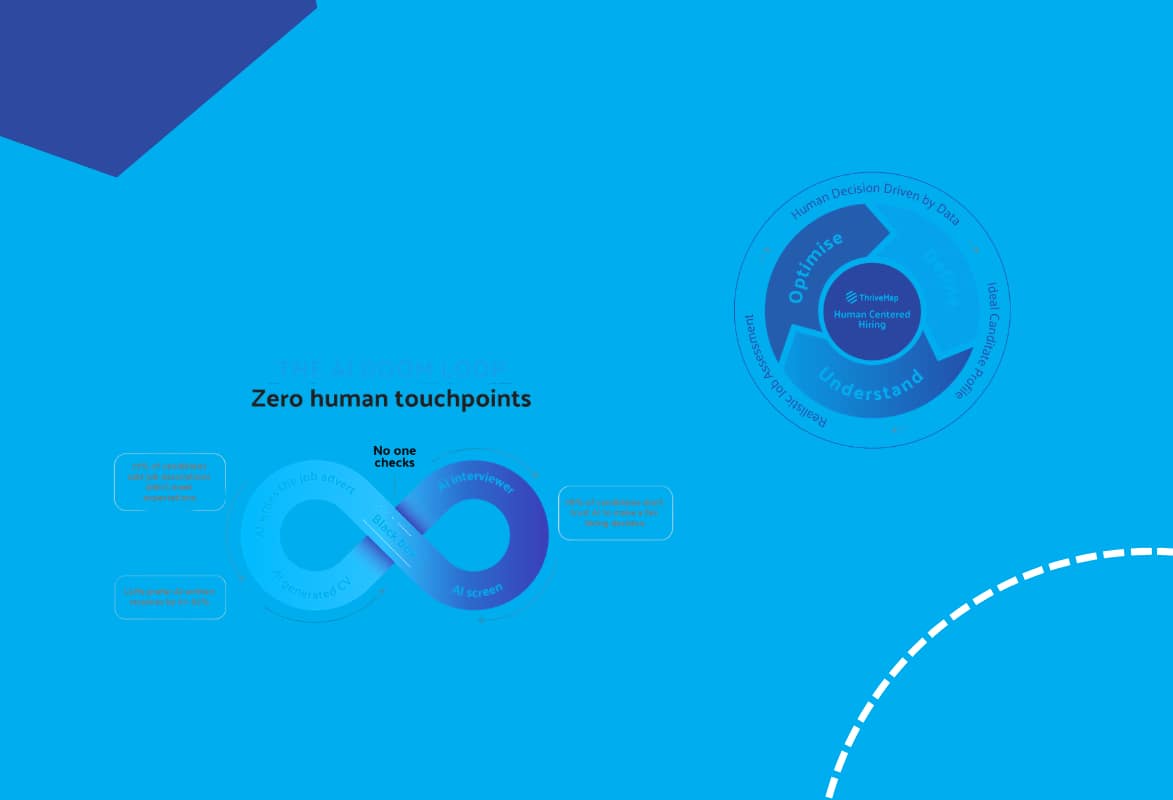
In this article, we break down what good pre hire assessment design actually looks like and how to get it right in practice. We cover the full process step by step, including: starting with proper job analysis, building an Ideal Candidate Profile, defining what good performance looks like, prioritising what to measure, involving the right stakeholders, designing realistic job tasks, ensuring fair and explainable scoring, keeping the candidate experience consistent, maintaining accessibility, validating against real hiring outcomes, and continuously reviewing and improving the assessment after launch.
1. Start with the job, not the test
The first question in any assessment project should not be, “Which test should we use?” It should be, “What does someone actually need to do well in this job?”
Too many assessment processes begin with a library of personality scales, cognitive tests, abstract exercises or generic competencies. The employer then tries to match those existing products to the vacancy. That approach may be commercially convenient, but it reverses the logic of good assessment design.
A strong assessment begins with structured job analysis. This means identifying the tasks people perform, the situations they regularly encounter, the decisions they make, the knowledge they use and the aspects of the working environment that influence whether they succeed or leave.
This information should be gathered from people who understand the role directly, including current employees, hiring managers, trainers, operational leaders and talent acquisition teams. No single stakeholder has a complete view of the job. Employees understand its daily realities, trainers see where new starters struggle and managers understand the performance standards the organisation needs.
We highly recommend trying our free Signal job analysis questionnaire tool. Role experts are asked what they do, which attributes they believe are required and which parts of the job they find challenging or rewarding. Those responses are then consolidated and discussed, rather than accepted as an unquestioned list of requirements.
The purpose of job analysis is to establish which capabilities are genuinely necessary and how those capabilities appear in practice.
That distinction is especially important because candidates do not trust every assessment method equally. When ThriveMap surveyed 1,000 UK frontline workers, 54% selected job relevant skills or work sample assessments as the most accurate way to choose candidates. Only 10% selected personality tests and 10% selected cognitive ability tests. Job relevant assessments were also considered the fairest option by the majority of workers.
2. Build an Ideal Candidate Profile
Once the job has been analysed, the next step is to define what the organisation is actually looking for.
At ThriveMap, this is captured in an Ideal Candidate Profile. It acts as the blueprint for the assessment by setting out the attributes that matter, how they are defined and how much weight each one should carry.
ThriveMap organises these attributes into three categories.
Capability asks whether the candidate can do the job. This includes the skills, behaviours and knowledge required to perform successfully and usually forms the scored core of the assessment.
Commitment asks whether the candidate understands and genuinely wants the role. Rather than relying on self reported motivation, which can be easy to exaggerate, this may be assessed through how well the candidate understands the organisation, responsibilities, hours or expectations.
Environment asks whether the candidate is likely to be comfortable with the realities of the workplace. This might include physical conditions, performance pressure, working patterns or customer demands. These factors are usually communicated and explored rather than treated as scored pass or fail criteria.
Keeping these categories separate matters. An assessment should distinguish between a candidate who lacks an essential capability and one who simply needs clearer information about the working environment. Treating both as the same type of “fit” creates unclear decisions and increases the risk that subjective preferences become selection criteria.
Vague competencies produce vague assessments.
Consider “communication skills”. Depending on the role, that could mean speaking confidently, listening carefully, explaining technical information, recording accurate notes, calming an unhappy customer or adapting language for different audiences. These are different capabilities and should not be treated as interchangeable.
Before creating questions, assessment designers need to define how each attribute appears in the role.
A weak definition might be:
Demonstrates good attention to detail.
A more useful definition would be:
Accurately records customer information, notices discrepancies and checks important details before submitting work.
The second definition provides observable evidence. It can be translated into a realistic task and scored against criteria that hiring managers can understand.
The same principle applies to qualities such as resilience, judgement, teamwork and problem solving. Each one must be converted from an abstract label into behaviour or performance that can be observed in the actual job.
This process creates a defensible line between the role, the question, the score and the hiring decision. Without that line, assessment design can quickly become an exercise in measuring attributes simply because they sound desirable.
4. Prioritise what genuinely matters
A good assessmentneeds to measure the most important attributes that can be assessed appropriately at that stage of recruitment.
Trying to cover 12 or 15 competencies often produces a longer but weaker assessment. Each attribute receives too little evidence, candidates are subjected to unnecessary repetition and the eventual scores become more difficult to interpret.
ThriveMap’s guidance typically recommends prioritising three to six capability attributes, one or two commitment attributes and one to three unscored environment attributes. Each attribute can then be weighted according to its importance in the role.
This is broadly reflected in the platform data. Across more than 200,000 assessment completions, the median ThriveMap assessment measured six attributes using 23.5 questions. This is a benchmark rather than a fixed rule, but it demonstrates the value of focus.
Assessment teams should therefore prioritise ruthlessly. Is the capability essential from the first day of employment? Could it reasonably be developed during training? Would poor performance create a meaningful safety, compliance, customer or operational risk? Is it already evaluated at another stage of the process? Can it be measured fairly online?
Some requirements may be better assessed through a structured interview, practical exercise or later stage selection activity. Others belong in onboarding rather than recruitment.
Assessment design is as much about deciding what not to test as deciding what to include.
5. Involve the people closest to the work
Assessment design should not be controlled by one hiring manager, one recruiter or an external provider working in isolation.
Each stakeholder sees a different part of the role. Current employees understand the daily reality. Trainers know where new starters struggle. Hiring managers understand performance expectations. Talent acquisition teams understand candidate behaviour and process constraints. Operational leaders understand business risk.
No single person should have authority to decide what to assess or how to assess it. The attributes should be discussed and agreed as a group, with ThriveMap contributing assessment design expertise and the employer contributing the reality of the work.
This does not mean every stakeholder suggestion should be accepted. People often recommend assessing qualities they personally value, even when those qualities are not essential to the role.
The purpose of the ThriveMap workshop is to examine the evidence, remove duplication, challenge assumptions and agree what genuinely matters. The job analysis remains the anchor.
This collaborative approach also improves adoption. Stakeholders are more likely to trust and use the assessment when they understand how it was built and have contributed to the decisions behind it.
6. Recreate meaningful parts of the work
Where possible, candidates should be asked to perform tasks or make decisions that resemble the work they are applying to do.
For a contact centre role, that could mean interpreting customer information and choosing an appropriate response. For a warehouse position, it might involve spotting damaged items, following a picking instruction or prioritising an urgent request. For an administrative role, it could involve entering data accurately, checking a document or deciding which task to complete first.
The closer the exercise is to meaningful work, the easier it becomes to explain why the candidate is being assessed on it.
This does not mean every organisation needs expensive virtual reality, elaborate animation or a gamified interface. Realism comes from the context, evidence and decision being tested, not the amount of decorative technology surrounding it.
A Realistic Job Assessment may use short scenarios, images, documents, audio, written responses or data entry tasks. Some capabilities may still require a more abstract format, but even then the question should be framed within the context of a genuine task wherever possible. Behavioural attributes may suit situational questions, skills may suit practical tasks and knowledge may require a different format.
The current market remains inconsistent on this point. Although 82% of talent acquisition leaders told ThriveMap that they use job relevant skills or work sample assessments somewhere in their process, 64% use cognitive tests and 56% still rely on personality tests. Only 10% of candidates considered either of those methods the most accurate.
That does not mean cognitive or personality measures can never contribute useful evidence. It does mean employers should be cautious about allowing them to become the primary signal when more direct evidence of job capability is available.
7. Give candidates an honest view of the role
Candidates are also making a decision. They need enough information to judge whether the work, schedule, pressure and environment are right for them.
ThriveMap’s candidate research found that 72% of UK frontline workers had accepted a job that was misrepresented during hiring. Of those, 60% left earlier than they had planned.
When asked what would have helped them understand the role, 48% wanted more honest information about the workload, pressure or environment. Thirty one per cent wanted clearer information about pay, hours and expectations, while 29% wanted either direct insight from existing employees or a day in the life preview.
A well designed assessment should therefore communicate the realities of the role as well as measuring capability. This might include shift patterns, physical requirements, repetitive work, difficult customer interactions, performance targets, travel expectations or limited flexibility at particular times.
Commitment should also be assessed carefully. Simply asking candidates how motivated they feel is unlikely to provide reliable evidence. A better signal may be whether they understand the hours, responsibilities and expectations well enough to make an informed application.
Presenting these realities may cause some candidates to withdraw. That should not automatically be treated as assessment failure.
ThriveMap’s analysis of more than 200,000 completions found that the largest candidate drop occurred during the first quarter of the assessment. Once candidates passed that point, 96% completed the process.
Some of that early withdrawal is likely to reflect informed self selection, particularly where the opening section communicates important realities of the role. It should therefore be investigated rather than automatically treated as a candidate experience problem.
Losing a candidate after ten minutes because they recognise the role is unsuitable is usually preferable to losing a new employee during their first three months.
8. Use scoring criteria that can be explained
A well designed assessment should make it possible to answer a simple question: why did this candidate receive this score?
Scoring rules should be established before candidates complete the assessment. The strongest answer should reflect effective performance in the job, not merely the personal preference of one hiring manager.
For situational questions, this may require subject matter experts to agree which responses are more or less effective and why. For practical exercises, the assessment may measure accuracy, completeness, prioritisation, quality or the identification of a critical risk.
Speed should only influence the result when speed genuinely matters in the role. A time limit should not be added simply because the platform supports one. Otherwise, the assessment risks measuring reading pace, familiarity with online tests or response to pressure rather than the capability it claims to evaluate.
Weightings should also reflect the consequences of poor performance. A minor administrative error should not receive the same weighting as a decision that would create a serious safety, regulatory or customer risk.
Employers should be able to explain what evidence contributed to a candidate’s result and why that evidence was relevant to the job. If they cannot, the assessment will be difficult to defend to candidates, internal stakeholders or regulators.
9. Keep the candidate experience consistent
Candidates applying for the same role need a comparable opportunity to demonstrate their ability.
That means they should receive equivalent instructions, comparable questions, consistent time expectations, the same scoring criteria and clearly defined progression rules. Consistency reduces the influence of recruiter instinct, shifting manager expectations and subjective impressions.
This does not necessarily mean every candidate must see identical content. Equivalent question variants may improve assessment security and reduce the value of sharing answers. However, the underlying capability, difficulty and scoring model should remain comparable.
10. Keep assessments focused and proportionate
Longer assessments are not automatically more robust.
Across ThriveMap’s 2025 platform data, the average assessment completion time was 25.5 minutes, although this varied considerably between industries. Transport assessments averaged 19.2 minutes, while real estate assessments averaged 34.9 minutes. Customer service assessments had the highest dropout rate by role type and also had the longest average assessment time, at 33.3 minutes.
This does not prove that length alone caused candidates to leave. More demanding roles, candidate expectations and realistic self selection may also contribute. However, when completion falls below expectations, assessment length should be one of the first factors reviewed.
Every question should earn its place. It should provide distinct evidence, communicate something meaningful about the role or support a necessary hiring decision. Questions that duplicate evidence, test trivial knowledge or exist because they were available in a content library should be removed.
The objective is not to create the shortest possible assessment. It is to create the shortest assessment capable of generating sufficient, reliable evidence.
11. Build accessibility into the original design
Designers need to consider whether question formats, instructions, media and timing create barriers that are unrelated to successful job performance. Does a timed exercise measure necessary speed or simply reading pace? Is essential information available only through audio? Can the assessment be completed with common assistive technologies? Is the language more complex than the role requires?
Candidates should also be told clearly what the assessment involves and how to request reasonable adjustments. An adjustment should remove an irrelevant barrier without changing the capability being assessed.
This requires more than offering additional time by default. Extra time does not resolve an inaccessible interface, unclear wording or a question format that measures a disability related characteristic rather than job performance.
Good accessibility design usually improves the experience for everyone. Clear instructions, uncluttered layouts, relevant language and flexible ways to access information make assessments easier to understand without lowering the standard required.
12. Test for fairness at role level
An assessment can appear acceptable overall while producing problematic results for a particular role, location or candidate group.
Employers should therefore analyse completion rates, score distributions, progression rates, withdrawal patterns, adjustment requests and adverse impact wherever the available data allows it.
This work should happen at the level at which decisions are made. Pooling results from unrelated jobs can hide problems within a particular assessment. A method that performs adequately for warehouse applicants may function very differently when used for customer service, engineering or administrative roles.
Fairness is also not a one off exercise completed at launch. Jobs change, applicant populations shift and candidates become more familiar with common assessment formats. New technology may also alter the way questions are completed.
Assessment data must therefore be monitored over time. Where a particular group is being disproportionately excluded, the employer should examine whether the requirement is essential, whether the question is measuring it appropriately and whether another method could generate the same evidence with fewer irrelevant barriers.
Fairness needs to be demonstrated through data. It cannot be established through a general assurance from the assessment provider.
13. Keep humans meaningfully involved
Assessment scores should inform recruitment decisions rather than replace them entirely.
The answer is not to ignore useful technology. Structured assessment can reduce inconsistency, process large applicant volumes and provide evidence that a human reviewer may otherwise miss.
However, automation does not remove accountability. Employers still need to understand what the assessment measures, how scores are produced, where errors may occur and when human review is required.
A hiring manager should not override assessment evidence merely because they liked a candidate. Equally, an organisation should not reject a candidate solely because an unexplained model generated a low score.
The strongest processes combine structured evidence with informed and accountable human judgement.
14. Review the assessment before launch
Once the Ideal Candidate Profile has been agreed, the assessment should be drafted and reviewed by the people who helped shape it.
ThriveMap recommends sharing the draft with the original stakeholder group so they can test whether the questions feel realistic, whether the instructions are clear and whether the scoring reflects effective performance. This review also helps build confidence in the final assessment before it is introduced to hiring teams.
This stage should be more than a copy check. Reviewers should challenge whether every question maps clearly to an agreed attribute, whether the scenario reflects the actual job and whether a person outside the original workshop could understand what is being assessed.
The Ideal Candidate Profile should remain the reference point. If a question cannot be traced back to an agreed attribute or job requirement, it should be questioned.
15. Validate the assessment against meaningful outcomes
A candidate score only becomes useful when it can be connected to an outcome the organisation values.
That might include training performance, probation outcomes, productivity, customer satisfaction, safety incidents, quality measures, sales results or new hire retention. The correct measure will depend on the job and on the reason the assessment was introduced.
16. Continue reviewing the assessment after launch
Assessment launch should be treated as the beginning of the evaluation process rather than the end of the design project.
Employers should review where candidates leave, which questions provide useful differentiation, whether scores relate to subsequent performance and whether hiring managers are using the results consistently.
Candidate feedback can also reveal issues that performance data alone may not show. Instructions may be unclear, the technology may behave differently on mobile devices or a scenario may feel unrealistic to people who have actually done the job.
Assessment teams should be prepared to remove weak questions, change weightings, update scenarios and revise role information as the work changes.
An assessment that remains untouched for several years is unlikely to stay aligned with the role, even if it was well designed initially.
What good pre hire assessment design looks like
A strong assessment has a clear line running through it: the work people do, the attributes required to do it, the evidence candidates are asked to provide, the way that evidence is scored and the hiring outcome the organisation wants to improve.
Break that line and the assessment becomes harder to interpret, validate and justify.
This is why assessment design cannot begin with a catalogue of tests, a generic competency framework or a fashionable technology. It has to begin with the job and with evidence from the people who understand it.
The best pre hire assessments do more than rank applicants. They help employers identify capability, give candidates an honest view of the role and produce hiring decisions that can be explained using relevant evidence.
That is what turns an online test into a useful selection tool.
How ThriveMap designs Realistic Job Assessments
ThriveMap creates Realistic Job Assessments for entry level, high volume hiring.
The process begins with structured job analysis through Signal, followed by a facilitated workshop involving the people who understand the role. Together, they agree an Ideal Candidate Profile covering capability, commitment and environment, prioritise the attributes that matter most and define how they appear in practice.
ThriveMap’s Assessment Design Experts then translate those attributes into realistic tasks and scenarios, with score weightings agreed according to their importance. The draft is reviewed by the original stakeholder group before launch to ensure it is accurate, clear and recognisable as the real job.
ThriveMap also recommends agreeing clear measures of success, such as probation performance, early retention, interview efficiency and time to offer, so the organisation can evaluate whether the assessment improves hiring outcomes.
The goal is not simply to predict who can pass an online test. It is to understand who can perform the work, who understands its realities and who is more likely to succeed once hired.
Book a ThriveMap demo