
When organisations look for pre-hire assessment tools, SHL and ThriveMap often appear on the shortlist. Both help employers make better hiring decisions, but they take very different approaches.
SHL is one of the longest-standing providers of psychometric testing, with a global reputation and vast library of tests. ThriveMap, by contrast, is a newer entrant focused on job simulation tests – assessments that take candidates through a realistic “day in the life” of the job.
| Feature | ThriveMap | SHL |
|---|---|---|
| Assessment type | Job simulations and realistic role-based tasks | Psychometric, personality, cognitive, SJTs |
| Best for | Entry-level and frontline hiring | Professional and executive hiring |
| Candidate experience | Immersive, mobile-first, engaging; encourages candidate self-selection | Multiple lengthy tests, abstract questions |
| Customisation | Fully bespoke; client defines hiring attributes | Mostly off-the-shelf, customisation is limited |
| Scoring | Percentage fit (0–100%), benchmarked against actual applicant pool | Norm group comparison (generic, not role-specific) |
| Validation | Ecological validity (direct link to job tasks) | Psychometric validity (trait-based, cross-context) |
| Reporting | Detailed candidate reports, dropout/withdrawal insights | Standardised psychometric reporting |
| Pricing model | Annual subscription, unlimited use for defined roles | Credit-based, per-test pricing |
| Optimisation | Ongoing collaboration to refine and adapt assessment as your needs evolve | Limited ongoing support, focus on standardised tools |
SHL is one of the largest and most established names in the assessment space. Founded in 1977, SHL has grown into a global company with clients in more than 150 countries. Their platform offers a wide test library, covering areas such as:
These tests are generally designed to measure abstract traits such as numerical reasoning, verbal ability, or personality dimensions, and then compare candidates against large, pre-validated norm groups.
This approach works well for organisations that want to understand how a candidate compares to a broad population. SHL is widely used in executive search, graduate schemes, and professional-level hiring.
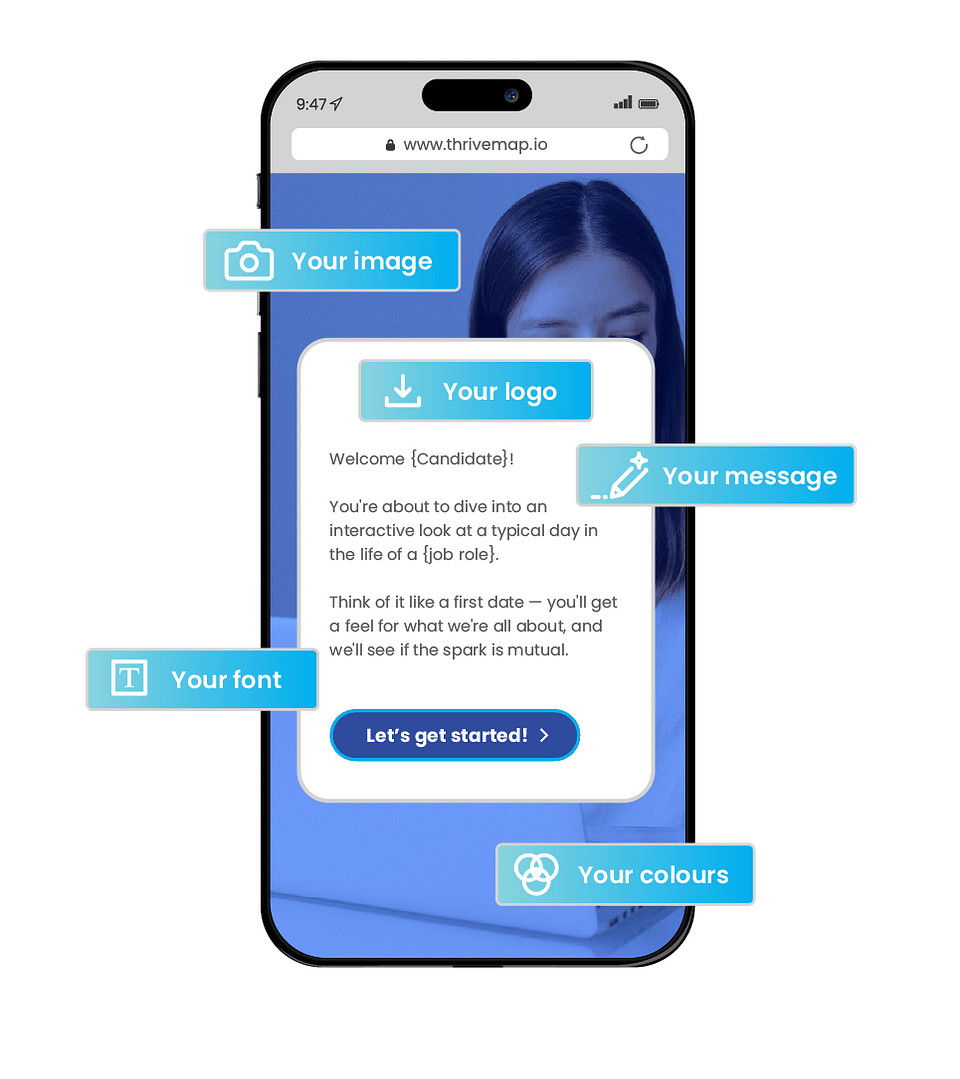
ThriveMap is a new-generation assessment provider focused solely on Realistic Job Assessments. Instead of abstract psychometrics, ThriveMap builds simulations that mirror the actual role.
How it works:
📊 Each candidate receives a score from 0–100%, with clear grading from Excellent to Below Average.
👥 Candidates are benchmarked against the real applicant pool, not an abstract norm group.
🏢 Assessments double as realistic job previews: candidates learn about the role and environment, and can self-select out if it’s not right for them.
This approach combines assessment with self-selection, reducing the risk of early attrition. In fact, ThriveMap data shows that 55% of entry-level hires leave jobs within the first year because the reality doesn’t match expectations. By giving candidates a realistic preview, ThriveMap helps reduce these costly mismatches.
Tests abstract traits (personality, cognitive, reasoning). Good for broad comparisons, but less tied to specific job tasks.
Simulates the actual job, giving a clearer line of sight to role performance—especially for frontline & entry-level positions.
Longer test batteries, multiple-choice focus; can feel repetitive and fatiguing, with limited insight into the day-to-day job.
Mobile-first simulations that feel like the job. Candidates self-select out earlier, improving experience & protecting your brand.
Some bespoke SJTs available, but most organisations rely on off-the-shelf content with slower turnaround.
Fully bespoke: you define attributes, scenarios, branding, and length. Built around the realities of your roles.
Benchmarks against generic norm groups; insights may be less role-specific and harder to action for hiring teams.
0–100% fit against job-specific attributes, benchmarked on your actual applicant pool. Reports include dropout & withdrawal insights.
Emphasises psychometric validity; generic questions across contexts can raise fairness concerns for specific roles.
Ecological validity: assessment content mirrors real tasks, reducing legal risk by tightly linking what’s assessed to the job.
Credit-based, pay-per-test. Different tests consume different credits, making budgeting and scaling harder.
Annual subscription by hiring volume for specific roles; unlimited candidate usage. Simpler to plan, ideal for high-volume hiring.


A global logistics company previously relied on SHL’s generic assessments to screen candidates for frontline roles. However, the tests didn’t reflect the actual work environment, and early attrition remained high.
After switching to ThriveMap’s Realistic Job Assessments, candidates experienced a day-in-the-life simulation of the role before being shortlisted. This helped unsuitable candidates self-select out and gave hiring managers clearer insights into candidate fit.
Both SHL and ThriveMap are respected assessment providers, but they serve different purposes.
👉 Book a demo with ThriveMap to see how job simulation assessments could transform your hiring process.

