Is your pre-hire assessment predictive of performance?
4 minute read
Posted by Emily Hill on 14 July 2025
Most hiring assessments claim to be science-backed. But how many truly predict performance?
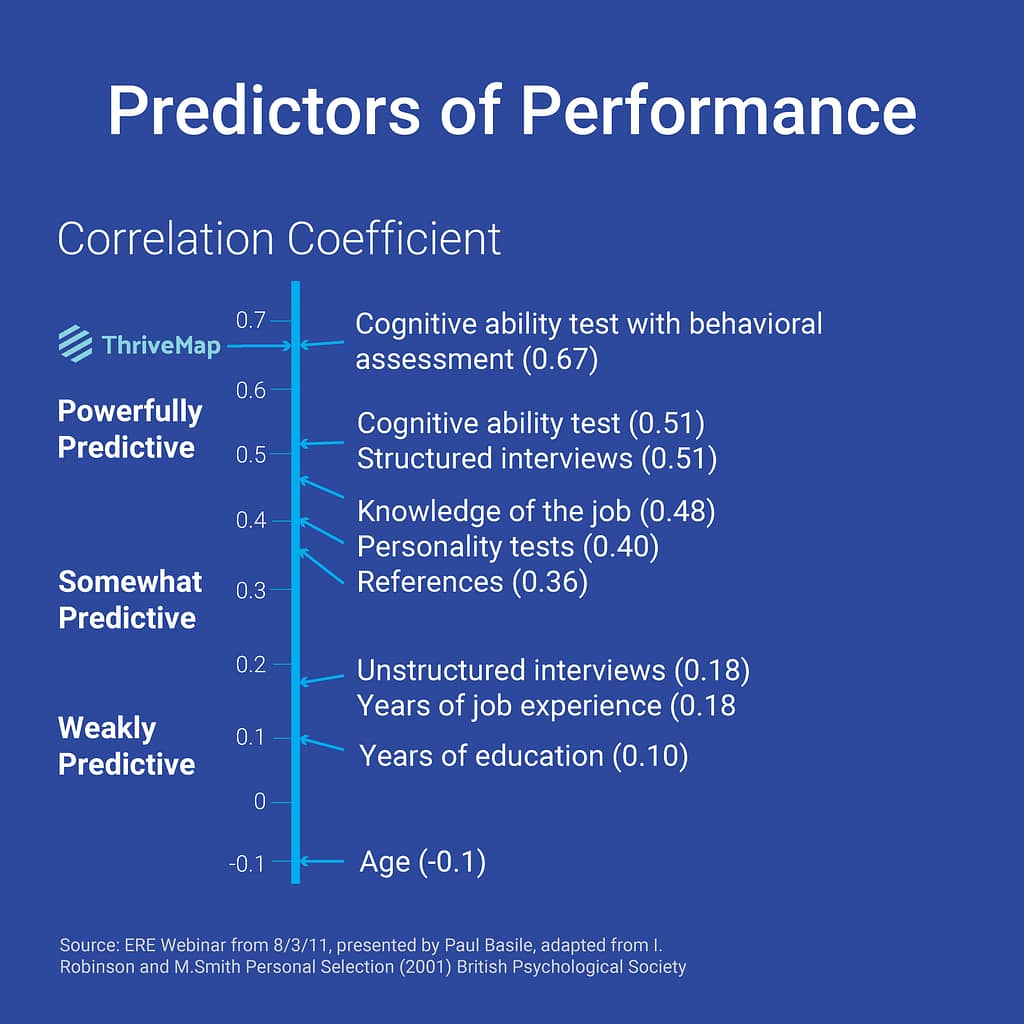
From personality profiles to gamified puzzles, pre-hire assessments have exploded in popularity. But for all the bells and buzzwords, most have a fundamental problem: they aren’t actually predictive of on-the-job performance. And if they’re not measuring what success looks like in your organisation, they’re not helping you hire the right people.
At ThriveMap, we take a different approach—one built around job reality, not guesswork. Our Realistic Job Assessments (RJAs) simulate what the role actually involves. They’re built with your people, tested against real-world outcomes, and constantly refined over time.
“It’s easy to mistake complexity for value when it comes to assessments,” says Chris Platts, Managing Director at ThriveMap. “But predictive power doesn’t come from how abstract the test is—it comes from how well it mirrors the job.”
Here’s what that looks like in practice—and why it matters if you care about hiring accuracy.
What makes an assessment predictive?
A predictive assessment does one thing really well: it helps you choose the candidate who’s most likely to succeed in the role.
That means it must be:
Job-relevant
Context-specific
Validated against real outcomes
Adaptable over time
Let’s break down what most assessments get wrong—and why ThriveMap gets it right.
1. Job relevance: tasks that actually matter
Most assessments: Rely on generic traits like conscientiousness or abstract reasoning ThriveMap: Simulates tasks candidates will actually do in the role
If your customer service rep will never solve logic puzzles at speed, why test for that? ThriveMap assessments ask candidates to complete real-world scenarios—writing emails, prioritising requests, or managing difficult situations—based on actual job analysis.
That means you’re not just testing if someone might be a fit. You’re seeing how they’ll perform in context.
2. Context alignment: built for your culture
Most assessments: One-size-fits-all content with no link to your environment ThriveMap: Tailored to your team, tone, and tools
Even a well-designed task loses predictive power if it’s not grounded in your reality. ThriveMap’s assessments are custom-built to reflect how your organisation actually works—from tech stack to team structure to communication style.
“Hiring for culture add, not just culture fit, means showing candidates the real context they’d be working in,” says Platts. “That’s what RJAs do.”
3. Predictive validation: refined by outcomes
Most assessments: Go live and stay static ThriveMap: Continuously updated using post-hire data
Most assessment vendors walk away after launch. We don’t. ThriveMap assessments are treated as live products—linked to performance data from your hires so we can identify which tasks best predict success. Then we refine them.
The result? An assessment that gets smarter—and more predictive—the longer you use it.
4. Adaptability: built to evolve
Most assessments: Stay the same as your roles change ThriveMap: Evolves with your hiring needs
Your business isn’t static. Neither is your team. Whether you’re rolling out new workflows, adapting to new customer expectations, or redefining performance metrics, we evolve your assessment alongside your roles.
You don’t just get a product—you get a partner in hiring accuracy.
Why this matters
Entry-level recruitment is about making critical decisions that affect your team, your culture, and your bottom line. If your pre-hire assessments aren’t giving you clear, job-relevant signals, they’re not just useless—they’re risky.
Realistic Job Assessments give you the confidence that those who perform well pre-hire will thrive post-hire.
They’re not just valid once. They stay valid—because they stay real.
“We don’t believe in generic hiring tools,” says Platts. “We believe in assessments that reflect your world, your challenges, and your version of success.”
👇 Want to see what a predictive hiring assessment really looks like?
Discover how Realistic Job Assessments improve your entry-level recruitment process.
Get started herewith a demo or try our Smart Assessment Builder tool.
Share
The ThriveMap Newsroom
Subscribe for insights, debunks and what amounts to a free, up-to-date recruitment toolkit.
About ThriveMap
ThriveMap creates customised assessments for high volume roles, which take candidates through an online “day in the life” experience of work in your company. Our assessments have been proven to reduce staff turnover, reduce time to hire, and improve quality of hire.
Not sure what type of assessment is right for your business? Read our guide.
Other articles you might be interested in
The State of the Assessment Market Report 2026: Now Live
As the new UK National Hiring Strategy highlights, poor hiring decisions come at a significant cost. The strategy estimates that poor hiring decisions cost the UK economy £14.4 billion each year. Unemployment drains a further £61 billion, while inefficient recruitment processes and unfilled vacancies add nearly £150 million more. But the challenge facing employers isn’t […]
How Berkeley achieved 100% graduate retention by optimising their pre-hire assessment
Most hiring teams optimise for speed. Time to hire.Application conversion.Assessment completion rates.Offer acceptance. These metrics are easy to measure and easy to improve. They also tell us very little about whether hiring actually worked. The real test of hiring success happens months later, when new employees decide whether to stay. Across early careers hiring, this […]
Pre-hire assessment completion rates & candidate drop-off by industry
What 200,000+ candidate journeys reveal about how hiring performance changes across sectors Why do candidates complete nearly every assessment in some industries — but never even start them in others? At first glance, the explanation seems obvious. Different sectors have different candidates, different expectations, or different hiring challenges. But analysis of more than 200,000 pre-hire […]