Recruitment Assessment Tools: The Complete 2026 Guide (Based on Real Data)
14 minute read
Posted by Emily Hill on 9 June 2026
Recruitment assessment tools are software platforms that help organisations evaluate candidates before hire. They range from cognitive ability tests and skills assessments to video interviews, situational judgement tests and realistic job simulations, and choosing the wrong one for your hiring objective is a costly mistake.
So what actually makes a recruitment assessment tool effective? We’ve analysed 200,000+ candidate journeys and surveyed 1,000+ candidates and 200 talent acquisition teams to find out, and the answers are not what most vendors will tell you.
If you’re evaluating recruitment assessment tools, there’s a good chance you’ve already tried one that didn’t deliver. Perhaps it sped up screening but had little impact on retention. Perhaps there was plenty of data, but nothing you could act on. Or perhaps the candidates who looked great on paper left within months anyway.
So you switched tools. Or added another one. And the problem persisted.
That’s because most recruitment assessment tools treat the symptoms rather than the cause. They optimise for screening efficiency, test completion or candidate scoring – without ever addressing why the wrong people are getting through, or why the right people are leaving.
Most guides on this topic are written by companies trying to sell you the same solutions all over again – just different logos. This one is different. Rather than recycling vendor descriptions, we’ve built it from the ground up using primary research, analysing more than 200,000 candidate assessment journeys, surveying 1,000+ candidates on what recruitment processes get wrong, and interviewing 200 talent acquisition teams across sectors ranging from apprenticeships and public services to engineering, sales and customer service.
The result is an independent view of what actually works. Not in theory, in practice, across organisations with genuinely different hiring challenges. Whether you’re trying to reduce early attrition, improve quality of hire, give recruiters more actionable intelligence, or identify candidates who will genuinely succeed long term, this guide will help you understand which approach is most likely to solve the specific problem you’re facing, rather than just adding another tool to the stack.
What most recruitment assessment guides get wrong
Before comparing platforms, it’s worth naming the flaw in most vendor-written roundups. They evaluate tools by features. Test library size. ATS integrations. AI capabilities. Pricing tiers.
None of those things tell you whether an assessment will improve your hiring outcomes.
The right question is not “which tool has the most features?” It’s “which approach is most likely to solve my specific problem?” That requires starting with the outcome you want, not the tool you’re considering.
Start here: Define your hiring objective
The most common mistake organisations make is selecting an assessment platform before defining what they’re actually trying to fix.
The challenge is that most hiring problems are connected. High recruiter workload can often be a symptom of high attrition. If you’re constantly refilling the same roles, no amount of screening automation will solve the underlying problem. Poor quality of hire and weak candidate experience frequently share the same root cause: candidates entering roles with unrealistic expectations of what the job actually involves.
That’s why the starting point matters so much. The right question is not “which tool has the best features?” It’s “what is actually driving our hiring problem, and which approach addresses that cause, not just the symptom?”
The most common objectives and what they actually require:
Reduce early attrition. The cause is almost always expectation mismatch. Candidates need a realistic understanding of the role before they accept an offer. Realistic job assessments are the only category specifically designed to solve this.
Improve quality of hire. Requires better signal on both capability and fit. Realistic job assessments, structured assessments and role-specific simulations all contribute here.
Reduce recruiter workload. Async video and AI screening reduce time spent on first-stage screening. But if workload is driven by constant rehiring, addressing attrition at source will have a greater long-term impact than adding screening automation.
Verify technical skills. Requires validated, role-specific measurement. Coding tests and technical assessments are purpose-built for this.
Improve candidate experience. Candidates consistently ask for relevance, transparency and realism. Assessments that help candidates understand the role, not just evaluate them, score significantly higher on experience measures.
Increase hiring manager confidence. Structured assessments with consistent scoring give hiring managers comparable data rather than gut feel.
The clearer your objective, the easier it becomes to identify which approach is genuinely relevant and which vendor claims deserve scrutiny.valuate which tool category is relevant and which vendor claims deserve scrutiny.
What 1,000 candidates told us
The recruitment industry often assumes candidates want shorter applications, fewer assessments and less friction. Our research suggests the reality is more nuanced.
We surveyed more than 1,000 candidates about what recruitment processes could do better to help people end up in the right job.
Candidates did not ask for faster screening. They did not ask for shorter tests. They asked for honesty.
The most common themes:
Greater transparency about what the role actually involves day-to-day
Clearer expectations about performance targets, work environment and team dynamics
Job realism – what success and difficulty look like in the role
One candidate summarised it directly:
“Focus on realistic job previews and day-in-the-life simulations rather than just interviews.”
Another said:
“Provide clearer information about day-to-day responsibilities so candidates know what the role is really like.”
Perhaps the most revealing response:
“The biggest problem is that you won’t truly know if the job is right for you unless you actually try it.”
The implication matters enormously for how you think about assessment.
Candidates are not just asking to be evaluated. They are asking to be informed. They want recruitment processes that help them evaluate the role, not just processes that evaluate them.
Most assessment tools are designed entirely for the second purpose. The first is largely ignored. That gap is why expectation mismatch and early attrition remain so persistent even when organisations invest heavily in assessments.
What do hiring teams want from assessment tools? 200 TA teams share their insights
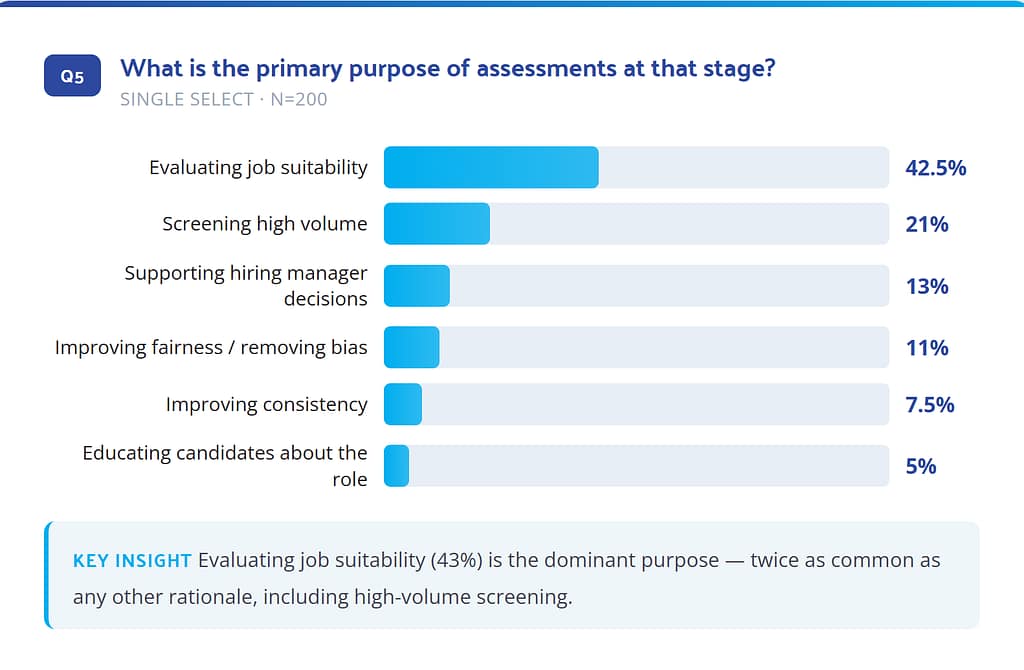
Our State of the Assessment Market research found that quality of hire remains the number one objective for talent acquisition leaders. Retention, recruiter efficiency, hiring manager satisfaction and candidate experience also featured prominently.
What is increasingly clear, however, is that these objectives are connected in ways many organisations underestimate.
Poor hiring outcomes are rarely caused by a lack of candidate capability alone. More often, they occur because candidates enter roles with unrealistic expectations or a limited understanding of what the role actually involves.
This is where traditional assessment approaches consistently fall short.
The majority of assessments focus on predicting whether somebody can do the job. Very few focus on helping candidates understand whether they genuinely want the job.
The distinction matters because long-term hiring success depends on both.
What 200,000 candidate journeys reveal about assessment design
Survey responses tell us what candidates say they want. Behavioural data tells us what actually happens.
Across more than 200,000 assessment journeys, we found several patterns that challenge the conventional wisdom about assessment design.
The drop-off myth
The most widely repeated assumption in recruitment assessment is that candidate drop-off is caused by length. Shorten the assessment, and more people will complete it. Our data tells a different story.
The largest drop-off occurs at the very beginning of the assessment experience, not during it.
Once candidates successfully complete the first section, the overwhelming majority continue through to completion. The problem is not length. The problem is the initial impression: does this feel relevant, worthwhile, and connected to the reality of the job?
Candidates are willing to invest time in assessments when they feel the process is helping them understand the role and demonstrate their genuine suitability. They abandon assessments that feel generic, repetitive, or disconnected from the job they’re applying for.
What recruitment assessments look like: benchmark
Median assessment: 23.5 questions, six attributes assessed
Most common question format: multiple choice (approximately half of all assessment content)
Other formats: checklist, narrative, and ranking exercises
Completion pattern: front-loaded drop-off, high completion once started
The design implication
This has a direct consequence for organisations considering switching assessment providers. If your completion rates are low, the problem is almost certainly not that the assessment is too long. It is that the opening experience does not convince candidates the process is worth their time.
The best assessment providers continuously analyse completion data, candidate feedback and hiring outcomes to improve performance over time. Many providers treat implementation as the finish line. The strongest ones treat it as the starting point.
The most important distinction in assessment: job relevance vs job realism
This is the concept most assessment vendors do not want to talk about, because most of them have not solved it.
Job relevance means the assessment measures something related to the job. A customer service assessment asking candidates how they would handle a difficult customer is job relevant.
Job realism means the assessment shows candidates what the job is actually like. A simulation that puts candidates inside the real environment with queue lengths, performance targets, competing priorities, frustrated customer, is job realistic.
Both have value. But they serve different purposes.
Job-relevant assessments help you assess whether a candidate can do the job.
Job-realistic assessments help candidates assess whether they want to do the job — and help employers identify candidates whose expectations match reality.
This distinction explains one of the most persistent failures in recruitment: organisations hire capable people who leave within months because the role was not what they expected. The assessment told the employer the candidate could do the job. It told the candidate nothing about whether they would want to.
Our candidate research makes this gap plain. Respondents repeatedly asked for realistic job previews, day-in-the-life experiences, work samples and honest depictions of what challenges look like — not just what success looks like.
That insight sits at the heart of realistic job assessments, and it’s why organisations using this approach see meaningfully different retention outcomes than those using capability-only screening.
The five characteristics of the strongest assessment platforms
Across our work with hundreds of hiring teams, the platforms that consistently improve hiring outcomes share five characteristics.
1. Built around clearly defined hiring objectives Not generic competency frameworks. Not “best practice” templates. Assessments designed specifically around what success looks like in a particular role, in a particular environment.
2. Measure behaviour, not just self-report Self-reported responses (how would you handle this situation?) have limited predictive validity. Assessments that put candidates in realistic scenarios and observe how they behave produce better signal.
3. Help candidates understand the realities of the role Not just measure capability. Assessments that help candidates self-select in or out based on genuine understanding of the role reduce expectation mismatch and improve long-term fit.
4. Support long-term outcomes, not just application filtering The question is not just “does this candidate make it through screening?” It is “does this candidate stay, perform and thrive twelve months from now?” Assessments should be evaluated on retention and quality of hire data, not just completion rates.
5. Improve over time Hiring markets change. Candidate expectations evolve. Roles develop. Assessment strategies built once and left unchanged degrade in quality. The strongest vendors continuously refine assessments based on completion data, hiring outcomes and candidate feedback.
Recruitment assessment tools reviewed by use case
Best for realistic job assessments and retention: ThriveMap
What it does: ThriveMap builds realistic job assessments grounded in detailed job analysis. Candidates experience the actual realities of a role, its environment, its demands, its challenges, before they’re hired. This creates two outcomes simultaneously: employers identify candidates whose expectations match what the job actually involves, and candidates make better-informed decisions about whether the role is right for them.
The evidence: Outcomes achieved by ThriveMap customers include:
Apprentices at Berkeley were approximately twice as likely to remain after 12 months
Up to 40% reduction in early attrition at Mitie
$1.1 million in annual attrition savings at Safelite
96% reduction in time to offer at Wincanton
Lauren Turner, Senior Manager of Talent Acquisition at ArcBest, described the impact directly:
“Before ThriveMap, our recruiters were spending a significant amount of time on traditional phone screens that only scratched the surface. ThriveMap changed that by offering assessments that provide a crystal-clear understanding of what the job actually entails, making it much easier to gauge true fit and commitment.”
Where it wins: Organisations where early attrition, expectation mismatch and quality of hire are the primary challenges. No other category of assessment tool is designed specifically to solve this problem.
Best for: Retention-focused hiring, realistic job previews, long-term fit, high-volume roles with significant attrition risk.
Best for live coding interviews: Codility
What it does: Live coding interviews and take-home technical assessments with a polished in-browser IDE, structured scoring and session replay.
Where it wins: Best-in-class live coding experience for real-time technical interviews.
Where it falls short: Higher price point. Better suited to teams hiring engineers regularly than organisations with occasional technical roles.
Best for: Engineering teams that conduct live technical interviews.
Best for leadership and executive assessment: SHL
What it does: Leadership assessments, executive assessment centres, psychometric testing, succession planning and leadership potential evaluation for senior and executive hires.
Where it wins: One of the most established providers in leadership assessment. Strong benchmarking data, validated psychometrics and enterprise-grade assessment frameworks make it a popular choice for large organisations hiring senior leaders.
Where it falls short: More focused on measuring leadership traits, behaviours and potential than helping candidates understand the reality of the role. The assessment experience can also feel more formal and less job-specific than simulation-based approaches.
Best for: Enterprise organisations hiring senior leaders, directors and executives who want robust psychometric data and leadership benchmarking.
How to evaluate any assessment vendor: The questions that matter
Most vendor demos are designed to show best-case scenarios. These questions surface what you actually need to know.
Questions about what the tool measures
What specific dimensions does the assessment evaluate? Vague answers like “job fit” or “potential” are not sufficient.
Is this a validated instrument with published reliability data, or a proprietary tool? Both can be useful, but they carry different weight and different obligations.
What evidence do you have that this assessment predicts the outcomes we care about — specifically retention and quality of hire, not just screening efficiency?
Questions about candidate experience
Walk me through the assessment on a mobile device. How long does it take? What does the first screen look like?
What are your average completion rates? How do you explain drop-off when it occurs?
How does the assessment help candidates understand the role — not just demonstrate their capability?
Questions about outcomes over time
What data do you have on 12-month retention for candidates who pass your assessment versus those who don’t?
How do you improve assessments after implementation? What does ongoing optimisation look like?
Can you show me before-and-after data from an organisation similar to ours?
Questions about integration and compliance
How do assessment results appear in our ATS — structured fields or a pasted note?
What candidate data do you collect, how long is it retained, and what happens to it when we cancel?
What is your approach to adverse impact monitoring?
Final thoughts
For years, recruitment teams have been told to optimise for speed, and more recently, for quality of hire.
Both matter. Neither tells the full story.
The most qualified candidate is not always the best hire. The strongest CV does not automatically translate into long-term success. The fastest hiring process is not necessarily the most effective one.
The organisations achieving the strongest hiring outcomes are increasingly focused on a different question: how do we identify candidates who can do the job, understand the realities of the role, and still want to be there six months later?
That is why assessment strategies are shifting away from abstract measures of potential and towards more realistic, evidence-based approaches.
If you are evaluating recruitment assessment tools, do not just ask how well they predict performance on day one. Ask how they improve retention, reduce expectation mismatch and help candidates make better-informed decisions about whether the role is genuinely right for them.
In our experience, the closer an assessment gets to the reality of the job itself, the more likely it is to improve the outcomes that actually matter.
This guide is produced by ThriveMap, based on analysis of 200,000+ candidate assessment journeys, a survey of 1,000+ candidates, and survey of hundreds of hiring teams across apprenticeship, frontline, professional and technical hiring.
FAQs
What are recruitment assessment tools?
Recruitment assessment tools are platforms that evaluate candidates before hire using structured, repeatable methods, cognitive tests, skills assessments, situational judgement tests, async video interviews, realistic job simulations, or combinations of these. They replace or supplement unstructured screening methods like CV review and phone screens with more consistent, comparable evaluation.
The category has fragmented significantly in recent years. There are now specialist tools for technical hiring, high-volume frontline roles, behavioural profiling, async video screening and realistic job assessment. Choosing the right one requires starting with your hiring objective, not the tool’s feature list.
What is the difference between a talent assessment and a realistic job assessment?
Most talent assessments are designed around one question: is this candidate right for the job? They measure traits, aptitude, personality or capability and attempt to predict future performance.
Realistic job assessments add a second question: is this job right for this candidate?
By exposing candidates to the actual environment, demands and day-to-day realities of a role before they accept an offer, realistic job assessments help both sides make a better-informed decision. The result is stronger fit, fewer surprises and meaningfully lower early attrition.
Do recruitment assessments actually reduce attrition?
Capability-only assessments have limited impact on attrition because they do not address its most common cause: expectation mismatch. Candidates who leave in the first three to six months typically do so because the role was different from what they expected, not because they lacked the ability to do it.
Assessments that help candidates understand what the role genuinely involves before they accept an offer are consistently more effective at reducing attrition than those that screen purely on skills or aptitude. Our data shows 66% of candidates have left a job because the reality did not match their expectations, a problem no cognitive test addresses.
How do recruitment assessments affect candidate experience?
Design determines almost everything here. Assessments that feel generic, abstract or disconnected from the role are perceived negatively and generate higher drop-off. Assessments that help candidates understand what the role genuinely involves, while evaluating their suitability, are consistently rated as fair and valuable, even by candidates who withdraw.
Our survey of 1,000+ candidates found that what they most want from recruitment processes is not shorter tests or less evaluation. They want honesty, job-realistic information about what the role actually involves day to day.
How do I measure the ROI of a recruitment assessment tool?
Measure the outcomes that matter to your organisation, not just process efficiency. The metrics that matter are 12-month retention rate for candidates who pass the assessment, quality of hire scores from hiring managers, recruiter hours saved, and cost per successful hire.
Completion rates and time-to-hire tell you something about process efficiency. They tell you nothing about hiring quality. The organisations getting the strongest return from assessment tools are the ones measuring what happens after the hire, not just during the process.
Share
The ThriveMap Newsroom
Subscribe for insights, debunks and what amounts to a free, up-to-date recruitment toolkit.
About ThriveMap
ThriveMap creates customised assessments for high volume roles, which take candidates through an online “day in the life” experience of work in your company. Our assessments have been proven to reduce staff turnover, reduce time to hire, and improve quality of hire.
Not sure what type of assessment is right for your business? Read our guide.
Other articles you might be interested in
Employers have adopted the job-relevant assessments, but personality tests are undermining them
New research finds most talent acquisition teams have already moved to skills-based hiring, but legacy tools may be cancelling out the benefit. New UK research* from pre-hire assessment specialist ThriveMap suggests that mostemployers have already made the right call on assessment format, testing job-relevant skillsand real work samples rather than relying on personality profiling alone. […]
94% of the cost of early attrition sits outside the recruitment budget
New customer analysis has found that almost all of the financial cost of early employee turnover falls outside recruitment, with training and lost productivity accounting for more than 94% of the total cost. A UK retail and distribution business mapped every cost associated with a warehouse operative leaving within their first month as part of […]
What skills talent acquisition professionals need in 2026 and beyond
Every conversation about AI in recruitment seems to end in the same place. “AI is saving recruiters hours.” That’s great. But the more interesting question is what recruiters should actually be doing with those hours. That was one of the biggest themes coming out of RecFest UK 2026. The technology is improving at an incredible […]