In the rapidly evolving job market, skills-based hiring is becoming increasingly significant, heralding what some call the “death of the degree.” With technology advancing at breakneck speed, employees find themselves in a constant cycle of acquiring new skills to stay relevant.
This shift has led many job seekers and employers alike to prioritize skills and experience over traditional educational credentials. Here’s a deeper dive into the world of skills-based hiring and its implications for the future workforce.
Skills-based hiring focuses on the specific skills and experiences candidates bring to the table, rather than their formal education or degrees. This approach has gained traction as technological advancements, particularly in AI and generative AI, demand a workforce that can adapt and learn new skills quickly. Despite the value of a college education, research from Pearson Business School reveals a disconnect, with only 13% of graduates possessing job-ready skills immediately upon graduation.
The Rise of “No CV” Hiring
For decades, a college degree was seen as the golden ticket to a successful career. However, the job landscape is changing. With the surge in educational attainment not matched by the occupational distribution, employers are now questioning the necessity of degree requirements for many roles. This realization, spurred by the tight labor market and the push for workforce equity, has led to the adoption of skills-based hiring practices.
Several factors are driving the shift towards skills-based hiring:
Technological Progress: The rapid development of new technologies requires a workforce capable of constant learning and adaptation.
Talent Shortages: With low unemployment rates and an aging workforce, companies struggle to fill open positions with qualified candidates.
Changing Employee Expectations: Today’s workers value flexibility and mobility, pushing companies to adapt their recruitment strategies.
Recognition of Non-traditional Learning: There’s a growing acknowledgment of the value of self-taught skills and experiences, with 70 million Americans identified as “STARs” – those Skilled Through Alternative Routes.
The Impact of Skills-Based Hiring
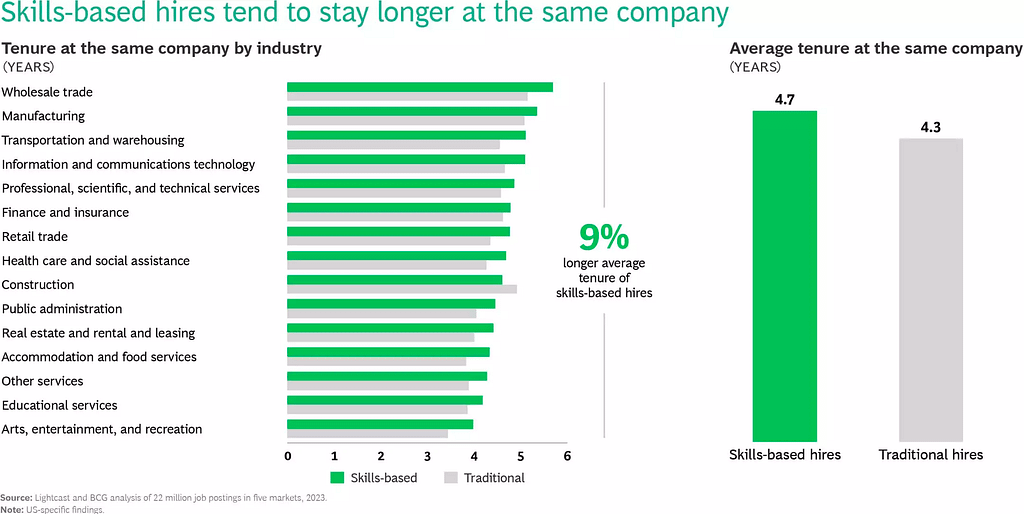
Skills-based hiring not only broadens the talent pool by including individuals without traditional degrees but also promotes diversity and innovation within organizations. Lightcast and BCG’s analysis of over 20 million job postings reveals a slow but steady decrease in degree requirements across various industries, particularly in the United States. It also shows that skills-based hires tend to stay longer with the same company improving staff retention.
Why Skills-Based Hiring Matters
Addressing Degree Inflation: The phenomenon of degree inflation, where jobs that previously didn’t require a college degree now do, has created barriers to employment for skilled workers without degrees. Skills-based hiring aims to dismantle these barriers, promoting a more inclusive and equitable job market.
Filling the Skills Gap: Many industries face a skills gap, where the demand for certain technical or digital competencies outstrips the supply of qualified candidates. By focusing on skills, companies can more effectively match candidates to the needs of the role, improving productivity and innovation.
Enhancing Diversity and Equity: Traditional hiring practices can inadvertently exclude talented individuals from underrepresented groups. Skills-based hiring offers an alternative that values diverse experiences and competencies, contributing to a more diverse and dynamic workforce.
Implementing Skills-based Hiring Successfully
For organizations looking to embrace skills-based hiring, several strategies can help ensure success:
Redefining Job Requirements: Challenge traditional biases by focusing on the specific skills needed for a role.
Using Skill Assessments: Develop robust methods to assess candidates’ skills, including the use of micro-credentials and simulation tools.
Promoting an Inclusive Culture: Foster a workplace environment that values diversity in educational and career backgrounds.
Supporting Career Development: Continue to prioritize skills for promotions and internal opportunities, facilitating flexible career paths for all employees.
The Benefits of a Skills-First Hiring Approach
Research suggests that hiring for skills is significantly more predictive of job performance than educational background or work experience. Furthermore, skills-based hires often demonstrate higher motivation and longer tenure with their employers, bringing valuable perspectives and capabilities to their roles.
Looking Ahead
As the job market continues to evolve, skills-based hiring represents a critical opportunity for employers to tap into a rich, diverse talent pool. By focusing on the capabilities that matter most, companies can build more dynamic, resilient, and innovative teams capable of navigating the challenges of the modern economy.
In embracing skills-based hiring, organizations not only contribute to a more equitable and inclusive job market but also position themselves to thrive in an increasingly competitive and fast-paced world.
Subscribe for insights, debunks and what amounts to a free, up-to-date recruitment toolkit.
About ThriveMap
ThriveMap creates customised assessments for high volume roles, which take candidates through an online “day in the life” experience of work in your company. Our assessments have been proven to reduce staff turnover, reduce time to hire, and improve quality of hire.
Not sure what type of assessment is right for your business? Read our guide.
Other articles you might be interested in
The State of the Assessment Market Report 2026: Now Live
As the new UK National Hiring Strategy highlights, poor hiring decisions come at a significant cost. The strategy estimates that poor hiring decisions cost the UK economy £14.4 billion each year. Unemployment drains a further £61 billion, while inefficient recruitment processes and unfilled vacancies add nearly £150 million more. But the challenge facing employers isn’t […]
How Berkeley achieved 100% graduate retention by optimising their pre-hire assessment
Most hiring teams optimise for speed. Time to hire.Application conversion.Assessment completion rates.Offer acceptance. These metrics are easy to measure and easy to improve. They also tell us very little about whether hiring actually worked. The real test of hiring success happens months later, when new employees decide whether to stay. Across early careers hiring, this […]
Pre-hire assessment completion rates & candidate drop-off by industry
What 200,000+ candidate journeys reveal about how hiring performance changes across sectors Why do candidates complete nearly every assessment in some industries — but never even start them in others? At first glance, the explanation seems obvious. Different sectors have different candidates, different expectations, or different hiring challenges. But analysis of more than 200,000 pre-hire […]