The 3 best pre-hire assessment tools for graduate recruitment in 2025
3 minute read
Posted by Emily Hill on 28 February 2025
The recruitment landscape is being reshaped by artificial intelligence, and hiring teams must adapt to stay ahead. This is particularly true in graduate recruitment, where over 50% of candidates are already using AI tools. The result? Recruitment processes are becoming faster, more competitive, and harder to navigate.
For recruiters using pre-hire assessment tools, the rise of AI-driven applications makes one thing clear: it’s time to focus on assessing candidates’ true competency, commitment, and fit, not just how well they can use AI.
Here are three of the best pre-hire assessment tools for graduate recruitment in 2025, each specialising in a different part of the market to help you make smarter hiring decisions.
1. ThriveMap
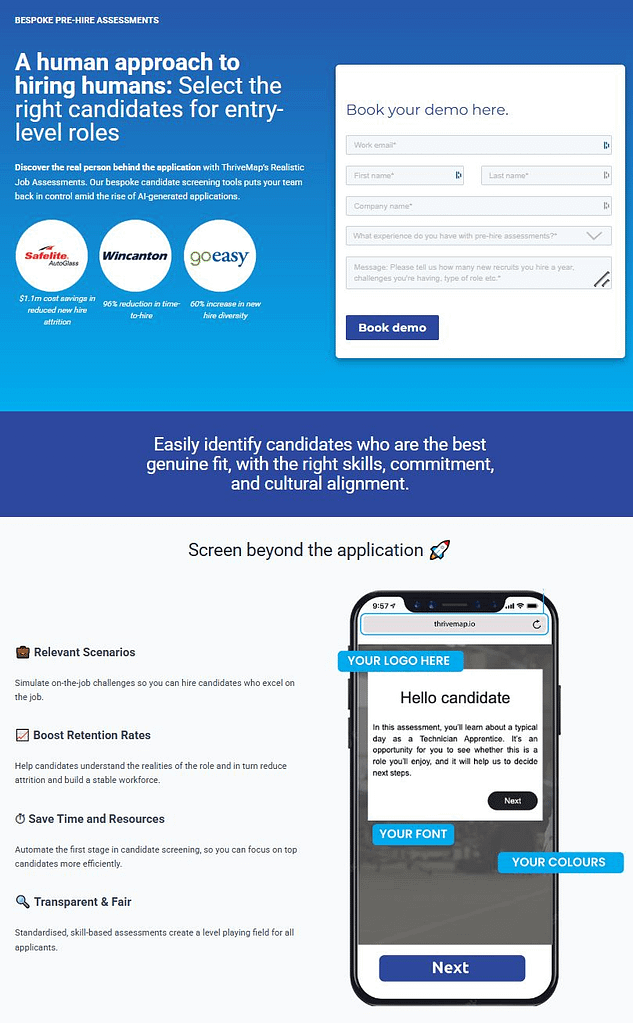
ThriveMap offers bespoke assessments tailored to specific roles and company cultures. Unlike generic tools, ThriveMap creates Realistic Job Assessments that simulate the day-to-day tasks of the role, giving graduates a clear understanding of what to expect.
Why it works for graduate recruitment:
Contextual relevance: Assessments are customised to reflect the exact demands of the job, providing highly accurate candidate evaluations.
Engaging candidate experience: Graduates engage in realistic scenarios, helping manage expectations and reducing early attrition.
Fairness and validity: ThriveMap ensures assessments are rigorously validated for predictive success and fully compliant with legal standards.
Is it AI-proof? ThriveMap’s bespoke Realistic Job Assessments evaluate candidates based on their ability to complete job-specific scenarios, focusing on real-world tasks rather than generic questions, making it highly resistant to AI manipulation.
ThriveMap is perfect for organisations needing bespoke assessments to handle high volumes of applications while resisting AI manipulation.
Codility specialises in technical pre-hire assessments, focusing on software engineering and programming. Their tools test practical coding skills through challenges, real-world tasks, and live coding interviews.
Why it works for graduate recruitment:
Ideal for technical roles: Codility supports multiple programming languages and provides in-depth assessments of coding abilities.
Plagiarism detection: Ensures fair assessments by identifying copied code.
Real-time evaluation: CodeLive allows for live coding interviews to assess problem-solving in action.
Codility is an excellent choice for companies hiring graduate tech talent who need practical, hands-on assessments to identify top performers.
Is it ai-proof?: It’s ai-proofed through practical coding challenges and live coding interviews that require candidates to demonstrate hands-on technical skills in real time.
SHL offers a wide range of graduate-focused assessments, from cognitive ability and personality testing to behavioural simulations. Their platform is designed for large-scale recruitment across various industries.
Why it works for graduate recruitment:
Versatility: SHL covers both hard and soft skills, making it suitable for diverse roles.
Scalability: Ideal for companies hiring large graduate cohorts, with a standardised and efficient assessment process.
Insightful analytics: Advanced reporting tools provide valuable insights into candidate potential and fit.
SHL is perfect for organisations needing a scalable, data-driven assessment process to streamline high-volume hiring.
Is it ai-proof?: SHL has conducted research to evaluate the impact of AI tools like ChatGPT on their assessments, finding a low to moderate effect, and continues to develop methods to detect AI-generated responses, enhancing the reliability of their evaluations.
Choosing the right tool for your graduate recruitment
The rise of AI means it’s crucial to go beyond traditional approaches. By focusing on tools that align with your goals and create a positive candidate experience, you’ll not only hire the best graduates but also enhance your employer brand in a competitive market.
Share
The ThriveMap Newsroom
Subscribe for insights, debunks and what amounts to a free, up-to-date recruitment toolkit.
About ThriveMap
ThriveMap creates customised assessments for high volume roles, which take candidates through an online “day in the life” experience of work in your company. Our assessments have been proven to reduce staff turnover, reduce time to hire, and improve quality of hire.
Not sure what type of assessment is right for your business? Read our guide.
Other articles you might be interested in
The AI Doom Loop: Why automated hiring is screening out the people you actually want
Job applications grew four times faster than job openings in the first half of 2024 alone, and that gap has only widened since. Gartner projects that by 2028, one in four job candidates globally will be fake: AI-generated profiles with fabricated resumes, cloned voices, and deepfaked video sitting through interviews that were never a real […]
Want to assess attention to detail in your hiring process? Here’s how to ensure you hire the right person
Attention to detail is one of the most commonly assessed skills in recruitment, and for good reason. In many roles, the ability to spot errors, follow processes and work accurately has a direct impact on quality, compliance and customer outcomes. So it makes sense that employers invest in attention to detail tests. The problem is […]
Employers have adopted the job-relevant assessments, but personality tests are undermining them
New research finds most talent acquisition teams have already moved to skills-based hiring, but legacy tools may be cancelling out the benefit. New UK research* from pre-hire assessment specialist ThriveMap suggests that mostemployers have already made the right call on assessment format, testing job-relevant skillsand real work samples rather than relying on personality profiling alone. […]