Imagine your team spends a day sifting CVs. The first few are underwhelming. Then they open one that’s reasonably strong and, by comparison, it looks excellent.
Or you’re interviewing six candidates in a day. The 10am candidate gives polished, detailed answers and sets an unusually high bar. The person who follows is perfectly capable, but somehow feels less impressive. Later, after a particularly poor interview, an average candidate suddenly feels like a much safer hire.
That’s contrast bias.
Rather than judging each candidate independently against what the job requires, we unconsciously judge them in the context of the people we’ve just seen. The standard moves. A candidate’s chances can therefore be affected not just by their own skills and suitability, but by where they happened to land in the CV pile or interview schedule.
It’s easy to dismiss this as one of the many cognitive biases recruiters are trained to be aware of. But when organisations are trying to improve quality of hire, it’s a fairly serious flaw in the way selection decisions are made.
What contrast bias actually looks like in hiring
Contrast effects have been studied extensively in human judgement. We don’t evaluate information in a vacuum; what we’ve just experienced influences how we perceive what comes next.
Hiring creates particularly favourable conditions for that to happen because candidates are so often assessed sequentially.
A recruiter might review dozens or hundreds of applications in succession. Hiring managers may interview several people back to back. Even where scoring frameworks exist, assessors are repeatedly exposed to different standards of candidate before making the next judgement.
That creates some predictable problems.
A strong candidate can make the next candidate appear weaker than they otherwise would. A weak candidate can make the next person seem unusually impressive. An interviewer who has just heard an exceptional answer to a competency question now has that answer sitting in their head when evaluating the next one.
The problem isn’t that recruiters or hiring managers are deliberately comparing candidates unfairly. It’s that human judgement is inherently contextual. Telling people to “be objective” doesn’t switch that off.
And once that contextual judgement enters a selection process, two candidates demonstrating roughly the same level of suitability can receive different evaluations simply because they were assessed in different contexts.
Why that matters for quality of hire
That might sound like a relatively small source of noise. At scale, it isn’t.
Every time a candidate is over or underrated because of who came before them, the hiring process becomes slightly less effective at doing the thing it exists to do: identifying the people most likely to succeed in the role.
And employers already have a sizeable gap between selection and what happens after somebody joins.
ThriveMap’s State of the Assessment Market Report 2026, drawing on more than 200,000 candidate assessment journeys alongside research with talent acquisition leaders and 1,000 UK candidates, found that 66% of candidates had left a role because of a mismatch between their expectations and the reality of the job.
That should make TA leaders particularly interested in anything introducing unnecessary noise into selection.
If Candidate A is rated more highly because Candidate B happened to perform badly, that’s not evidence of job fit. If Candidate C is rejected because they followed the strongest interviewer of the day, that isn’t evidence they couldn’t perform. It’s an artefact of the process.
The consequences aren’t limited to an individual hiring decision either. In high volume recruitment, small inconsistencies can be repeated across thousands of candidates. The more applications being sifted and the more interviews being conducted in close succession, the more opportunities there are for contextual judgement to influence who progresses.
Contrast bias therefore creates a simple but uncomfortable possibility: some of the difference you’re seeing between candidates may come from the order in which you assessed them, rather than meaningful differences in their ability to do the job.
Why awareness training isn’t enough
The obvious response is to make recruiters and hiring managers aware of contrast bias.
That isn’t a bad idea. Understanding that the bias exists may encourage assessors to stop themselves making explicit comparisons such as “she wasn’t as impressive as the previous candidate”.
But awareness doesn’t change the underlying structure of the decision.
If somebody spends an afternoon reviewing 70 CVs, they still have the previous applications in their head. If a hiring manager interviews five people consecutively, they cannot somehow erase the first four before evaluating the fifth.
Structured interviews and scoring frameworks are much more useful because they give assessors something more stable to judge candidates against. Instead of asking “How good was this person compared with the others?”, the interviewer can ask whether they demonstrated specific predefined criteria.
But even that only works if the criteria themselves are good.
And this is where attempts to remove contrast bias can miss the bigger point.
Don’t just create a fixed benchmark. Create a relevant one.
Imagine an organisation responds to inconsistency in CV screening by introducing a detailed scoring matrix. Every candidate gets points for years of experience, qualifications, previous job titles and sector experience. The same criteria are applied to everybody.
Excellent. The benchmark no longer moves.
But there’s another question: does scoring highly against that benchmark actually mean somebody is more likely to perform well in the job?
Consistency and job relevance aren’t the same thing.
You can consistently score candidates against years of experience without establishing whether five years predicts better performance than three. You can consistently award points for a qualification without establishing whether people with that qualification perform better. And you can ask every candidate identical interview questions without establishing whether the ability to produce an excellent interview answer translates into better performance once they’re hired.
A hiring process can be highly consistent and still consistently measure the wrong things.
So reducing contrast bias requires more than standardising the process. Employers need to establish what good performance actually looks like in the role and build the benchmark around it.
Move assessment closer to the job
That means starting with the work.
What will this person actually need to do? What decisions will they make? What situations will they encounter? Which behaviours distinguish somebody who performs well from somebody who struggles?
Once those things are understood, employers can assess candidates against them directly.
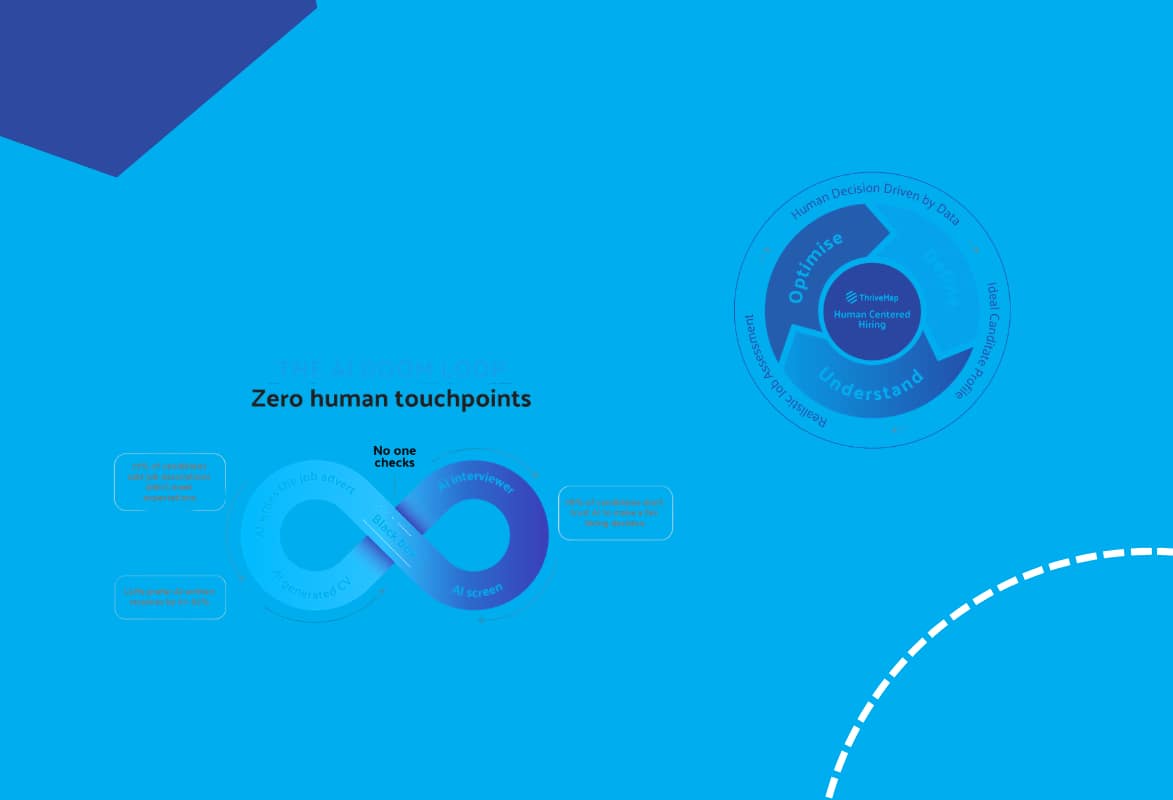
That’s the principle behind Realistic Job Assessments. Rather than relying primarily on proxies such as CV credentials or somebody’s ability to describe what they’ve done previously, candidates complete tasks and scenarios based on the reality of the role.
If prioritisation matters, give candidates a realistic prioritisation problem. If handling difficult customer situations matters, show them one and ask how they’d respond. If attention to detail matters, create a task where noticing the right information changes the outcome.
Every candidate can then encounter the same scenarios and be assessed against the same predetermined criteria.
That helps tackle contrast bias because Candidate B doesn’t need to be judged against Candidate A. Both are judged against the same benchmark.
More importantly, the benchmark is based on the job itself.
Better evidence, not just less bias
There’s a candidate benefit too.
Realistic assessment doesn’t only give employers better evidence about candidates. It gives candidates better evidence about the job they’re considering.
ThriveMap’s 2026 research found that 82% of candidates would feel more confident accepting a role after completing a realistic work sample. Given that 66% also reported leaving a role because expectations didn’t match reality, that matters.
Candidates get to see something closer to the real decisions, challenges and demands of the role before accepting it. Employers get to observe how candidates respond to those situations before hiring them.
That is a much stronger foundation for quality of hire than asking recruiters and hiring managers to become better at suppressing a cognitive bias.
Contrast bias is ultimately a symptom of a wider problem: too much of traditional selection depends on human judgement of candidates relative to other candidates.
The answer isn’t to remove human judgement entirely. Nor is it simply to make everyone more aware that contrast bias exists.
It’s to give assessors better evidence and a better benchmark.
Define what good performance looks like. Build assessment around the tasks and behaviours that actually matter. Decide the scoring criteria before candidates arrive. Then assess everyone against that same job relevant standard. Because whether the previous candidate was brilliant, terrible or somewhere in between should have absolutely nothing to do with whether the person in front of you can do the job.
Read about the other types of hiring bias here