AI is changing both sides of recruitment at the same time.
Candidates can use it to write CVs, improve applications, prepare interview answers and increasingly automate the application process itself. Employers are using AI to screen candidates, match people to roles and automate parts of selection.
Some of this technology is genuinely useful. Some of it is legally questionable. And some of it risks creating a strange new version of recruitment where AI helps create the application and another AI decides whether that application is good enough.
For employers, that raises a bigger question than whether candidates should be “allowed” to use AI: what evidence can we actually trust when deciding whether somebody will be good at the job?
AI is exposing weaknesses that were already there
Candidate use of AI gets a lot of attention. Employers understandably want to know whether the person answering an application question or completing an assessment is actually producing the response themselves.
But trying to detect every use of AI misses something important. If a candidate can ask an AI tool to produce a convincing answer to your selection question, how much was that question really telling you about their ability to perform the job?
CVs, application forms and competency questions have always relied heavily on candidates describing their experience and presenting themselves effectively. Generative AI hasn’t created that limitation, but it has made it much harder to ignore.
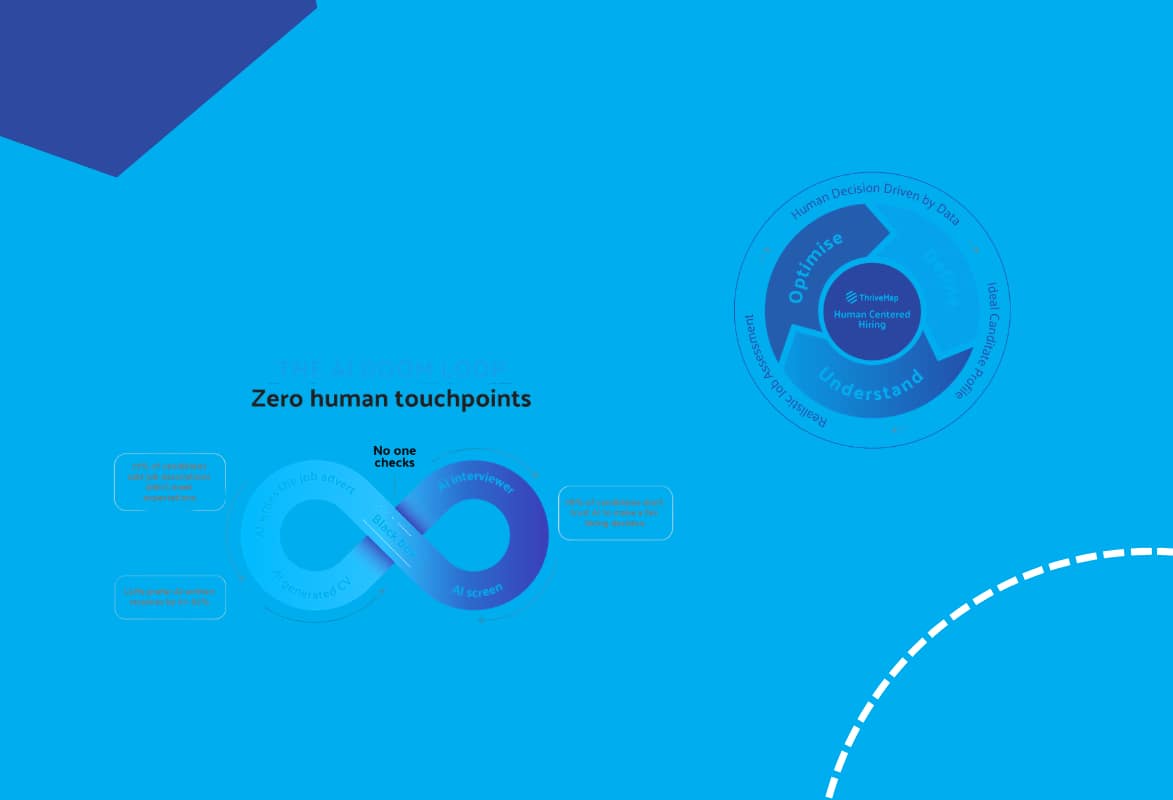
The risk is that employers respond by creating an arms race: candidates use more sophisticated AI to apply, while employers introduce more sophisticated AI to screen and detect them.
Neither necessarily gets us any closer to answering the thing selection is supposed to establish: who is actually likely to succeed in this role?
More technology doesn’t automatically mean better selection
AI has enormous potential in recruitment. It can remove repetitive administration, help teams handle large candidate volumes and support more consistent processes.
But automation and good assessment aren’t the same thing.
Employers introducing AI-powered screening and assessment tools still need to understand what those tools are measuring, whether that evidence is relevant to performance and how decisions are being made.
There are legal questions too. As AI becomes more involved in employment decisions, organisations need to think carefully about transparency, discrimination, data protection and the extent to which automated decisions can or should influence who progresses.
The question shouldn’t simply be “Can we automate this?”
It should be “Will this help us make a better hiring decision?”
Selection needs to get closer to the job
At ThriveMap, we’ve long argued that employers should assess candidates against the reality of the role they’re actually applying for.
AI makes that principle even more important.
If a selection process relies predominantly on polished CVs, written application answers or predictable questions, increasingly sophisticated AI can help candidates produce increasingly sophisticated responses.
Realistic job assessments take a different approach. Candidates encounter situations, decisions and tasks based on the work they’ll actually be expected to perform. Employers can then collect evidence against the skills and behaviours that genuinely matter in that particular job.
That doesn’t make assessment magically AI-proof. Nor should the objective necessarily be to catch candidates using AI.
The more useful goal is to design selection processes where the evidence being collected is meaningful, relevant and predictive of someone’s ability to do the work.
What does this mean for candidate experience?
There is another side to the AI arms race.
Candidates are experiencing more automation too. Automated screening, AI interviews, assessments and application processes can make recruitment more efficient for employers, while potentially making it feel less transparent or human for the person going through it.
If candidates don’t understand how they’re being assessed, what technology is involved or why certain information is being collected, trust can disappear quickly.
The organisations that get this right won’t necessarily be those using the most AI. They’ll be the ones that know where technology improves selection and where it doesn’t.
What should employers change for 2026?
There probably isn’t going to be a neat dividing line between “AI hiring” and “traditional hiring”. AI is becoming part of the recruitment process whether employers actively introduce it or candidates bring it with them.
The more useful response is to examine the selection process itself.
What are you trying to predict? What evidence are you collecting? Could that evidence be easily generated or manipulated? Is the technology you’re introducing improving the quality of the decision, or simply making an existing process faster? And are candidates being given a fair opportunity to demonstrate the things that actually matter in the job?
Those are much harder questions than which AI tool to buy next.
They’re also considerably more important.
Join the discussion: The Future of Selection and Assessment
On 14 October, Michael Blakley from Equitas, Chris Platts from ThriveMap and Medis Moradi from Morgan Philips will be discussing The Future of Selection and Assessment: 2026 and Beyond.
We’ll look at AI from both sides of the hiring process: how candidates are using it, how employers are responding, what’s legal, what actually works, what it means for candidate experience and how selection needs to evolve.
Because AI isn’t just changing the tools available to recruiters.
It’s forcing us to reconsider what good evidence of a good candidate actually looks like.