Becoming a Skills-Based Organisation? Here’s How ThriveMap Can Help
6 minute read
Posted by Chris Platts on 14 May 2025
The way organisations hire, develop, and structure their workforce is changing. With job titles becoming less predictive of performance and traditional CVs offering limited insight, more companies are shifting towards becoming skills-based organisations. But what does that actually mean, and how do you get there?
Let’s break it down and explore how ThriveMap can support your journey.
A skills-based organisation focuses on what people can do, rather than what their job title says or where they’ve worked. Instead of hiring based on previous experience or qualifications alone, these organisations prioritise the specific skills required for success in a role.
Similarly, a skills-based hiring approach is the practice of recruiting based on proven ability to perform the tasks involved in the job, rather than relying on CVs, education history, or proxies for performance.
This approach is gaining traction because it’s more inclusive, more predictive of performance, and better aligned to the realities of work today.
Skills-based vs traditional organisations
Traditional Organisation
Skills-Based Organisation
Roles defined by job titles
Roles defined by capabilities
Fixed career ladders
Fluid career paths and projects
Recruitment by CVs
Recruitment by demonstrated skills
Limited internal mobility
Talent deployed dynamically
Annual appraisals
Continuous skills visibility
The business case for becoming a skills-based organisation
Becoming a skills-based organisation isn’t a nice-to-have — it’s a strategic imperative. The companies leading the market are no longer structured around rigid roles but around capabilities. That shift unlocks measurable gains across performance, retention, and adaptability.
1. Agility in a volatile market Traditional job architectures struggle to keep up with the pace of change. When work is organised by fixed titles, talent can’t easily flow to where it’s most needed. A skills-based approach allows you to redeploy people dynamically, filling capability gaps faster and scaling new initiatives without lengthy hiring cycles. McKinsey estimates that organisations adopting skills-based models can boost internal mobility by up to 30% — a critical advantage in industries facing talent shortages.
2. Better hiring accuracy and lower attrition When you recruit for skills rather than credentials or experience alone, you open access to a wider, more diverse talent pool. Candidates are matched to roles based on demonstrated capability, not assumptions from their CV. This alignment translates into stronger job fit and lower early attrition — both major cost drivers in high-volume hiring environments. ThriveMap’s own data shows that when candidates see a realistic preview of the work and are evaluated on the skills that matter, hiring quality improves significantly.
3. Increased productivity and employee engagement People perform best when their strengths are recognised and used effectively. A skills-based organisation makes those strengths visible — across teams, functions, and projects. That transparency allows managers to build teams around complementary skills and employees to pursue meaningful development opportunities. The result: higher engagement, faster time to proficiency, and a measurable productivity lift.
4. Smarter workforce planning and reskilling Skills visibility gives leadership a real-time map of organisational capability. Instead of reacting to skills gaps after they appear, you can plan development and reskilling proactively. This reduces dependency on external hiring and makes workforce planning a data-driven process rather than an annual exercise in guesswork.
5. Competitive advantage that compounds A skills-based model creates a self-reinforcing advantage. The more you measure, develop, and deploy skills effectively, the more responsive your organisation becomes. That responsiveness feeds innovation and resilience — two attributes that define the world’s most adaptive employers.
What steps are needed to become a skills-based organisation?
Transitioning to a skills-based model isn’t something that happens overnight. It requires a shift in mindset, process, and tools. Key steps include:
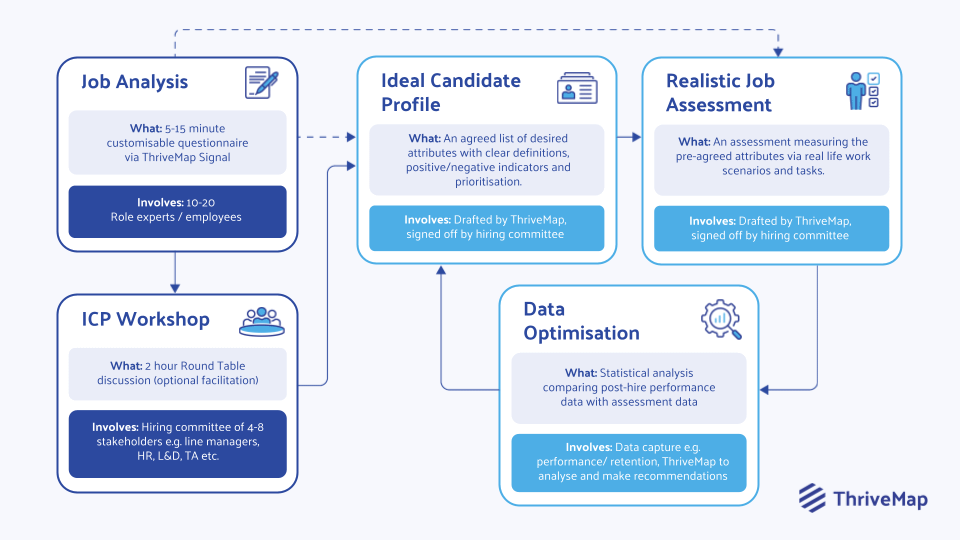
Define the Skills Needed Break down roles into the key skills and capabilities they require. This includes both technical and behavioural competencies. If you need help using a Job Analysis tool like Signal can help.
Inventory Current Skills Map out the skills your existing workforce has. This may involve self-assessments, manager evaluations, or objective testing.
Align Hiring and Development Practices Shift recruitment and learning strategies to focus on closing skill gaps, rather than filling job titles.
Measure Skills Objectively Implement tools that provide reliable data on whether someone possesses the necessary skills, not just whether they say they do.
Embed Skills into Culture and Structure Use skills as a common language across hiring, promotion, performance management, and workforce planning.
How ThriveMap supports your shift to skills-based hiring
At ThriveMap, we help organisations move beyond gut feel and guesswork by providing real-world assessments that measure what really matters: someone’s ability to do the job.
Here’s how our assessments support the transition to a skills-based hiring model:
Grounded in the Role Every ThriveMap assessment is built around the actual tasks, challenges, and decisions someone will face in the job. That means you’re testing real skills, in real contexts – not abstract traits or generic competencies.
Job-Relevant Skills, Not Fluff Whether it’s decision-making, prioritisation, communication, attention to detail, or process-following, our assessments give you data on how someone actually performs, not just how they present themselves.
Objective and Scalable Our assessments give every candidate the same fair experience and generate consistent, objective data you can use to make hiring decisions, spot skill gaps, or benchmark talent across locations and teams.
Bridging the Gap Between HR and Operations Because our assessments are built from a deep job analysis process involving frontline teams, hiring managers, and HR, they reflect the real operational demands of the role, ensuring alignment across your organisation.
Why skills-based hiring matters
Becoming a skills-based organisation isn’t just about being fairer: it’s about being smarter. When you hire and manage people based on what they can actually do, you reduce turnover, improve performance, and build a more agile, future-ready workforce.
ThriveMap is here to help you make that transition, with tools that are as practical as they are powerful.
Interested in making your hiring process truly skills-based? Get in touch to see how ThriveMap’s job-realistic assessments can support your transformation.
Share
The ThriveMap Newsroom
Subscribe for insights, debunks and what amounts to a free, up-to-date recruitment toolkit.
About ThriveMap
ThriveMap creates customised assessments for high volume roles, which take candidates through an online “day in the life” experience of work in your company. Our assessments have been proven to reduce staff turnover, reduce time to hire, and improve quality of hire.
Not sure what type of assessment is right for your business? Read our guide.
Other articles you might be interested in
The State of the Assessment Market Report 2026: Now Live
As the new UK National Hiring Strategy highlights, poor hiring decisions come at a significant cost. The strategy estimates that poor hiring decisions cost the UK economy £14.4 billion each year. Unemployment drains a further £61 billion, while inefficient recruitment processes and unfilled vacancies add nearly £150 million more. But the challenge facing employers isn’t […]
How Berkeley achieved 100% graduate retention by optimising their pre-hire assessment
Most hiring teams optimise for speed. Time to hire.Application conversion.Assessment completion rates.Offer acceptance. These metrics are easy to measure and easy to improve. They also tell us very little about whether hiring actually worked. The real test of hiring success happens months later, when new employees decide whether to stay. Across early careers hiring, this […]
Pre-hire assessment completion rates & candidate drop-off by industry
What 200,000+ candidate journeys reveal about how hiring performance changes across sectors Why do candidates complete nearly every assessment in some industries — but never even start them in others? At first glance, the explanation seems obvious. Different sectors have different candidates, different expectations, or different hiring challenges. But analysis of more than 200,000 pre-hire […]