Attrition Rate: What it Means and How To Calculate It
4 minute read
Posted by Chris Platts on 9 March 2021
Confused between terms like attrition rate, turnover rate, and churn rate? Want to know how to calculate them and work out your actual attrition rate? Then this post is for you. We’ll teach you how to calculate it and show you why keeping a healthy attrition rate matters.
What is Attrition Rate, and Why Does it Matter?
Attrition (the loss of staff members) is an inevitable reality for all businesses to deal with.
Attrition rate is a metric used to measure the pace at which employees are lost over a set period of time. It’s also used interchangeably with terms like employee turnover rate or churn rate. Your attrition rate accounts for employees who leave either voluntarily (i.e. resignation, retirement, or promotion) or involuntarily (i.e. termination). Employers often use the employee attrition rate to forecast the number of expected job vacancies within the organisation.
Some common issues that often lead to high attrition include:
Inadequate benefits or pay rate
Subpar management
Insufficient recruitment or training strategies
Oversized workloads
Poor work culture
Lack of advancement opportunities
When a company discovers that its attrition rate is trending in the wrong direction, it often needs to make systematic changes to reduce attrition.
Staff turnover isn’t always a bad thing. Letting go of underperforming employees can lead to productivity increases and boost employee morale. A healthy attrition rate will also vary depending on the industry the company is in; a high employee turnover for one company may be a low turnover for another.
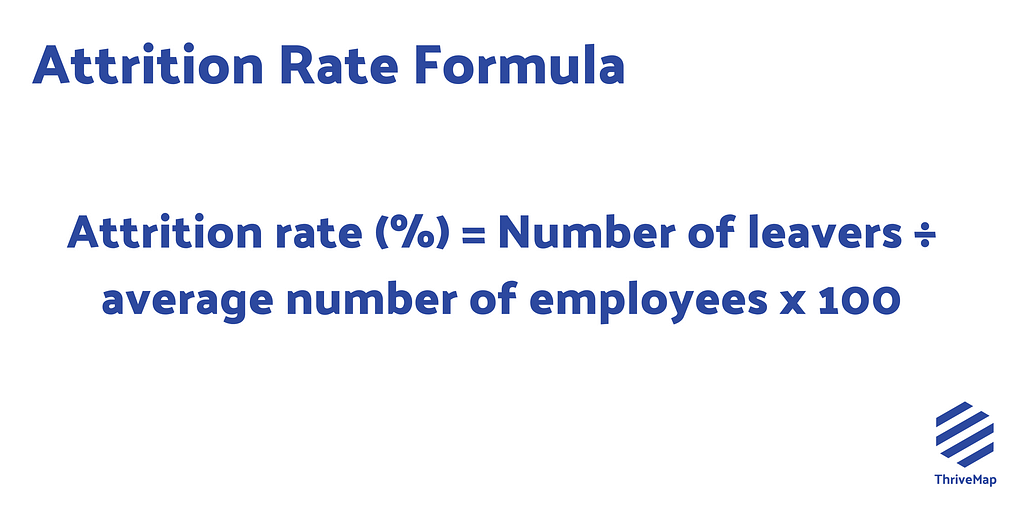
The formula for calculating your attrition rate is simple:
(# of employees left / average # of employees over a given period of time) x 100
In order to calculate the average number of employees over a given period of time, you can use this formula:
(beginning # of employees + end # of employees) /2
For example, let’s say your company employed 100 people to begin the year and ended the year with 120 employees. Let’s say that 5 of your employees left, either voluntarily or involuntarily, over the course of the year. Your rate would be calculated as follows:
Step 1: Determine your average number of employees
(100 + 120) / 2 = 110
Step 2: Divide the total number of employee leavers by your average number of employees
( 5 / 110) x 100 = 4.55% annual attrition rate
Analyzing Your Attrition
It’s important to analyse your attrition rates through different lenses. First, you will want to compare your employee turnover to that of other companies within your industry or occupational group.
For example, according to DailyPay, the US staffing industry had an employee turnover rate of 352% in 2017, whereas finance and insurance jobs only had an employee turnover rate of 1.7%. Similarly, according to XpertHR, HR staff in the UK in 2017 experienced a 12% average turnover rate, whereas the engineering occupational group was only 4.9%.
If your churn rate is substantially higher than that of another company within your industry, you may have an issue.
Secondly, you should analyze your annual attrition in-depth and break it down on a departmental or team basis. A yearly decrease in employee turnover is a strong indicator that your company, department, or team has made productive modifications to address any causes of staff turnover.
Lastly, it’s also important that you monitor attrition rates on a monthly or quarterly basis.
Here’s an example: your annual attrition rate is 4%, which is on par with the rest of the successful companies in your industry. Upon further examination, you see that your quarterly turnover rates were:
Q1: 1%
Q2: 3%
Q3: 5%
Q4: 7%
This indicates that, while your overall turnover rate for the year was sufficient, it’s trending steeply in the wrong direction.
Employee attrition is an inevitable aspect of an organization’s lifecycle. While some staff turnover can sometimes have a positive effect on a company, it is important to monitor it frequently in order to identify trends over time.
Want help finding the strongest candidates for your jobs? Want to ensure there’s here to stay? Contact us here at ThriveMap! Request a demo or read more of our blog posts for more information on how we can help you improve your recruitment strategy!
Not sure where to start with realistic job assessments?
Don’t worry! We’ve written the ultimate guide to getting started with pre-hire assessments – it’s a simple, straightforward guide that we hope will help answer a lot of your questions.
Subscribe for insights, debunks and what amounts to a free, up-to-date recruitment toolkit.
About ThriveMap
ThriveMap creates customised assessments for high volume roles, which take candidates through an online “day in the life” experience of work in your company. Our assessments have been proven to reduce staff turnover, reduce time to hire, and improve quality of hire.
Not sure what type of assessment is right for your business? Read our guide.
Other articles you might be interested in
Principles and best practices for pre hire assessment design
A pre hire assessment can look sophisticated, feel engaging and process thousands of candidates without measuring anything especially useful. The quality of an assessment is not determined by how impressive the technology appears or how many question formats it contains. It depends on whether the assessment measures capabilities that genuinely matter in the job, produces […]
The AI Doom Loop: Why automated hiring is screening out the people you actually want
Job applications grew four times faster than job openings in the first half of 2024 alone, and that gap has only widened since. Gartner projects that by 2028, one in four job candidates globally will be fake: AI-generated profiles with fabricated resumes, cloned voices, and deepfaked video sitting through interviews that were never a real […]
Want to assess attention to detail in your hiring process? Here’s how to ensure you hire the right person
Attention to detail is one of the most commonly assessed skills in recruitment, and for good reason. In many roles, the ability to spot errors, follow processes and work accurately has a direct impact on quality, compliance and customer outcomes. So it makes sense that employers invest in attention to detail tests. The problem is […]