Skills-based hiring is proven to enhance candidate experience, promote diversity, and reduce turnover. Despite its advantages, organisations often struggle to implement skills-based testing in the hiring process at scale.
To help you get started, we have assembled a list of the top skills-based hiring tools to use and explore:
1. Realistic Job Assessments: ThriveMap.io
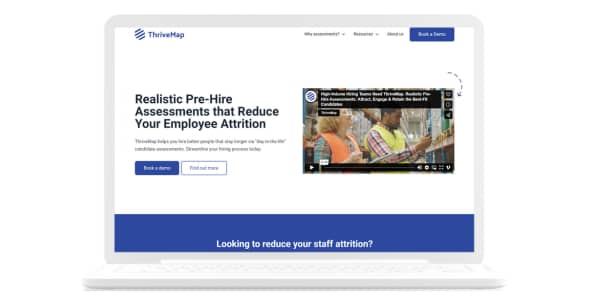
ThriveMap are specialists in designing bespoke assessments for high-volume recruitment, streamlining manual and time-intensive processes, improving candidate experience and hiring consistency.
ThriveMap’s skills-based assessments are innovatively designed to immerse candidates in ‘day-in-the-life’ scenarios and tasks. This approach not only aids hiring teams and recruiters in identifying candidates with the most job-relevant skills but also empowers candidates to self-opt out if the role doesn’t align with their expectations. The emphasis on preventing attrition via managing the candidate expectation gap ensures a match between what candidates anticipate a role to entail and its actual responsibilities. This improves new hire retention, hiring consistency and on-the-job performance.
thrivemap.io
In traditional recruitment, such as CV screening, there’s a 60% chance of missing out on top talent due to unconscious bias, limiting your company’s growth potential.
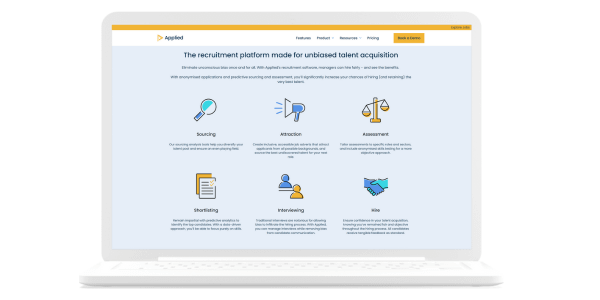
Applied, a skills-based assessment tool for specialist, low volume and senior roles, operates on the principle that traditional hiring methods are prone to human biases, leading to unethical and ineffective decision-making. Unconscious bias often results in overlooking the best candidates, particularly those from under-represented backgrounds. What we really like about this platform is the ability to show data on how candidates are evaluated and highlight any potential bias in the hiring process
Similar to ThriveMap, Applied prioritises a scientific-approach to ensure a fair and unbiased evaluation of candidates, fostering a diverse and inclusive recruitment process for enhanced organisational success.
beapplied.com
The scarcity of skilled software engineers is a challenge in recruitment, exacerbated by traditional background and credential assessments falling short in predicting actual performance.
Further complicating matters is the diverse landscape of software engineering roles, making it challenging to match the right engineer to a specific job. Recruitment errors in software engineering come at a high cost.
Codility addresses this by specialising in crafting skills-based assessments tailored for software roles. Their approach focuses on evaluating candidates based on their ability to solve real-world problems, moving away from abstract brain teasers.
With Codility, candidates’ potential is assessed using job-relevant, skills-based evaluations. The solutions prevent cheating through features like generative AI-resistant tasks and proctoring, ensuring a thorough and accurate evaluation of software engineering candidates.
codility.com
Tazio addresses the challenge of finding suitable candidates, especially for early careers and graduate roles.
Tazio’s recruitment process stands out for its holistic approach, incorporating assessments, tests, and interactions to provide a comprehensive evaluation of the candidate’s profile. This method facilitates the identification of the best-fit candidates for your organisation.
Notably, Tazio leverages a combination of behavioural science and AI to tailor assessments.
tazio.io
Tengai functions as an avatar designed to streamline the candidate screening process. It conducts structured interviews, gathering relevant data on candidates to facilitate a comparison of their fit for the position. This minimises the need for substantial resources from your recruitment teams in terms of time and energy.
What sets Tengai apart is its human-like qualities. Programmed with gestures like nodding, blinking, and attentive listening, Tengai aims to replicate a natural interview experience. The AI leverages Natural Language Understanding (NLU) in an attempt to comprehend spoken language in real-time.
Noteworthy is Tengai’s commitment to fairness through “blind interviews.” It operates without access to candidates’ personal data and avoids facial recognition software, mitigating the risk of discrimination based on appearance.
tengai.io
If you’re looking for the wrong hiring criteria in the first place, you’re going to hire the wrong candidates. Signal by ThriveMap is a free Job Analysis tool, serving as a crucial initial step in skills-based hiring practices. Its primary function is to gather insights from individuals currently performing the job, aiming to identify the actual skills required for the position.
Emphasising its importance, Signal is recommended as the starting point in the skills-based hiring process. By directly questioning those engaged in the role, it unveils valuable information about the specific skills essential for success. Many recruitment teams and hiring managers find this initial stage to be enlightening, often revealing unexpected insights about the job requirements. Therefore, it is strongly advised not to overlook this foundational step when implementing skills-based hiring practices.
One to Avoid: Chat GPT
While ChatGPT is effective for content optimisation and generating ideas, it tends to regurgitate information based on assumptions. When tasked with creating skills-based assessments, it may introduce biases from its input data, providing an incomplete picture. So, in summary, it’s best to avoid using ChatGPT when making recruiting decisions.
It’s recommended to conduct a job analysis first, recognising that complete removal of human decision-making in recruitment isn’t feasible. Differing company perspectives on roles, such as customer service representatives, require a nuanced understanding of varied skill sets. Also, as a tool, it doesn’t provide candidate analytics.
Ready to try skills-based assessments?
Incorporating skills-based testing tools like ThriveMap.io, Applied, Codility, Tazio, Tengai, and Signal strategically enhances the hiring process. These tools prioritise objectivity, fairness, and accuracy, reducing biases and elevating hiring decisions’ overall quality.
Book a demo
ThriveMap’s skills-based assessments