Realistic hiring, real feedback: ThriveMap’s new feature for candidate dropout insight
3 minute read
Posted by Emily Hill on 30 June 2025
Every candidate dropout tells a story. But until now, most hiring teams have had no way to hear it.
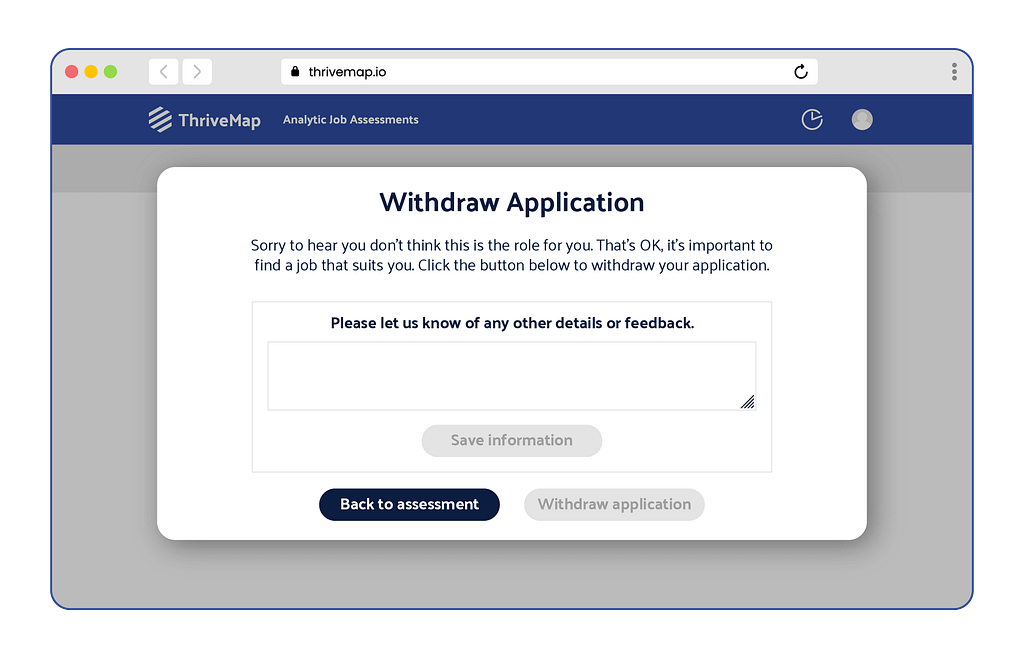
With ThriveMap’s new Withdrawal Reasons Capture feature, recruiters can finally get structured, real-time feedback from candidates who choose to leave the assessment process. It’s a subtle but powerful shift: turning candidate exits from black holes into opportunities for reflection, learning, and improvement.
“When someone chooses to withdraw, that’s not necessarily a failure – it can be a sign that the assessment is doing its job,” says Chris Platts, CEO at ThriveMap. “But when we understand why, we can make even better decisions about how we design fair, realistic, and effective hiring processes.”
Why candidate droupout insights matter more than you think
Hiring teams have long focused on who passes an assessment, but far fewer look closely at who leaves the process, and why.
This new feature captures a short, structured response from any candidate who exits the process early. They can select from a set of standardised options (such as “not the right role for me”, “the process was unclear”, or “I had another offer”) and provide additional context if they choose.
That data flows straight into the ThriveMap analytics dashboard, where it can be visualised alongside other assessment performance metrics. The goal? Help hiring teams differentiate between productive drop-off – people opting out because the job isn’t the right fit – and avoidable friction.
When realism works – and when it needs adjusting
ThriveMap’s approach to hiring assessments is grounded in realism. Candidates are given a clear picture of the job they’re applying for, not a gamified test or abstract competency quiz. That means drop-off isn’t necessarily bad. In fact, it’s often a sign the process is doing what it’s meant to do: creating clarity, and encouraging self-selection.
But realism doesn’t mean rigidity.
“We want our assessments to be challenging in the right way – true to the role, but never needlessly difficult or confusing,” says Platts. “This feature helps us ensure that when someone exits, we can distinguish between disinterest in the job and improvements in the assessment design.”
By capturing these insights, hiring teams gain a richer understanding of candidate behaviour, and can continually fine-tune the balance between job accuracy and candidate experience.
A step forward for transparency and fairness
Unlike most assessment tools, ThriveMap isn’t just a one-way filter – it’s a two-way conversation. Withdrawal insights provide valuable signals about:
Whether job expectations are being communicated clearly
If candidates are exiting due to external factors (e.g. other offers)
Whether the design of the assessment is unintentionally excluding or deterring the wrong people
All of this contributes to a fairer, more transparent process – both for hiring teams and candidates.
And because these insights are visualised inside the platform, they become a regular part of assessment review, not an afterthought.
What it means for hiring teams
In a time where candidate experience matters more than ever, and where top candidates have more choice than ever, insight is a competitive advantage.
This feature doesn’t just help companies reduce unknowns. It helps them act with confidence, knowing that their hiring process is grounded in data, shaped by feedback, and aligned with the needs of real candidates.
Want to see the feature in action?
Book a demo or talk to our team about how candidate withdrawal feedback can improve your process, without compromising on realism: thrivemap.io/get-started
Share
The ThriveMap Newsroom
Subscribe for insights, debunks and what amounts to a free, up-to-date recruitment toolkit.
About ThriveMap
ThriveMap creates customised assessments for high volume roles, which take candidates through an online “day in the life” experience of work in your company. Our assessments have been proven to reduce staff turnover, reduce time to hire, and improve quality of hire.
Not sure what type of assessment is right for your business? Read our guide.
Other articles you might be interested in
Principles and best practices for pre hire assessment design
A pre hire assessment can look sophisticated, feel engaging and process thousands of candidates without measuring anything especially useful. The quality of an assessment is not determined by how impressive the technology appears or how many question formats it contains. It depends on whether the assessment measures capabilities that genuinely matter in the job, produces […]
The AI Doom Loop: Why automated hiring is screening out the people you actually want
Job applications grew four times faster than job openings in the first half of 2024 alone, and that gap has only widened since. Gartner projects that by 2028, one in four job candidates globally will be fake: AI-generated profiles with fabricated resumes, cloned voices, and deepfaked video sitting through interviews that were never a real […]
Want to assess attention to detail in your hiring process? Here’s how to ensure you hire the right person
Attention to detail is one of the most commonly assessed skills in recruitment, and for good reason. In many roles, the ability to spot errors, follow processes and work accurately has a direct impact on quality, compliance and customer outcomes. So it makes sense that employers invest in attention to detail tests. The problem is […]